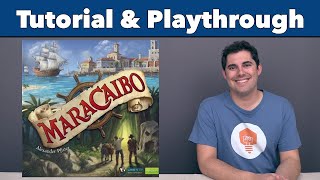
Maracaibo, a strategy game for 1-4 players by Alexander Pfister, is set in the Caribbean during the 17th century. The players try to increase their influence in three nations in four rounds with a play time of 40 minutes per player.
The players sail on a round course through the Caribbean, e.g., you have city tiles where you are able to perform various actions or deliver goods to. One special feature is an implemented quest mode over more and various tiles, which tells the player, who chase after it, a little story.
As a player, you move with your ship around the course, managing it by using cards like in other games from Alexander Pfister.
NOTE: The Spanish and Portuguese editions of Maracaibo contain La Armada mini-expansion packaged inside the base game's box.
- great stock/investment-like mechanism
- engaging and varied play
- can be punishing if misplayed
- deck-driven action selection with tension
- Caribbean exploration
- thematic euro with systems-driven play
- Pulsar 2849
- Luxor
Mechanics (from transcript analysis)
- dice_drafting — dice-derived actions with variable effects
- engine_building — cards and actions build up efficiency
Video topics + discussion points
Quotes (from this video)
- probably my favorite tire placement game of all time
- this one is like a companion game to el grande
- Arc Nova certainly the hotness at the moment
References (from this video)
- deep integration of multiple design influences
- campaign-like with strong thematic hooks
- can be dense and heavy for two players
- influence with nations and quest completion
- Caribbean sea exploration and quest-based play
- story-driven with helper recruitment
Mechanics (from transcript analysis)
- area control / quest completion — player moves through a map completing quests with helper recruitment and influence mechanics
- multi-use card system — cards have multiple uses; choosing one sacrifices another
Video topics + discussion points
Quotes (from this video)
- I think Concordia is one of the best games ever made, full stop
- two players it works extremely well because the downtime is gone
- it's a brain burner game
- the tension in the two-player game is great
- loads of content to explore, tons of replayability
References (from this video)

- deep strategic options
- strong thematic resonance
- steep learning curve
- ship routes and campaign-style engine-building
- Caribbean trade and piracy era exploration
- n/a
Mechanics (from transcript analysis)
- engine-building / area movement — players build engines of their shipyard and travel to different regions with varying effects
Video topics + discussion points
Quotes (from this video)
- representation is really really important you know like this is speaking from experience growing up as a people of color
- we are curious to know what your experience was like with spiel digital and online conventions
- calico, i really enjoyed learning and playing calico
- we would like to know what your thoughts are on Patreon and what you would like to see
- this month you'll probably see beyond the sun and at least on two Fridays we're going to be live streaming
References (from this video)

- rich engine-building with a flavorful theme
- strong timing and resource management
- engaging route planning
- steep learning curve for new players
- rule depth can be intimidating
- commerce, risk management, and strategy over sea routes
- Caribbean trading and exploration during the era of sailing ships
- procedural, event-driven engine building
Mechanics (from transcript analysis)
- deck-building — cards fuel actions, movement, and resource generation
- resource management and route planning — managing goods, routes, and ships to maximize profit
- timing/round strategy — timed actions and sequence planning influence engine efficiency
Video topics + discussion points
Quotes (from this video)
- it's basically a euro game set in the Caribbean where you are sailing around
- I really like legendary encounters alien it's one of my absolute favorite deck builders
- Time of Crisis with the iron and rust expansion
- I'm a Roman history enthusiast
- that's my personal Christmas wish list for this year
References (from this video)
- innovative campaign structure with story decks
- great thematic immersion and flavor
- elegant card-driven progression that stays fresh across games
- some scenarios can be highly luck-driven
- learning curve for the card interactions can be steep
- exploration, piracy, and opportunistic quests
- Caribbean mercenary exploits in a sea-trade-pirate backdrop
- campaign-style with a chain of story-driven story decks
- Oath: Chronicles of Empire and Exile
- Eldritch Horror
- Mage Knight
Mechanics (from transcript analysis)
- campaign deck/story deck integration — story cards provide ongoing quests and add new board elements.
- multiflow route progression — story strands and side-quests dynamically alter scoring and routes.
- open-world island exploration — you visit islands, discover quests, and manage resources.
Video topics + discussion points
Quotes (from this video)
- easy to set up and it's short
- the new modules that you get in this really cool they change up the game for the better
- this is the open-ended thing open-ended so the story you tell in between you kind of make up as you go along
- the campaign system is tiny all you're going to be doing is adding a card
- it's a one-and-done game so you open this one up you throw it away
- the dream world or real world
- the story deck add new cards to the deck and narrative arcs on the board
References (from this video)

- Rich comparison with other Alexander Pfister titles
- strong thematic flavor and interactive play
- not as varied as some rivals; could be dense for new players
- commerce, exploration, and voyage logistics
- caribbean-scale maritime trading and exploration setting
- multi-path scenario-driven play with evolving states
- Boone Lake
- Nova Luna
- Terraforming Mars
Mechanics (from transcript analysis)
- deck-building with action cards — cards provide actions and bonuses; players manage timing and combos
- story-driven scheduling — timed events and decisions influence sequence and scoring
Video topics + discussion points
Quotes (from this video)
- "I think this is my favorite Alexander Fisher game"
- "it's just it just works for me like it just clicks with my brain"
- "I adore teach you it's one of my favorite games"
- "terraforming mars is one of my favorite games"
- "you can gain hopefully some insight from that"
References (from this video)
- Deep, multi-layered economy with upgrades, quests, and city actions
- Campaign/story content variability through legacy/story cards
- Tight integration of exploration, combat, and trade mechanics
- Rich thematic flavor with multiple scoring paths
- Clear, modular component design and visual cues
- Steep learning curve and rule depth for new players
- Potential for longer play sessions due to four-round structure
- Component management and tracking can become fiddly during heavy action turns
- trade, exploration, naval power, empire-building
- Caribbean, 17th-century colonial era
- campaign/legacy-driven with evolving map and quests
Mechanics (from transcript analysis)
- Assistants — Blue scrolls create optional main actions; assistants cost figures and may be activated once per visit.
- Campaign/Legacy Integration — Standalone campaigns with evolving content stored in a special bag to separate legacy materials.
- Combat System and Influence — Engage combat to gain nation-specific benefits, using combat value and spending points/figures to activate actions.
- End-Game Scoring and Prestige — Points come from tracks, completed quests, prestige buildings, and nation-based scoring with nobility adjustments.
- Main Actions and Destination Abilities — On your turn, perform a main action at your destination; options depend on where you finished.
- Movement and Sailing — Move 1–7 spaces clockwise around the board; you may share spaces with opponents.
- Quests, Story Cards, and Legacy — Story cards drive quest tile placement and can alter map state; campaigns yield variability and legacy changes.
- Resource management — Three resources—balloons, combat points, and figures—are earned, spent, and tracked to drive actions and scoring.
- Upgrade system — Player boards offer 12 upgrade slots; you unlock them by clearing discs and acquire upgrades throughout the game.
- Village Actions and City Actions — Visit villages and cities to gain upgrades, money, goods, or to buy cards; the number of village actions scales with movement.
Video topics + discussion points
Quotes (from this video)
- In Maraco, players are seafaring merchants in the colonial era of the Caribbean.
- The game plays in four rounds and each round plays in turns round and round the table until one player has completed a lap of the board.
- There are three main resources: the balloons, combat points, and figures.
- On your turn, you can move a card from your hand to one of these three planning spaces.
- The most important village action is to buy a card from your hand or planning area.
- There is a special blue colored bag with the game, letting you keep your active legacy content separate from the rest.
References (from this video)

- Complex interconnected mechanics
- Multiple strategic paths
- High replayability
- Interesting theme
- Steep learning curve
- Long play time
- Many interlocking rules
- Kingdom building and resource management
- Medieval Western Europe
- Players as head paladins managing a kingdom
- Architects of the West Kingdom
Mechanics (from transcript analysis)
- action selection — Choosing from multiple action types each turn
- Resource management — Managing silver, provisions, and other resources
- worker placement — Players assign workers to different action spaces
Video topics + discussion points
Quotes (from this video)
- I don't even own this game and I know how to play it.
- We are all paladins managing our work.
- This game's crazy.
References (from this video)

- Transforming a competitive design into a cooperative experience with Marrabo/Uprising
- Strong integration of narrative and theme with gameplay mechanics
- Innovative deck-building that remains punishing yet fair
- Rule explanations can be lengthy due to campaign complexity
- The merged cooperative variant requires players to align values and strategy
- Cooperative (in uprising variant) and epic campaign storytelling
- Caribbean privateering era with colonial and indigenous dynamics
- Narrative-driven, with an emphasis on empowerment of indigenous populations
Mechanics (from transcript analysis)
- Deck-building with campaign progression — Characters and cards unlock through a campaign, with optional standalone or narrative-linked play
- Multi-use cards — Cards function as crew, goods, or events; some are used for trading and others for actions
- Rondelle movement — Movement around a large circular track to reach ports and manage actions
Video topics + discussion points
Quotes (from this video)
- It's the castles of Burgundy. Oh my gosh, this is Euro perfection.
- Everything about Tiny Towns is fantastic. It's phenomenal.
- The Loop is a very pandemic inspired style game.
- This is the greatest cooperative fantasy deck building game of all time.
- The most powerful things we can do in this game is call a meeting between department heads.
- Earth is a masterpiece of positive player interaction. Really fun, tight, constrained tableau building and one of the best engine builders ever.
References (from this video)

- immersive theme and Pfister signature engine work
- varied routes and decision-rich play
- great for fans of Pfister-style euros
- complex to teach
- can be lengthy and heavy for some groups
- commercial empire building, risk management, engine-driven play
- Caribbean trade routes, piracy era, voyage-driven exploration
- story-like progression through voyages and decisions
Mechanics (from transcript analysis)
- deck-building / hand management — Build an engine through card play and actions.
- Resource/crew management — Manage ships, resources, and effects across voyages.
- Variable board / modular structure — Different ship routes and event triggers shape each session.
Video topics + discussion points
Quotes (from this video)
- it's a very difficult game
- a fully cooperative game where you are trying to protect this island from invaders essentially
- each player plays as a different spirit who is protecting the island
- each spirit has their own thematic asymmetric card
- we vow to do more play-throughs of because we really enjoyed it
- it's a dry euro
- this is a big combo-tastic game
- chronicle Darwin's journeys throughout the Galapagos Islands
- it's a party style game where you're going to be drawing
- it's hilarious
- I'm terrible at it
- we played with the sisters and everybody had a really good time
- we definitely want to do another top 10 this month
- maracaibo this week
- we're going to release maracaibo this week
- we think cloud age is on its way
References (from this video)
- Deep, interlocking systems that rewards players who invest across multiple tracks (influence, money, quest progression, and combat).
- Strong thematic integration where naval combat, exploration, and mercenary diplomacy feel cohesive and meaningful.
- Flexible pathways to victory; no single dominant strategy, encouraging diverse play styles and adaptive decision-making.
- Clear, visually legible incentives for continuing to invest in cards, upgrades, and synergies.
- Harbor and prestige-building options add meaningful long-term payoff and late-game swing potential.
- Tutorial structure provides a thorough, accessible entry point that demonstrates core mechanics clearly.
- Engagement remains high as players balance immediate gains with long-term positioning and end-game scoring.
- Nice balance of luck (combat draws) with strategic skill (token management, track advancement, and timing).
- Rule density can be intimidating for new players; the number of interacting systems may overwhelm beginners without the tutorial.
- Late-game complexity can become heavy, especially with prestige buildings and multiple synergy interactions.
- Token clearance requirements can slow early gameplay and occasionally stall momentum if opponents monopolize delivery options.
- High money requirements for some cards and buildings can create a resource bottleneck in the mid game.
- The standalone easy mode mitigates some story-driven complexity, but players who want full depth may wish for more expanded scenarios.
- mercantile expansion, exploration, and political influence; balancing risk and reward through a mix of combat, commerce, and exploration
- Caribbean trading theatre during the colonial era; competing powers contend for influence while mercenary crews pursue wealth, prestige, and control of key locations
- tutorial-playthrough with explicit demonstrations of core mechanics and strategic decision points; a guided walk-through rather than a narrative fiction
Mechanics (from transcript analysis)
- City actions and the delivery/upgrade economy — When a ship lands on a city, players may take a city main action which typically includes delivering goods (using cards that match a city’s required goods), acquiring workers, and purchasing or reserving new cards. The delivery mechanic requires discarding a card with a matching good and moving a token from your board onto the map, thereby blocking one of the city’s delivery options until that effect is cleared. The consequence is twofold: you gain a tangible reward (money and/or tokens) and you unlock potential ongoing or one-time benefits by triggering the city’s reward track. The city actions interlock with card management (buying, reserving, and building) and interact with other tracks on the board, reinforcing the sense that a single city excursion can ripple across several score-chasing avenues.
- Combat and influence across three nations — Combat is conducted by selecting a nation (France, Spain, or England) to fight for during a combat action. The nation choice determines both the strength you gain during that combat and the influence you receive within that nation’s sphere. The combat system is modular: you draw a combat tile, allocate strength to pay for rows of effects, and resolve gained influence and city captures by placing nation-specific cubes on the board. You can capture cities, displace other nations’ cubes, and gain money, influence, and victory points. The system also uses a dynamic where the strongest nation on the map confers a tactical advantage and where the third-place nation can provide bonus strength if you choose it—adding a layer of strategic misdirection and risk management.
- Goods, tokens, and map-based unlocks — Delivering goods and placing tokens on the map is central to unlocking one-shot or ongoing bonuses. The tokens are placed at various map locations and are locked behind clearance conditions (i.e., you must remove a number of tokens before a given ability becomes available). This creates a controlled push-your-luck dynamic: early token extraction grants quick cash and temporary leverage but also reduces future opportunities by opening or closing different boosters. The tokens also visually demonstrate the tension between immediate monetary gain and long-term strategic positioning, as removing tokens can unlock advantages that persist for the rest of the game and influence end-game scoring, particularly via the noble rank mechanic and influence multipliers.
- Hand management and card usage — Cards in hand are multi-use: they can be played for their primary function, used to deliver goods, or spent to move to a different location and unlock associated rewards. Each card features a goods icon and sometimes an object or worker icon. You must balance spending cards to achieve immediate actions against preserving cards to fuel future rounds. The reserve can hold cards as possible projects that you might build later, and you can still buy from the reserve as a payment, with discounts and synergies sometimes altering the cost. This creates a layered decision tree: what to play now, what to reserve, and what to acquire to set up future round leverage.
- Influence tracks and noble ranks — Influence tokens are advanced by placing cubes on nation rows through combat and card-driven actions. The influence tracks culminate in end-game scoring where noble ranks multiply the points you’ve earned via the cubes displaced or removed. The noble rank system introduces a long-term scoring ladder: the higher you climb the influence tracks, the greater the multiplier at the end of the game. End-game scoring is a composite of money income, victory-point income, the number of completed quests, and the crown synergy benefits (e.g., tokens that boost end-game scoring via house or anchor synergies). Interacting with this mechanic requires balancing early aggression with late-game consolidation to maximize your rank multipliers.
- Movement and range on a shared map — Players control a single mercenary ship and move it around a stylized Caribbean map. Movement is measured in spaces, with a typical turn allowing movement from one to seven spaces in a clockwise pattern. The act of moving serves not only to position for future actions but also to unlock different types of actions depending on where the ship ends its move. Location types include cities, villages, and exploration spots, each offering distinct main actions (city, village, or exploration-related) that drive economy, acquisition of cards, and progression toward victory points. The movement system creates a dynamic where position affects access to benefits and competition for limited tokens on the board. Strategic decisions include whether to race ahead for immediate bonuses or slow-roll to optimize longer-term income and power, as well as considering how proximity to opponents might influence the timing and value of encounters.
- Prestige buildings and late-game bonuses — Prestige buildings are rare, expensive, and powerful end-game assets. They appear in a reserve deck and require substantial money and, in some cases, workers or specific synergy tokens to acquire. Owning prestige buildings grants fixed end-game points and triggers conditional bonuses that scale with your synergies and quest completion. The decision to pursue prestige buildings is a high-stakes strategic choice: it can yield the most substantial end-game payoff but demands significant resources and forethought about card timing and tempo. The inclusion of prestige buildings injects a long-term planning dimension into Maracaibo that rewards players who can maintain economy stability while pursuing a costly, high-reward objective.
- Quests, exploration, and quest tokens — Quests are paired with exploration moves and require discarding certain cards or paying other costs to gain rewards. Quests provide a flexible pathway to end-game scoring that scales with the number of completed tasks and the number of compasses you accumulate throughout the game. The exploration track gives access to higher rewards as you advance, but advancing also carries a risk: you may race to the end of the track to maximize quest and influence benefits while exposing yourself to higher opportunity costs earlier in the game. The interplay between quest completion, exploration milestones, and compass-based rewards creates a large network of strategic options that reward careful planning and dynamic adaptation to how opponents are competing in influence and territory.
- Synergy tokens and card-building bonuses — Synergy tokens are earned by purchasing certain cards and building a harbor or other buildings; these tokens unlock additional benefits and generally shape long-term strategy. Each synergy token is tied to a color symbol that corresponds to a particular category of bonuses on your board and in your cards. You cannot collect multiple copies of the same synergy symbol, so the strategic objective is to diversify token collection to unlock a broad range of benefits rather than stockpiling a single symbol. Tokens improve your income, victory points, and sometimes unlock special actions when certain conditions are met, creating a feedback loop between card acquisition and long-term resource generation.
- Workers, actions, and free actions — Workers are a limited resource that can be spent to activate or augment abilities tied to buildings and cards. In many city actions you can gain a worker or other resources, and one of the core decisions is weighing whether to expand your workforce now or wait for stronger synergies later. Free actions include starting or advancing on career tracks, which can yield ongoing bonuses or end-game rewards. The worker economy interacts with the cost curves for cards in hand, as some powerful cards require spending workers to activate their special benefits. The strategic calculus involves prioritizing actions that unlock long-term value such as career progress, harbor boosts, or prestige-buildings, while maintaining enough cash to sustain immediate needs.
Video topics + discussion points
Quotes (from this video)
- each player is in charge of a single mercenary ship
- the round ends once one player gets to the very end of this track
- you are mercenaries so you decide who you fight for each time you fight
- we're going to pull these tokens off which immediately gets them five money