Millennia: Tracks of Time is a competitive civilization game for 1-4 players.
The game’s setting spans several millennia, a time span of thousands of years. Players go through eight ages, from the ancient to medieval ages, to the modern age, and finally to the near future, until the player with most fame wins. The game features more than 300 unique cards with more than 200 distinct illustrations showcasing historical inventions, buildings, and wonders. Your goal is to acquire the most advantageous cards to advance different aspects of your civilization, like research, military, population, prosperity, and culture.
Millennia utilizes a mix of drafting, engine building, and set collection mechanisms, all while introducing a unique twist with the concept of obsolescence. As time progresses, acquired technology and building cards will become obsolete, lasting only one to four ages before they must be discarded. This feature allows for the pursuit of various strategies during gameplay and, combined with the vast array of buildings and wonders, variable setup, and rich thematic elements, creates an incredibly replayable experience.
Each age has several phases during which the players:
draft new technology cards from that specific era
acquire important buildings and famous wonders
simultaneously use their technologies and buildings to increase various aspects of their civilization
compare their military strength with that of their opponents to determine the strongest force
After 8 ages, the player with most victory points is crowned the winner!
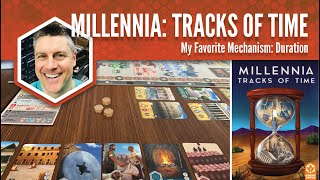
- Card drafting offers multiple interdependent choices combining income, icon use, and duration.
- Two ways to advance on tracks (tokens vs icons) add tactical depth.
- Prosperity goals provide a focused objective amid many possible actions.
- The ongoing clean-up aspect feels satisfying and tangible in play.
- Two-player playability and potential for strategic depth.
- No major cons discussed in the video; potential complexity for new players not addressed.
- track-based advancement and resource/growth planning
- civilization-building on track progression
- strategic, abstract civilization progress
- Tapestry
Mechanics (from transcript analysis)
- action marker placement — place tokens to claim cards and activate card-related benefits.
- card drafting — players draft and claim cards by placing action markers; cards have income values based on their row and perform varying one-time or ongoing effects.
- card longevity / duration — cards show how many rounds they'll remain in play, affecting value of taking them.
- deck/card cleanup — as play progresses, cards are moved out of the active area and some are removed from play, enabling physical cleanup.
- income row dynamic — cards come from different rows with different income values (2, 3, 4, 5) influencing choice.
- prosperity goals — each round has prosperity opportunities; collecting certain icon pairs advances the prosperity track for points.
- track advancement via icons and tokens — cards' icons and token placements advance players on tracks, enabling various benefits.
Video topics + discussion points
Quotes (from this video)
- This is my favorite mechanism if I had to choose a number one mechanism in the game.
- I really had fun my first play.
- If you can think of any other games that do that or if you have a different favorite mechanism in Millennia, let me know about it in the comments below.
- these numbers mean how long that card will remain in play.