In Molly House, players take the roles of the gender-defying mollies of early eighteenth century London. Throw grand masquerades and cruise back alleys while evading moralistic constables who seek to destroy your community. Be careful, there may even be informers in your midst!
Over the course of an hour, players will draft hands of vice cards representing the different gestures, desires, and encounters that were frowned upon by the Society for the Reformation of Manners, a citizen group that sought to stamp out any behavior it deemed deviant in late 17th and early 18th century London. These cards allow players to host festivities with the help of their fellow mollies and create joy. But, those same cards can also lead players to be arrested and to the ultimate ruin of the molly house.
As players encounter the Society’s enforcers, they will often have to pay bribes or may be coerced into becoming informers for the Society. Informers must try desperately to undermine the community around Mother Clap’s Molly House without being discovered by their fellow mollies.
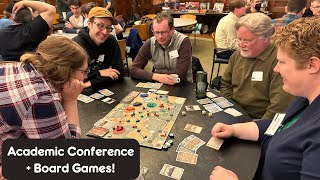
Mechanics (from transcript analysis)
- Prototype_design — Early-stage game mechanics and balance under exploration.
Video topics + discussion points
Quotes (from this video)
- this weekend was partially cool just because of the people I got to meet
- board gaming will join video games and take its place in Academia
- I really hope to see more work like this happen in the future
- the weekend really filled my cup intellectually
- I got to play Prime Minister and I actually won
- Prime Minister is a mean little game
- it's hard to decide what to do socially in Prime Minister
References (from this video)
- Joyful, party-centered design foregrounding queer history
- Innovative informer mechanic that creates tension and narrative friction
- Evolution from earlier designs to a map-based, external-mocus play with richer Molly-card interactions
- Inclusive art direction and authentic representation
- Subject matter may be polarizing or challenging for some players
- Rule complexity and learning curve can be steep for new groups
- Historical references and flavor text could be dense for casual players
- queer social spaces, community resilience
- 1720s London
- historical, card-driven party planning with social dynamics
- Black Sonata
Mechanics (from transcript analysis)
- card drafting — Players draft cards to assemble events and Molly actions.
- hand management — Manage a hand of cards to form Molly party sets and fulfill goals.
- Informers and guilt tokens — Informers and guilt tokens create hidden information and risk via accusation mechanics.
- Raid track / raid dynamics — A raid track determines whether the Molly house stays open or is raided and closed.
- Set collection / poker-hand like objectives — Molly cards form poker-like hands that score Joy for players.
- Social deduction / tension — Player actions can expose or conceal information to influence outcomes.
Video topics + discussion points
Quotes (from this video)
- the players are playing as mollies in the Molly house
- Victory conditions are also built around the informers
- queer Joy was worth it then and it's worth it now
- the game is kind of what it always should have been which is like really joyful really fun
References (from this video)
- widens historical topics beyond warfare
- broad appeal
- potentially niche topic for some players
- social history rather than military conflict
- 18th-century London, LGBTQ+ history
- cultural exploration with euro aesthetics
- Winter Rabbit
- City of Six Moons
Mechanics (from transcript analysis)
- cooperative/experimental — non-traditional objectives and social history focus
Video topics + discussion points
Quotes (from this video)
- historical wargaming is more of a mixed stew than ever.
- evocative rather than granular to make it easier for you to play.
- the boundary lines are getting blurrier and blurrier.
- I acknowledge that games are product and that those two things are inseparable.
- we need more people who see games that way.
References (from this video)

- Thematic fit with social dynamics and intrigue
- Good balance for both solo and social play
- Publisher information is not widely publicized
- Accessibility for new players could be a barrier
- Power, influence, and social ritual
- Courtly intrigue and social maneuvering
- Story-rich with a focus on social dynamics
- Oath
- Old King's Crown
Mechanics (from transcript analysis)
- bidding — Bid-based allocation of opportunities or resources
- social negotiation — Players negotiate to advance goals through dialogue and deals
- solo mode compatibility — Designed with explicit solo play in mind
Video topics + discussion points
Quotes (from this video)
- the solo mode has to deliver an emotional experience
- we want to create something that's not average you want to create something that's new
- it's not just a flourish at the end, it's central to the game
- you can't do that solo, you need to say yes you can
- it's about delivering a different story when playing solo
References (from this video)
- Rich London 18th-century setting with a focus on queer community themes
- Multiple paths to endgame victory and varied party types
- Dynamic interaction between joy, reputation, gossip, and raids creates tension and strategic depth
- Three-player playthrough demonstrates interplay and swingy outcomes well
- Relatively steep learning curve and many interconnected rules
- High degree of randomness from dice and card draws can dominate outcomes
- Certain party mechanics (e.g., christenings) may feel challenging to balance in 3-player games
- forming a joyful queer community under pressure from the watchful society
- London, early 18th century
- historical social-deduction with cooperative goals and factional risk
- John Company (Second Edition)
- Infamous Traffic
Mechanics (from transcript analysis)
- Dice-based movement — Players roll dice to move their pawn on the board; boots on the board can be used as movement or to trigger actions.
- endgame conditions — Victory can come from forming a sufficiently joyful community, or from raiding all houses or other thresholds depending on the game state.
- Gossip deck and threats — Two discard piles form the gossip/deck system; revealed threats can cause raids on Molly houses.
- Indictments and loyalty tokens — Players can be loyal or an informer; indictments affect endgame scoring and can lead to raids or pardons.
- Molly houses and raids — Houses can be raided when threat indicators accumulate, producing endgame consequences and indelible effects on scoring.
- Party mechanics with poker-hand scoring — Parties are built by laying out cards to form poker-like hands; different hands yield different scores and effects.
- Reputation and joy tracking — Desire, Molly, and other cards contribute to a player's reputation and joy, which are tracked via their player boards.
- Safe pile vs gossip pile — Some cards are kept in a public safe pile; others go to gossip, affecting future draws and scoring.
Video topics + discussion points
Quotes (from this video)
- Molly House, like any other worldly gig games, has multiple ways the game can end.
- The parties are one of the main ways we earn uh joy in this game.
- the safe pile is totally public knowledge, which is why we have it as a mess over here.
- We are a bunch of people in the queer community in 18th century London.
- London in the early 18th century.
References (from this video)
- Array
Mechanics (from transcript analysis)
Video topics + discussion points
Quotes (from this video)
- Len's Legacy was super good it was mean it was quick it was smart
- I really really do like Night Witches
- it's just the world's simplest card game
- I absolutely love Circle DC it's absolutely on my list to go to again next year
- I would do it again right now no matter how tired I am
- Circle DC you actually hang out with people and talk and play games
References (from this video)
- Unique historical theme
- Interesting social dynamics
- Multiple paths to victory
- Thematic gameplay mechanics
- Complex rule set
- Potential for player elimination
- Queer community and social survival
- 18th century London
- Collaborative with potential betrayal
Mechanics (from transcript analysis)
- Action Point Allowance — Players take turns moving and performing actions
- Betrayal — Players can choose to be informers to save themselves
- card management — Players manage hand of vice cards and build reputation
- set collection — Players collect cards to create best sets during festivities
Video topics + discussion points
Quotes (from this video)
- If the Mollies can build a joyful community before the Molly Houses are raided, the player with the most joy will win the game.
- The outcome all depends on the loyalty and love of the players.
References (from this video)

- unique, provocative theme
- beautiful production; thematic components
- dense rules; high learning curve
- mid-tier after first plays
- taboo venues, parties, and social dynamics
- Molly houses; LGBTQ+ nightlife in a historical context
- dense, multi-layered social interaction with hidden information
- Root
Mechanics (from transcript analysis)
- deck-building / hand management — Core mechanic revolves around cards in hand and action economies on spaces.
- negotiation / bluffing with limited information — Players speak about hosting parties but cannot reveal exact cards.
- worker/action economy on modules — Cards trigger party-hosting events; players must coordinate to host the party type.
Video topics + discussion points
Quotes (from this video)
- This game is phenomenal.
- It's closer to the Kuba Libre end of the learning spectrum than some of the big ones.
- I would like to play it because I do love Kuba Libre.
- I freaking loved it.
- I love multiplayer solitaire games.
- Pergola is the newest game from Rebel Studio, uh who you may know, they did Meadow, which is a game that we really enjoy.
- it's a massive like resource management. Sounds like a optimization game.
- I absolutely adore the theme.
References (from this video)

- strong thematic fit and setting
- tension between cooperation and betrayal is compelling
- co-op with meaningful player interaction
- card mechanics may not be immediately intuitive
- balls, events, community, potential betrayal
- Molly houses in 1800s England
- narrative-driven with a touch of tension and social dynamics
- Cross Bronx Expressway
- Battlestar Galactica
- The Resistance
Mechanics (from transcript analysis)
- card play / set-building — interacting across cards to drive events and scoring
- cooperation with betrayal tension — players collaborate but can betray or manipulate subtly
Video topics + discussion points
Quotes (from this video)
- Speak Easy is fantastic. It's great.
- it's almost like two different games where it works really good solo and really good two-player.
- I hate ordering this top 10. I hate ordering this.
References (from this video)

Mechanics (from transcript analysis)
Video topics + discussion points
Quotes (from this video)
- I think five shorts in the can is a momentum, it's going to be a priority.
- The YouTube algorithm is fickle because we don't want to tailor our content to it, but we have to consider it.
- PAX Unplugged could be a great place to do interviews, but we have to be mindful of publishers' time and not be overly intrusive.
- Yokohama is a really interesting game with an interesting history, and I wanted to capture that in the review.
- Desperate Oasis is a small game and the Shorts performed reasonably well for it.
References (from this video)

- Non-traditional war game with strong historical theming
Mechanics (from transcript analysis)
Video topics + discussion points
Quotes (from this video)
- I think onboarding is the key here and maybe that's a lesson every company and designer should take to heart.
- People are hungry for heavy games. If you present it in a way that is going to be accessible enough, they will come if you design it.
- Go play war game.
References (from this video)

- Well-received by critics
Mechanics (from transcript analysis)
Video topics + discussion points
Quotes (from this video)
- There's an absolute ton of campaigns
- Campaigns get pushed off. Campaigns get canceled. Campaigns get added. There's a lot of changes on a regular basis
- Cascadia is a game system that I absolutely love
- Really enjoyed Honor's End
- Journeys of Heart of the Katsuagi is going to be my number three pick
References (from this video)

- Cooperative gameplay
- Meaningful theme about LGBTQ+ community safety
- Cross-talk and discussion encouraged
- Community success threshold creates interesting tension
- Beautiful thematic execution
- Roll and move mechanic (though mitigated)
- Some find semi-cooperative elements unnecessary
- LGBTQ+ safe havens (Molly Houses) and finding joy and safety in community
- 18th century London
- Social cooperative experience focused on community well-being
- Marvel Legendary
Mechanics (from transcript analysis)
- Card Play — Playing cards with suits and values to meet party requirements
- cooperative gameplay — 80-100% cooperative with shared success condition
- Party Throwing — Throwing cooperative parties using card combinations at Molly Houses
- roll and move — Movement around board with mitigation options
Video topics + discussion points
Quotes (from this video)
- 2025 is halfway done. And this year, honestly, so far for board games has been super strong.
- This year has been really really strong.
- Race Chicago was a big surprise for us. We really liked it a lot.
- this just it doesn't feel like any other game I've played
- The Anarchy is an absolute banger.
- It's like the 2.0 level up from Hadrien's Wall.
- I love Molly House.
- it's really about coming together
- Luier is really really good. If you like big heavy euros that are pretty, it's a banger.
- this game is dope
- this is what I wanted Too Many Bones to be. It feels like too many bones leveled up.
- It's such a banger
- I just love the double-sided cards.
- Unstoppable is truly unstoppable.
- for my money, one of the best like two-player games I've played in a long time
- it's so good. It's so awesome.
References (from this video)

- Historically researched
- Unique narrative approach
- Meaningful decision-making
- Challenging to understand initial strategy
- LGBTQ+ historical experience
- Victorian England
- Social survival game
Mechanics (from transcript analysis)
- card management — Managing evidence and community joy
- risk management — Balancing personal survival with community preservation
Video topics + discussion points
Quotes (from this video)
- Digital adaptations are a blessing for Metro commutes
- Tabletop Simulator revolutionized game design
- Some games actually improve in digital format
References (from this video)

- Creates unique social experiences
- Strong thematic integration with meaningful storytelling
- Accessible to non-gamers while remaining engaging for hobbyists
- Subject matter may not be for every group
- Experiential focus can feel less structured to some players
- Experiential storytelling through social events
- Historical LGBTQ+ queer communities around 1900
- Narrative-building around player interactions and parties
- Dixit
- The Mind (for non-verbal coordination vibes)
Mechanics (from transcript analysis)
- Movement and action sequencing — Players move around a space and trigger actions to craft stories
- Story-driven card play — Actions shape the table narrative rather than simply scoring points
Video topics + discussion points
Quotes (from this video)
- This year was brutal for making a top 10; the quality was that high.
- This game will stay in the collection for the foreseeable future.
- It's a banger, mate. Absolutely a standout.
References (from this video)

- Cool integration of theme and mechanism
- Unique joy/guilt victory condition
- Good handling of informance mechanic
- Incentivizes cooperation in competitive game
- Not yet widely available
- Social competition with ethical considerations
- Gay Britain - secret parties
- Historical fiction
Mechanics (from transcript analysis)
- Cooperative incentive — Players incentivized to facilitate others' joy
- Joy/guilt continuum — Victory measured by joy spectrum with guilt component
Video topics + discussion points
Quotes (from this video)
- what's more fun than fighting out the naval campaign of the War of 1812 if there's something I don't know what it is
- it just really captured the nasty ambitious mess of it all
- got me to a place of extreme selfishness and frustration with the selfishness of others
- it's such a deeply it it's one of those games that as a game I'm not actually sure that any individual thing you're doing is any fun
- it's a block game but I still like it
- I love feeling bad playing that game
- the human baseness that it brings out is so pleasing
References (from this video)
- addresses underrepresented historical culture with care
- accessible for non-history-heavy groups
- concise play sessions suitable for social evenings
- sensitive subject matter requires careful handling
- availability and exact publication details may vary by release window
- identity, social boundaries, and community spaces in a historically sensitive context
- early 18th-century London and queer culture; historical slice focusing on Molly houses, policing, social venues
- historical reconstruction with emphasis on sensitive portrayal and social dynamics
- Oath: Chronicles of Empire and Exile
- Arcs
Mechanics (from transcript analysis)
- narrative-driven play — players explore a historical slice through guided storytelling and social interaction, with attention to identity and community
Video topics + discussion points
Quotes (from this video)
- Oath is the riskiest project we had ever worked on
- I want players to be the ones doing that authorship
- Oath is a storytelling-forward game
- the world should change slowly and be reintroduced across generations
- leadership is complex, and part of leadership is not being an expert