In the early Middle Ages, the peak of ecclesiastical power, no fewer than five monasteries were founded in a beautiful valley with the aim of spreading the Word of God.
As the dean of a cathedral school, you try to accommodate the novices entrusted to you in the monasteries, thus building up an unmistakable reputation. According to your talents, you send novices to monastery buildings, to the chapel, or to the cloister. The intercession of influential personalities or other monks should not be underestimated. You can also fulfill the special missions of the monasteries and build on the stained-glass windows of your cathedral to enhance the fame of your school.
After the three-year novitiate, it will become clear who has been able to earn the most fame and glory with their helpers.
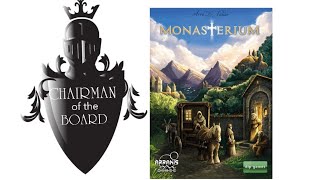
Monasterium (which is Latin for "Monastery") is a strategic game with an innovative dice mechanism that presents the players with ever new challenges. The game includes a double-sided game board: one side for the game for two and one side for 3-4 players.
- Innovative dice drafting that builds a dynamic engine as you unlock more options
- Clear and attractive visual language with a bright Euro aesthetic
- Tight pacing enabled by the three-round structure that keeps play snappy
- Strong player progression through upgrades on the personal boards
- Good scalability with different player counts and a useful double-sided board
- Multiple viable strategies and objective paths encourage varied play styles
- No solo mode available, which limits solo play options
- Three-round structure can feel rushed for some players, constraining long-term planing
- Religious life, community building, and competing for ecclesiastical influence within a town or region.
- A medieval monastic setting with churches, cloister, and chapels arranged on a central board; the layout is thematic to religious community life and pilgrimage routes.
- Euro-style strategic resource management with a strong emphasis on engine-building through progressive board and token unlocks.
- Yahtzee-style dice rolling (referenced as a point of reference for dice mechanics)
Mechanics (from transcript analysis)
- area control with round-based scoring — Pt allocation and majorities hinge on the distribution of worshipers across churches and cloister areas, with timing affecting scoring potential.
- dice drafting — Each player rolls a set of dice and drafts from pools laid out on the board. Dice values determine which actions are available, and some dice remain protected for a given player, preventing others from stealing them.
- double-sided board and scalable player count — The board and die pools scale with player count and are swapped to keep balance, maintaining a tight Euro feel across player configurations.
- pattern/board development and resource management — Players deploy worshipers into buildings and chapels by paying resource tokens (food, tools, books, and influence). Unlocking stained glass tiles and board rows expands future options.
- set collection and scoring via churches and cloister — Points come from majorities in churches, the number of chapels occupied, and fulfillment of public objectives tied to church layout and completion timing.
- tile and token upgrading — Stained glass window tokens and upgrade options on the player board allow new actions and points to be accessed as the game progresses.
- variable action selection per turn — Dice determine how many actions you can take per turn, with certain actions being limited or unique per turn. The system balances risk and reward by controlling how much you commit early.
Video topics + discussion points
Quotes (from this video)
- This one is a dice drafting game which is one of my favorite mechanisms.
- The dice drafted mechanism is something I really like.
- The balance of the game as well is really good.
- Extremely accessible but still has lots of interesting decisions throughout.
- The three-round structure keeps things tight and focused, and the rounds fly by.
References (from this video)
- smooth dice-drafting system
- well-rounded euro mechanisms
- compared to heavier dice-drafting titles, may not stand out as highly as top-tier euros
- monks, churches, and monasteries through dice allocation
- dice drafting within a monastic-themed setting
- light, abstract euro with a historical flavor
Mechanics (from transcript analysis)
- action allocation — players allocate dice to advance on different tracks and build up a scoring path
- dice drafting — dial-in actions by drafting dice values to take actions and progress on a road
Video topics + discussion points
Quotes (from this video)
- This is probably one of my favorite Uwe Rosenberg games I've played to date.
- it's a weird one because it's kind of like a full-size game but didn't quite feel like it
- the rules overhead was quite high in terms of remembering what they do
- usually trying to build these routes and establish these with blocks and then get the cards
- it's a pretty much a paint by numbers deck builder game