The walls were lined with iron shelves, each metal slat overfilled with glass jars containing formaldehyde and grotesque curiosities within. Pristine brass tools and refined metals of a quality I had never before laid eyes upon were strewn across sturdy slabs of rock and wood, their edges sharp with use. However, my eyes were soon drawn to a sturdy writing desk, its mahogany eaves inlaid with thin strips of copper, the center of which contained a well-worn leather-bound book. My father's journal — passed down to me and representing years of knowledge and countless experiments. And inside that weathered tome, atop the pearly parchment oxidized yellow at its frayed edges, were the deliberate quill marks of a crazed genius outlining the ambitious project he could never complete in one lifetime — his masterwork.
Without realizing it, my hands were shaking as I clutched the book to my chest. At once, I felt an ownership and anxiety for the scientific sketches scrawled so eloquently on those frayed sheets. It was at that moment that I began my obsession: I would restore this laboratory to its former brilliance and dedicate my life to completing my father's work!
In My Father's Work, players are competing mad scientists entrusted with a page from their father's journal and a large estate in which to perform their devious experiments. Players earn points by completing experiments, aiding the town in its endeavors, upgrading their macabre estates, and hopefully completing their father's masterwork.
But they have to balance study and active experimentation because at the end of each generation, all of their experiments and resources are lost to time until their child begins again with only the "Journaled Knowledge and Estate" they have willed to them — and since the game is played over the course of three generations, it is inevitable that the players will rouse the townsfolk to form angry mobs or spiral into insanity from the ethically dubious works they have created. The player with the most points at the end of three generations wins and becomes the most revered, feared, ingenious scientist the world has ever known!
—description from the publisher
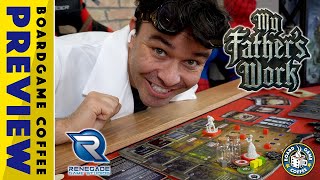
- Deeply thematic gothic setting and narrative
- Multiple paths via scenarios and app-guided play
- Generational progression with knowledge carryover
- Estate upgrades provide meaningful bonuses
- Distinct worker roles including caretakers, spouses, and town workers
- High complexity and potential learning curve
- Reliance on app may be a barrier or risk if tech issues arise
- Ambitious scope with three generations could slow gameplay
- mad science, generational legacy, moral ambiguity
- dreary gothic horror estate outside of town
- scenario-driven, branching narrative powered by scenario boxes and a digital app
Mechanics (from transcript analysis)
- Donations and church influence — donating to the church can erase sins and provide benefits
- Estate upgrading — improvements to the estate provide ongoing bonuses
- Generation-based progression — three rounds per generation across three generations
- Insanity track and compulsion — risk of losing mind; can earn compulsion or maladjusted penalties
- Knowledge retention — knowledge carries over to future generations via recording actions
- Moral/social dynamics — unrest and mobs can disrupt access to town and impact scoring
- Resource management — collect materials and knowledge to fuel experiments
- Scenario boxes and app integration — scenarios are provided by scenario boxes; an app guides and tracks progression
- Town vs estate actions — actions can be taken in town or in the estate with different consequences
- worker placement — players place workers to perform actions in the estate and town
Video topics + discussion points
Quotes (from this video)
- my father's work is a 2-4 player competitive worker placement that takes place in a dreary gothic horror story setting and has players sacrificing little wooden frogs to fuel their teleportation machines
- you don't actually need to complete it to win
- the app my father's work will have an app that directs your experience
- your story is bound to be different than mine
- this here is your insanity track
References (from this video)

- High production look even in prototype; artwork is bomb
- Thematic flavor with Frankenstein-inspired mad scientists
- Glass jars and metal coins feel premium for a prototype
- App-driven branching outcomes add replayability
- Prototype components may not reflect final production
- Rules and workflows are not yet known; execution complexity may be high
- Some elements like expansion vs base may be confusing in early stages
- Frankenstein-inspired experiments and family legacy
- Gothic scientific manor with mad scientists, laboratories and living quarters
- branching events driven by an app; adjustable outcomes across playthroughs
- Pandemic
- Monolith (prototype)
Mechanics (from transcript analysis)
- app_integration_and_branching_events — An app provides branching storylines that alter events based on player choices.
- generation_progression — Play progresses across 'generations' with carryover/replacement of tasks and consequences.
- resource_and_component_management — Management of tokens, glass jars, jars with liquids, and other components to support experiments.
- set_collection_and_vp — Complete experiments and earn victory points from cards and components.
- worker_placement — Players assign scientists to locations (laboratory, living room, etc.) to perform experiments and gather resources.
Video topics + discussion points
Quotes (from this video)
- the idea is you're mad scientists are doing experiments
- there's branching storylines
- it's going to look like it's going to be like a super high production quality
- mad science is the best kind of science
- i'm sold on this whole the whole presentation and theme of this game
- i want to learn how to play this right now
References (from this video)

- tough, challenging optimization layer
- interesting tension between progress and public opinion
- storytelling and app-driven elements may be weaker than the core optimization
- some players may find the external-town mechanics slow
- scientific progress vs community perception
- scientific town; laboratory-driven advancement with town dynamics
- heavy on optimization and long-term planning
- Viticulture
- Charterstone (city-building)
Mechanics (from transcript analysis)
- town voting / external actions — decisions outside your lab affect everyone and can alter the game state
- worker placement — you place workers to run projects and influence town outcomes
Video topics + discussion points
Quotes (from this video)
- the card play is just so uh different, it's so strategic; every move feels super important
- it's a longer game, but the cadence is really neat; you have to time everything to that cadence
- I love Obsession that game
- it's very mean, but in a fun, game-ifying way
References (from this video)

- deep flavor and story integration
- stellar production quality
- long play time and heavy rules can be a barrier
- mysterious family lineage and scientific pursuits
- Frankenstein-esque laboratory and generational invention
- story-rich with strong flavor text
- Mansions of Madness
- Arkham Horror family of games
Mechanics (from transcript analysis)
- app-assisted storytelling — App provides flavor text, world-building, and narrative depth
- generational progression — Play spans generations, building on previous actions
- worker placement Eurocore — Classic worker deployment to gather resources and meet objectives
Video topics + discussion points
Quotes (from this video)
- 13 games that we think you should check out for this Halloween season.
- This is one of the more immersive games I think we have on our list today.
- It's almost more of an activity than a game.
References (from this video)

- Exceptional production quality and components
- Rich storytelling with evolving narrative through the app
- Strong thematic cohesion and memorable moments
- Lengthy sessions and complex setup
- Some players may dislike the heavy theme or theme-specific quirks
- labors of creating masterworks through worker placement and scientific experimentation
- 19th-century Europe and a multi-generational mad scientist family
- story-rich with app-driven scenarios and evolving village ages
- Eldritch Horror (cooperative atmosphere)
Mechanics (from transcript analysis)
- app-driven storytelling — app provides scenarios and narrative beats that guide play
- flip-book aging system — the village ages and the board content evolves with age-specific events
- worker placement — place workers to gather resources for masterworks and experiments
Video topics + discussion points
Quotes (from this video)
- Return to Dark Tower is phenomenal.
- The app integration here works great.
- This is my number one app-driven game of all time.
- It's an incredibly fun game.
References (from this video)

- High-quality components and trays
- Strong storytelling and memorable moments
- Engaging, modular experience with evolving narration
- Family lineage and scientific progress
- Scientific experimentation across generations
- App-driven narrative with evolving board state
Mechanics (from transcript analysis)
- app-driven narrative — An app drives choices and events across generations.
- generational progression — Rounds progress to a new generation with evolving board state.
- Worker placement / resource management — Workers are real people who may die; progress depends on decisions and experiments.
Video topics + discussion points
Quotes (from this video)
- the rules are quick and easy to get through
- my daughter really likes birds
- the game uses the game trays making it a lot better easier to set up and take down
- one of the best components that I've ever seen
References (from this video)

- long, heavy feel with approachable rules
- narrative depth and multiple endings
- high production quality
- long playtime (3-4 hours)
- worker placement with branching narrative
- companion app narrations
Mechanics (from transcript analysis)
- app-assisted narration — companion app tracks decisions and endings with multiple endings
- worker placement — long, strategic placements with evolving outcomes
Video topics + discussion points
Quotes (from this video)
- It's better than code names. I I I have said that and I will stand by that on this channel.
- Wow, that was fast. I really appreciated how quick it was.
- Castles of Burgundy is just a solid game all the way through.
- So Clover is the quintessential inside jokemaker.
- In the Palm of Your Hand feels so different. I just really love the novelty of it.
- Phantom Inc., with its spooky vibe and Ouija-board feel, has been a big hit in our group.
References (from this video)
- Strong and intriguing theme; pedigree and concept are compelling
- Generational arc provides narrative depth
- Exact mechanical implementation is not fully described; risk of complexity
- horror-themed life/death experiments and lineage
- three generations of a family pursuing monstrous experiments
- darkly thematic, multi-generational storytelling
- story-driven Euro games
- generation-spanning narrative games
Mechanics (from transcript analysis)
- generational progression — each generation inherits a notebook of ideas; knowledge transfers across generations
- journal-based knowledge carryover — the story and mechanics evolve as generations die and new players take over
Video topics + discussion points
Quotes (from this video)
- I love games that have time tracks.
- the components in this game look great.
- I am a sucker for creative use of components.
- folding the corners over as you are playing the game.
- this one is suddenly a game that I am very interested in.
References (from this video)

Mechanics (from transcript analysis)
Video topics + discussion points
Quotes (from this video)
- I love this game it's a bag builder
- it's so good
- the characters feel I mean so thematic
- this is going to be good
- this is family friendly but it's not kid's game