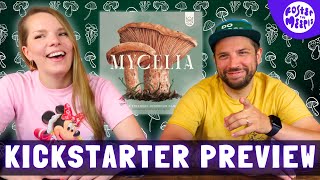
Mycelia is a dynamic game of tactics in a competition for space and resources to create your own mushroom kingdom. The game follows the life cycle of fungi, a journey of creation, expansion, death, and rebirth — in game terms, growing mushrooms to score points, sporing them to expand your mycelial network, and eventually seeing them decay to unlock special actions.
On a turn, a player has two actions to perform from the six options available. Using your decay actions, stealing spores, and blocking other mushrooms are just some of the ways to get ahead in the game. Players can evolve their own playing style, perhaps playing more aggressively to steal other players' spores or disrupt their mycelial network — or perhaps playing more defensively to try to protect their own area and spores.
The board is made up of triangle tiles that represent different environments and nutrients that the mushrooms need to grow. These tiles can be added to the board by the players, so the board is always growing and evolving.
Mycelia incorporates beautiful and accurate botanical style illustrations with over 69 mushrooms that can be found in the wild.
—description from the publisher
- Tightly themed while retaining abstract, puzzle-like depth
- Wind die introduces forced interaction, enhancing player engagement in two-player games
- Easy to learn but offers deep strategic decision-making and planning
- Dynamic board expansion keeps gameplay fresh and replayable
- Strong thematic visuals and presentation of the fungal ecosystem
- Potentially mean and aggressive at higher player counts (three to four players)
- Luck component tied to wind die and tile randomness can affect consistency
- Prototype components mentioned as potentially changing before final production
- Growth, decay, and competition for space and resources within a fungal life cycle
- A dynamic fungal ecosystem and “Mushroom Kingdom” with environments represented by triangle tiles that expand the board over time
- Thematic, nature-inspired abstraction with a strong ecological flavor
Mechanics (from transcript analysis)
- Area Control — Players compete to occupy and influence spaces on a shifting board via mushroom placements and decay mechanics.
- Blocking and connection constraints — Opponents can disrupt connections between spores, adding defensive and offensive tension.
- end-game trigger and scoring — End when a player decays mushrooms on five spots; points come from individual mushrooms, insects, and market refreshes.
- Growth and decay cycle — Mushrooms are grown, then Decayed to tuck behind the player mat, triggering end-game when five spots are filled.
- Insects as a resource — Insects on the board provide scoring or strategic benefits and can refresh the mushroom market.
- Spore movement via wind die — Spores spread according to a wind die, forcing interaction and shaping tactical decisions.
- Tile placement and board expansion — Triangular environment tiles are added to the board, creating a dynamic and ever-changing play area.
- Two actions per turn from a six-action set — Turn structure hinges on choosing two actions from a defined action set, driving planning and timing.
Video topics + discussion points
Quotes (from this video)
- Mycelia is for one to four players and it is pretty much just like an area control game.
- The tricky part of that is the spores on the board need to be connected.
- you are forced to interact with each other
- it felt like playing an abstract puzzle-y tile movement game but it was thematic in the way that the game worked
- the wind die really enhances that area control mechanic
References (from this video)

- ecosystem management
- fungal / mushroom theme
Mechanics (from transcript analysis)
Video topics + discussion points
Quotes (from this video)
- Welcome to the most boring unboxing in the world.
- I think Poison Ivy's on here somewhere, right?
- This box needs its own bag.
- Ah, it's an expansion for Federation Piracy.
- Remember there was a time this would have been super exciting.
- I’m gonna assume it’s War for New Eden because that’s what it says on the side of the box.
References (from this video)

- Adds new strategic depth
- Introduces interesting mechanics
- Increases player count to 5
- Thematically inspired by real fungal interactions
- Requires base game to play
- Mechanics add complexity
- Fungal ecosystem and network building
- Mushroom Kingdom
- Strategic exploration
Mechanics (from transcript analysis)
- Grandfather Trees — Strategic element allowing spore redirection and point scoring
- Saplings — New mechanic allowing symbiosis bonuses when spores are placed
- Spore Production — Players produce spores in triangular formations
Video topics + discussion points
Quotes (from this video)
- Welcome to the Mushroom Kingdom
- Mechanically, these new mechanics are inspired by the symbiotic relationship between fungi and trees
References (from this video)
- highly abstract with elegant tension
- anticipated Kickstarter launch adds hype
- prototype copy; limited visibility until full release
- rules rely on future production copy; may vary from final
- mycology-inspired scoring and influence
- abstract fungal influence puzzle on the board
- highly abstract with fungal growth metaphor
Mechanics (from transcript analysis)
- Influence placement — place influence tokens to maximize scoring on the board
- tile/spore interaction — spore-like tokens affect scoring dynamics and opponent options
Video topics + discussion points
Quotes (from this video)
- it's a pure abstract very family weight game
- I like it a lot
- gorgeous looking game with some amazing production choices
- the drafting system is much more streamlined
- they are all for the better
- it's a bit of a cult favorite
References (from this video)

- Distinct fungal theme with spatial grid mechanics
- Two-player focus supports tight tactical play
- Card-driven mushroom variety with variable scoring
- Dynamic board growth via explore actions adds replayability
- Prototype components may differ from final production
- Rule complexity can be intimidating for newcomers
- Two-player only design may limit long-term replayability for some
- Orchestrating consistent mycelial networks can be intricate
- growth, foraging, and decay within a mycelial network
- A fungal ecosystem built on a central star-shaped board with triangular tiles representing different environments and nutrients
- procedural, instructional
Mechanics (from transcript analysis)
- decay and power activation — Flip mushroom cards to reveal decay powers that may trigger immediately or upgrade future mushrooms
- discover — Draw new mushrooms or actions from the deck/display to expand strategic options
- domain and connectivity — Spores must be connected in your mycelial network and within your domain when growing
- Endgame trigger and scoring — Endgame is triggered when a player fills slots; all mushrooms score, including decayed ones, with insect leftovers scoring points
- explore — Place new perimeter tiles to extend the board and access new environments
- fruiting (grow) mushrooms — Spend spores to grow mushrooms, each with cost and reward numbers on the card
- insect tokens and market refresh — Spend insect tokens to refresh the market or move an opponent's mushroom, affecting strategy
- move and block — Move your mother mushroom to access new tiles and block opponents
- spore placement — Place spores on the board to form a growing mycelial network and set up future expansions
- wind-driven spore spread — Spore spread direction determined by wind die and board geometry
Video topics + discussion points
Quotes (from this video)
- this game is currently on Kickstarter
- welcome to the world of fungus and mushrooms
- these are the six different types of actions
- that's essentially how you play Mycelia
- you finish the action by returning the mushroom token and resetting the Spore counter
- the board is going to grow in unpredictable ways making each game a bit different
- discover or explore to expand your options and the board
References (from this video)
- Beautiful, colorful art
- Approachable yet interesting theme
- Abstract nature may be opaque to some players
- Mushrooms and kingdom-building
- Fungi kingdom
- Abstract/whimsical
Mechanics (from transcript analysis)
- area control/tableau-esque placement — Build a fungi kingdom through strategic placement.
- Resource management — Manage fungal resources to grow your kingdom.
Video topics + discussion points
Quotes (from this video)
- change is good change is always good
- we're going to be making changes to the show
- we're going to do some live shows
- we love you by bye now
- we are launching a new show which we tested out in 2023
- Ask OFG video questions