In this card game based in H.P Lovecraft's Cthulhu Mythos, you play an investigator (represented by a double sized card that has your stats, special abilities and keeps your story organized) who must complete stories without going insane. From a deck of at least 52 cards you draw 13 and take turns playing one at a time so it moves at a brisk pace. You stock your deck with at least 20 points of stories (usually 3 or 4) and try to get the required cards into play. As an example The card 'A Day in the Life of a M. U. Student' requires you to visit 3 Different Miskatonic University Locations, cast a spell, summon a monster, go to a country site and play an ally of the opposite sex. When you have fulfilled the conditions you score the card and gain sanity. In this card's case you score 8 points and gain 2 sanity.
The types of cards you have are locations (you almost always occupy one), allies, monsters, events, tomes, spells, artifacts and adventures. A round lasts until there are two passes, at which time all monsters played fight each other then go after the investigators to disable their allies or reduce their sanity. You can throw allies in front of the monsters as cannon fodder to protect your investigator. You then decide what cards you are going to keep in your hand (each investigator has a minimum and a maximum number of cards that must be kept) and draw back to 13 for the next round. Because of this you blow through your deck very quickly and you will go through it a couple of times in most games.
There are also some very nasty phobias and events to play on your opponents to interfere with their strategies. There is a lot of interaction and the Lovecraftian atmosphere is keenly felt.
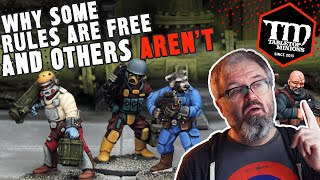
- Low barrier to entry for new players due to free or widely accessible rules
- Ability to trial the complete rules before committing to purchases
- Potentially greater discovery of the product through an approachable onboarding flow
- Potential confusion between multiple rule tiers (free vs paid) if not clearly segmented
- Risk that free rules cannibalize sales of deluxe rulebooks or accessories if not balanced
- Accessibility and onboarding through open rules; the philosophy of letting players read and experience a complete system before purchasing models.
- A mythic or fantastical world where wargaming and rules exploration intersect; the transcript frames Mythos within the broader discussion of accessible rulebooks and player onboarding.
- Informational, explanatory, and opinion-driven commentary about rule availability and its impact on purchasing decisions.
- Stargrave
- Planet 28
- Zona Alpha
- Rangers of Shadow Deep
Mechanics (from transcript analysis)
- Free-to-paid tier model — A strategy where a free or basic version of the rules exists, with optional paid upgrades or deluxe versions that add artwork, layout enhancements, or extra rules.
- Miniatures integration — The game is designed to pair with a range of models; purchasing miniatures is a path to expansion, but the core rules are tradeable without buying every miniature line.
- Rulebook-driven play — Play is enabled by a complete, accessible rule set that can be read and understood before acquiring the core product (models).
Video topics + discussion points
Quotes (from this video)
- the first taste of a game is often the most important moment for a new player to decide if they want to dive deeper
- we're going to give you the whole game, it's free
- the entire taste is free—the entire rule set
- you can proxy whatever you want to proxy
- money does need to get made, so the business has to decide how to monetize
- vote with your wallet and figure out how you want to do things