The Sherpa people are known for their exquisite mountaineering skills and often use that knowledge to be effective guides to explorers on mountaineering expeditions. In Nanga Parbat, you are a member of the Sherpa community that is establishing base camps on Nanga Parbat for foreign explorers. While there, you will also trap animals for food and clothing.
In this two-player game, players take turns placing hikers on the mountain where they can capture animals and build base camps. Five times during the game, a player may either trade in their animals or build a base camp for victory points.
On a turn, a player must place their hiker in the region containing the guide, who then moves based on the placement of the hiker, thereby forcing the opponent to place their hiker in a new region. However, players may spend their captured animals to perform special actions.
After 15 turns for each player, the game ends and the player with the most points wins.
—description from designer
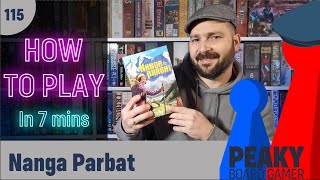
- Described as simple to learn and play, making it accessible for quick play sessions.
- Two-player focus with a clear end condition for efficient head-to-head play.
- Diverse scoring options (camps, trading by type, trading by mix) provide strategic depth without overcomplicating rules.
- Hidden objective cards add a layer of personal strategy and tension.
- End-game scoring can be complex due to three different scoring tracks and proximity bonuses, which may require careful study for new players.
- Component limits and the need to manage multiple trackables could slow pacing if players overthink sequences.
- Exploration, expedition logistics, and competitive scoring through set-building, trading, and positional play on a shared map.
- A mountainous expedition setting inspired by the Himalayan region around Nanga Parbat, represented on a six-region board with 6 sub-sections per region. Players deploy hikers and animals to score points and interact via a moving guide pawn.
- Instructional, example-driven rule explanation presented by the host with step-by-step demonstrations.
Mechanics (from transcript analysis)
- area control / region advancement — The board is divided into six regions (each with six sections). Players move a guide pawn between regions, place markers, and attempt to maximize scoring opportunities in favored regions.
- multiple scoring modes — Three distinct scoring options exist: building camps from adjacent hikers, trading different types of animals, and trading same-type animals; each requires different conditions to maximize points.
- one-time powers per animal — Each animal type carries a special power that can be used once during a player's turn to alter positioning or trigger effects, adding strategic depth to sequencing.
- resource and marker management — Players manage scoring cubes, camps, hikers, and markers with a limited supply, deciding when to invest resources for points and when to hold back.
- secret objective cards — Objective cards are shuffled and dealt secretly to each player, providing private scoring targets that influence regional checks at end of play.
- set collection — Players gather hikers and animals to form scoring opportunities; sets can be formed on the board and via the personal boards, with points awarded for grouped pieces.
Video topics + discussion points
Quotes (from this video)
- this one's only for two players, plays in 30 minutes and is called Nanga Parbat.
- the game is fairly simple.
- all animals have a specific power that can be used only once during a player's turn to spice things up.
- the pink player has a group of five adjacent hikers
- you acquire a red panda if you are behind (or tied) in the score, you score one victory point immediately.
- the game ends immediately in two different ways.
References (from this video)
- Strong two-player design with depth
- Specific data about publisher/designer is unclear in transcript
- Strategic ascent with mutual constraint and choice
- Two-player strategic exploration (Himalayan ascent theme)
- Abstract strategy with thematic framing
- Jaipur
- Lost Cities
Mechanics (from transcript analysis)
- Two-player abstract/duel — Competitive head-to-head with limited actions each turn
Video topics + discussion points
Quotes (from this video)
- i decided i was going to do a lot of promoting of other people's products
- the energy that i can give to a product
- we're a team we're a great team
- just do it man just do it
- the next ones we're gonna loosen it up attack too hard
- you make content here that's it and when i joined man vs meeple i was very clear
References (from this video)

- beautiful production
- tight two-player head-to-head feel
- not fully described as the author’s best, but highly regarded
- area control with strategic camp placement
- Two-player mountain-climbing and camp-building contest
- elegant, tactically rich
Mechanics (from transcript analysis)
- area control / route planning — players select regions to gain control and advance up the mountain
- tic-tac-toe-inspired region sequencing — regions chosen determine future placement and strategy
Video topics + discussion points
Quotes (from this video)
- Kickstarter has been a really emergent space ... more and more two-player games more and more single-player games are coming out first on Kickstarter
- art production is fantastic
- it's fast fun
- two-player head-to-head is a satisfying format when done well