Wind whistling, bees buzzing, rivers rolling along: the sounds of the great outdoors are everywhere. This open countryside is unspoiled by human hands, and it’s your job to keep it that way. Make sure the tourists and campers have somewhere to go, but don’t let their presence distract you from what really matters.
In Naturopolis, 1-4 players work together to build a new landscape. Using only 18 cards and a variable scoring system, the game is never the same twice.
First, players will randomly flip over 3 cards to see the scoring rules for the game. But not only do these 3 cards determine how you will score this game, they also determine how you win. Total up the values of all three cards, and that number is the scorethat you need to reach in order to win. Each game has drastically different scoring rules in unique combinations, and a new score to beat, ranging from 6 to 51 points.
Each turn, players will play one card from their hand to the growing landscape, trying to score as many points as possible. Players will have to communicate and plan without revealing their own cards in order to most efficiently develop large areas in each of the 4 zone types. Watch out though, road maintenance isn't cheap and each road will cost you points in the end. This is doubly true with Naturopolis’ double-lined roads as they will cost you -2 points each!
New to Naturopolis are the rivers, which occupy space the same way as roads but don’t hurt your score. (But roads and rivers cannot connect!) It also adds camp sites, which score based on certain goals.
When all cards have been placed, the game ends and players see if they have met the dynamically generated minimum score for their game.
Can you work with your team to make the most of these natural wonders while still leaving space for tourists, campers, and other visitors? It’s time to find out!
Naturopolis is the 3rd game in our series of standalone and combinable Sprawlopolis games. It brings mountains, lakes, forests and meadow blocks to the game, with the added bonus of campsites (which trigger scoring conditions), rivers (which also trigger scoring conditions and cannot connect to roads) and double line roads (which are worth -2 points each as disrupting nature is very costly!)
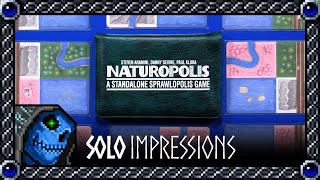
- Beautiful nature-inspired aesthetic that feels calming and table-friendly
- Scoring conditions feel elegant and fair, especially compared to earlier titles in the series
- Relaxed but still brain-burningly puzzle-like; rewarding for repeated play
- Improved card layout and typography improve readability and overall presentation
- Rivers and limited roads add fresh constraints without overcomplicating the puzzle
- Some players may miss the more urban theme of Sprawlopolis
- Expansion content and deeper play variants were not explored in this particular review
- Eco-focused urban planning with gentle, soothing visuals
- Nature themed city-building puzzle with a calming, nature-forward aesthetic
- abstract puzzle with environmental motif
- Sprawlopolis
- XCOM (2012)
Mechanics (from transcript analysis)
- cards_layout_and_text — Card typography and layout are used to convey scoring rules clearly and efficiently.
- repetition_reward — Repeated play improves efficiency and scoring familiarity, encouraging long-term optimization.
- roads_vs_rivers — Fewer roads than in prior games and the introduction of rivers add constraints and strategic considerations.
- scoring_conditions — Cards specify various scoring requirements; players optimize placements to maximize points across multiple conditions.
- tile_placement — Players place cards on a shared or personal grid to form spatial patterns that trigger scoring effects.
Video topics + discussion points
Quotes (from this video)
- This has become my new favorite button shy title.
- This is my new number one button shy game.
- Kudos to the designers.
- It rewards repeated play.
- It looks gorgeous on a table.
References (from this video)

- Good puzzle element with placement adjacency rules
- Thematic building experience
- Jamie finds it difficult to score optimally
- Failed to reach 30 point goal (scored 24)
- Building natural landscapes and cities
- Nature city and natural environment
- Tile-laying puzzle
Mechanics (from transcript analysis)
- Asymmetric hand size — First player gets 3 cards, second player gets 1 card per round (card passing each turn)
- Negative scoring — Roads subtract 2 points each - players want to minimize them
- Scoring bonuses — Three public conditions for bonus points: Impressive Range, Waterways, Second Nature
- Terrain majority — Score points for largest connected block group
- tile laying — Players build 3x5 grid over 15 rounds, each card has blocks and roads/rivers on back
Video topics + discussion points
Quotes (from this video)
- it's button shy day people there's no messing around
- I try to just choose ones mainly that I haven't played yet
- this game's incredible
- easy peasy lemon squeezy
- my brain
- pterodactyl eating a man
- we're brilliant geniuses
- we are moving along a time continuum