In Odin, you want to empty your hand as quickly as possible, sending all your Vikings out into the world.
The game lasts several hands, with each hand consisting of one or more rounds. The deck contains cards in six suits, each numbered 1-9, and each player starts with a hand of nine cards.
The lead player for the hand lays a single card on the table. The next player either passes (but can play on a future turn) or plays the same number of cards (or one more than that number) with a higher value. When you play two or more cards, the cards must be the same number or color, and the value of these cards is created by placing their digits in order from high to low. For example, if you play a blue 3 and blue 6, their value is 63, not 36. When you play and are not the lead, you must take one of the cards from the previous play into your hand, then discard the rest.
Play continues around the table until either a player is out of cards, which ends the round immediately, or all players have passed in succession. In the latter case, discard the cards last played; whoever played these cards lays a single card to start a new round. Alternatively, if the lead player has cards in hand of a single suit or number, they play all of these cards at once to end the hand. When a hand ends, each player scores 1 point for each card they still hold.
If no player has at least 15 points, shuffle the deck and start a new hand. If someone does have 15 or more points, whoever has the fewest points wins.
- real pacing issues
- rigid and lacks depth
- not enjoyable overall
Mechanics (from transcript analysis)
- card-laddering / multi-card play — Players can play multiple cards to climb to a higher value; players may need to play cards of the same number or same color to stay in the round.
Video topics + discussion points
Quotes (from this video)
- I hate trick taking. I don't like it at all.
- this is one of the only occasions where my pure disliking of the game brings it down rather than the actual quality of the design.
- I did not like this game at all, so I was quite shocked why his name was on the box because I thought it was a pretty bad design.
- It's extremely tactical. And not only that, it seems like the first half of the game, you're just kind of doing things for the sake of it because you do not know how these cues are going to work out.
References (from this video)
- extremely portable
- fast and easy to teach
- clear ladder mechanic
- rulebook clarity can cause confusion during play
- short play may limit depth for some players
- progression by playing higher-valued cards; climbing a ladder
- compact card game, Norse-themed ladder climbing
- abstract/standalone
Mechanics (from transcript analysis)
- card_value_progression — the last value dictates what's beatable; can combine cards to form higher values.
- compact_storage — tiny box and minimal components emphasize portability.
- ladder_climbing — play higher-valued cards or multiple cards of same value/color to beat the previous play.
- scoring_to_15 — players aim to finish with the fewest points; remaining cards are points.
Video topics + discussion points
Quotes (from this video)
- I think publishers should provide a fix. There should be something available to fix the problem.
- A PDF fix is viable in many cases because it's not expensive for the publisher and it's not expensive for the customer either.
- The publisher absolutely needs to take the responsibility of getting it right very seriously. People are funding your product.
References (from this video)

- easy to grasp for new players
- quick, approachable card game
- great entry for fans of Scout-like design
- some players may want deeper strategic depth
- card-driven, number-sum battle
- fantasy realm with hand-shedding mechanics
- direct, accessible
- Scout
Mechanics (from transcript analysis)
- Hand-shedding / set of cards — Players play cards to form sets that beat the previous hand; you can play the same number or one more; sum of numbers determines power.
Video topics + discussion points
Quotes (from this video)
- Earth Under Siege Flashpoint... captures a stealth game in the way that I want stealth to be captured in a board game.
- Cat Packs is a fantastic little sweet, charming game.
- Race to Mars... two halves; draft for crew, then deck build; it’s so good I reorganized my collection around it.
- Bobblins Rebellion... the goblin cubes are adorable and the engine-building is a blast.
References (from this video)

- Simple rules
- Quick to learn
- Enjoyable gameplay
- Portable
- Hand shedding
- Card game
- Ladder climbing
- Scout
Mechanics (from transcript analysis)
- hand shedding — Players try to get rid of all cards in their hand
- Ladder climbing — Play cards of same or increasing value
Video topics + discussion points
Quotes (from this video)
- We are trying to get through as many of the games released in 2024 that we have as possible
- We're trying to do a better job at playing more games this year
References (from this video)

- card shedding with color/number combos
- light, casual
Mechanics (from transcript analysis)
- card shedding — play cards with higher value or color to follow rules and outplay opponents
Video topics + discussion points
Quotes (from this video)
- I really like Feld's AA line of games much more than the Queen collection
- this is a new Feld design, not a reworking or anything like that
- two-player only kind of cat and mouse bluffing game
- I'm quietly optimistic about Mindbug
- roll and write, OG roll and write
- I don't like tricktaking
References (from this video)
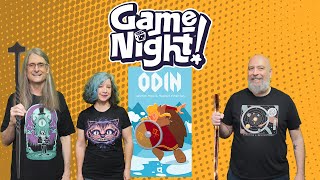
- Quick to learn with simple rules
- Strong Viking theme and artwork that fit the game
- Fast, interactive rounds that work well for groups
- Rule set accommodates 2–6 players and can leverage an app to sort hands
- Leading and hand management provide meaningful decisions despite simplicity
- Luck can dominate due to hand composition and dealing
- Shuffling can feel biased or repetitive, producing similar useful cards
- Not a deep strategy game; decisions can feel constrained by the dealt hand
- Long strings of rounds can feel repetitive if the same card distributions repeat
- Viking culture combined with a card shedding competition
- Viking era, Norse-inspired world with longships and feasting
- conversational and instructional with light humor
Mechanics (from transcript analysis)
- card shedding — Players aim to discard all cards by playing higher numbers or valid multi-card combinations; rounds progress as players choose to play or pass.
- color/number interaction — When playing multiple cards, players form combinations that must be higher than the previous play; colors may constrain or enable combinations.
- incremental card plays — The number of cards a player may play increases with position in the turn order (1, then 2, then 3, etc.).
- passing and re-entry — A player may pass if they cannot or choose not to play; players who pass can re-enter if others also pass; round ends when all but one pass.
- round rotation and dealing — After a hand ends, cards are discarded and a new nine-card hand is dealt; the last player to play typically starts the next hand.
- scoring by leftovers — At the end of a hand, players score 1 point per card left in their hand.
- short game length with target score — Players can set a target score (e.g., 15, 10–20) to determine game length.
Video topics + discussion points
Quotes (from this video)
- It's a quick, easy game.
- I enjoy the thinking of it.
- The art's really neat.
- I like the Viking theme on it.
- Leading is pretty good. Being able to get rid of one card and not take any other one card into your hand is awesome.