Following the success of unmanned rover missions, the United Nations established the Department of Operations and Mars Exploration (D.O.M.E.). The first settlers arrived on Mars in the year 2037 and in the decades after establishment of Mars Base Camp, private exploration companies began work on the creation of a self-sustaining colony. As chief astronaut for one of these enterprises, you want to be a pioneer in the development of the biggest, most advanced colony on Mars by achieving both D.O.M.E. mission goals as well as your company’s private agenda.
In the beginning, you will be dependent on supplies from Earth and will have to travel often between the Mars Space Station and the planet's surface. As the colony expands over time, you will shift your activities to construct mines, power generators, water extractors, greenhouses, oxygen factories, and shelters. Your goal is to develop a self-sustaining colony independent of any terrestrial organization. This will require understanding the importance of water, air, power, and food — the necessities for survival.
Do you dare take part in humankind’s biggest challenge?
On Mars is played over several rounds, each consisting of two phases - the Colonization Phase and the Shuttle Phase.
During the Colonization Phase, each player takes a turn during which they take actions. The available actions depend on the side of the board they are on. If you are in orbit, you can take blueprints, buy and develop technologies, and take supplies from the Warehouse. If you are on the surface of the planet, you can construct buildings with your bots, upgrade these buildings using blueprints, take scientists and new contracts, welcome new ships, and explore the planet’s surface with your rover. In the Shuttle Phase, players may travel between the colony and the Space Station in orbit.
All buildings on Mars have a dependency on each other and some are required for the colony to grow. Building shelters for Colonists to live in requires oxygen; generating oxygen requires plants; growing plants requires water; extracting water from ice requires power; generating power requires mining minerals; and mining minerals requires Colonists. Upgrading the colony’s ability to provide each of these resources is vital. As the colony grows, more shelters are needed so that the Colonists can survive the inhospitable conditions on Mars.
During the game, players are also trying to complete missions. Once a total of three missions have been completed, the game ends. To win the game, players must contribute to the development of the first colony on Mars. This is represented during the game by players gaining Opportunity Points (OP). The player with the most OP at the end of the game is declared the winner.

- space
- colonization
Mechanics (from transcript analysis)
Video topics + discussion points
Quotes (from this video)
- hey everyone who just kind of made it in time i'm not going to say it was a shall we say the easiest time to get here
- come on seriously i need to get on with a stream in a minute
- what is going on at fantasy fly at the moment they're just not bringing out any major good games
- every time they try to do a spin-off game that isn't a card game they tend to fail
- root's okay but i think the fact that you've got to have a balanced group of players who know what they're doing to play it i think it's just too much
- i just i'm okay with rue but i would never seek it out
References (from this video)

- highly engaging and deep design
- excellent for players willing to invest time to learn
- very hard to teach and learn for new players
- complexity can be intimidating
- engine-building and resource management
- space exploration / Mars colonization
- unknown
Mechanics (from transcript analysis)
- engine-building — build an engine through card interactions to generate points
- resource management / action sequencing — careful planning to optimize card synergy and timing
Video topics + discussion points
Quotes (from this video)
- Lisboa such a good game
- The Gallerist was the first design that I saw that looked absolutely beautiful
- Kanban is a fantastic game
- it's a clean and elegant design
- Escape Plan is the outlier in this group
- On Mars is a great game, but it's hard to teach
References (from this video)

- design depth and space-theme appeal
- strong mechanics when played with the right group
- polarizing among players; can be long and complex
- multi-stage, two-part game in orbit and on planet
- space exploration with base-building
- structural/instrumental
- Gloomhaven sun
- Lisboa
Mechanics (from transcript analysis)
- heavy resource management — detailed planning and scoring targets.
- two-part structure — orbit phase followed by planetary phase with distinct actions.
Video topics + discussion points
Quotes (from this video)
- "Point City... looks like this really cool game about pretty tactical about building up a really streamlined engine and just trying to get a bunch of points"
- "I’ve been fatigued by rolling rights"
- "the more you pull back or pull me back from being like in instruction mode the faster you’re going to find I end up"
- "Nostalgia definitely does apply"
References (from this video)

- Good Lacerda game
- Fun gameplay
- Nicely produced
- Way too complicated for its own good
- Too many moving parts
- Difficult rulebook to teach
- Seller's copy due to complexity
- Space colonization
- Mars colonization
Mechanics (from transcript analysis)
- Complex systems — Multiple moving parts and interconnected mechanics
Video topics + discussion points
Quotes (from this video)
- it's just like falling off it's just literally there are 100 better games in it
- Small Islands uh this is the one that i've been saying is a replacement for carcassonne
- way too complicated for its own good
- it is one of the most beautiful games in existence
- i still think five tribes is better than yamatai
- nations is still my preference to fruity ages in terms of playing a physical game
- really good negotiation game
- great teamwork cooperative very cool
- this is a really good solo
- the deductions are really hard it's a really tough one to do
- it's oh it's a mind bender gorgeous looking
- reef is still a really cool game
- azul is only that good at two player
- near and far still really good
- there's no reason to play that one if you have near and far
References (from this video)
- Recent popular worker placement game
- science_fiction
- space_exploration
- colonization
Mechanics (from transcript analysis)
Video topics + discussion points
Quotes (from this video)
References (from this video)

- immersive sci-fi setting
- substantial depth for a heavy euro
- great for players who like crunch and planning
- heavy rules and setup can be daunting
- could be lengthy for casual players
- space exploration and survival
- Mars colonization and settlement efforts
- heavy resource management with narrative flavor
- Kanban
- Lisboa
Mechanics (from transcript analysis)
- Resource management — manage limited resources to sustain the colony
- Strategic planning — long-term threat mitigation and objective completion
Video topics + discussion points
Quotes (from this video)
- it's kind of fun right
- it's kind of structured
- we're gonna be playing them in order of release so we're gonna be starting with video this first release and all the way up until on Mars
- we'll probably do it again in the future with a whole new list of games
References (from this video)

- Stunning artwork by Ian O'Toole with a cohesive red Mars aesthetic
- High-quality component production (thick stock, chunky tiles, insert tray)
- Clear color-coding and well-designed player boards
- Thoughtful insert and organization that holds all bits neatly
- Thematic integration and consistent visual language across all pieces
- Supports a satisfying solo play option and two-to-four player play
- Some symbols and rule interactions may require careful study for beginners
- Early learning curve due to the density of components and many icons
- The rule booklet, while concise, is information-dense for new players
- space exploration and settlement on Mars
- Mars colonization and terraforming; a Martian colony focused on resource extraction and development
- futuristic, procedural, with a focus on building and managing a Martian colony
- Terraforming Mars
- Escape Plan
Mechanics (from transcript analysis)
- player_boards_and_tokens — individual boards and tokens for tracking resources and actions
- resource_management — manage resources (energy, water, food, etc.) to support projects
- scoring_projects — complete projects to earn points and progress towards goals
- solo_mode — options to play solo or with multiple players; asymmetrical challenges
- tile_placement — place planet tiles to establish resource generation and objectives
Video topics + discussion points
Quotes (from this video)
- Oh baby I'm so excited for this game
- I'm digging this box
- this insert is amazing
- the artwork is awesome
- the rule book is nice and thin; it's a reference book
- I can't wait to play this
- these little astronauts are adorable
References (from this video)

- Complex euro-style gameplay
- Compelling Mars setting initially
- Interesting core mechanics
- Well-designed components
- Theme not integrated with mechanics
- Inconsistent worker placement rules
- Arbitrary crystal resource system
- Lacks environmental challenges (dust storms, etc.)
- Mars feels absent from the game experience
- Could be set anywhere - not thematically grounded
- Multiple rule incongruities that break immersion
- Communication restrictions not explained
- Tile placement mechanics lack narrative justification
- Mars colonization
- Space exploration
- Scientific research
- Resource management on alien planet
- Terraforming Mars (dismissed as incomparable)
- First Martians (favorably compared - Mars as character)
- Martian's: A Story of Civilization (favorably compared - Mars integrated)
- Gaia Project
- Under All the Cities
- Brass: Birmingham
Mechanics (from transcript analysis)
Video topics + discussion points
Quotes (from this video)
References (from this video)

- grand, interconnected design that rewards forward planning
- lives up to Vital Lacerda's signature style
- great with experienced players
- high learning curve
- long playtime
- colony building and resource management
- settlement of Mars and space infrastructure
- heavy Euro with lifecycle mechanics
Mechanics (from transcript analysis)
- asymmetric worker placement — diverse actions and pathways require forward planning
- heavy planning with space between surface and station — go back and forth between space and surface to optimize flow
- resource lifecycle / module planning — manage resources and build life support for a Mars base
Video topics + discussion points
Quotes (from this video)
- it's like a TV show, you're going from one episode to the next
- this is my number one game of all time
- it's a true point salad game
- money equals points
- the life cycle of everything
- the auction phase and the multiplayer solitaire space
References (from this video)

- tight action economy
- strong thematic feel
- rules heavy for new players
- industrial efficiency and exploration
- space colonization; strategic base-building
- Array
- Gaia Project
- Lords of Waterdeep
Mechanics (from transcript analysis)
Video topics + discussion points
Quotes (from this video)
- we're collecting for Sick Kids
- this is the second time we're giving away gifts
- Merry Christmas guys
- it's a big thank you to all of our donors
- it's Game of Thrones I feel like such a tool
References (from this video)
- ambitious scope and interesting themes
- not truly Marsy; inconsistent world-building; communication constraint feels forced
- colonial/resource extraction
- Mars base, space mining
- lunar narrative consistency
Mechanics (from transcript analysis)
Video topics + discussion points
Quotes (from this video)
- this exorcism for those games banishing them from my presence so they can move on to a better and hopefully more peaceful existence
- there's no point holding on to stacks and stacks of boxes of games you're just never gonna play again
- normalizing in the hobby
- not every game needs to cater to my very peculiar Wants and needs
- cathartic process of moving games on from my collection
References (from this video)

- Tight, tightly integrated worker placement with space theme
- Compelling timing and planning across locations
- Rule complexity can require a learning curve
- Can feel heavy for some players when played repeatedly
- Colonists managing limited resources across planet and orbit
- Space exploration and colonization, engine-building in a hostile environment
- puzzle-driven with strong tactical choices
- Dune Imperium
- Lords of Waterdeep
- Lost Ruins of Arnak
Mechanics (from transcript analysis)
- deck-building/hand-management — Cards drive actions, timing, and resource generation.
- Resource management — Balance scarce resources to advance objectives and build engines.
- worker placement — Place workers to perform actions and gather resources.
Video topics + discussion points
Quotes (from this video)
- super fun, super cute
- pure work replacement and that's almost it
- the game is so good it reminded me how good this game is
- it's just so small, perfect for family weight
References (from this video)

- Fantastic game
- Well-written rulebook by Paul Grogan
- Heavy but manageable
- Excellent expansions
- Mentally engaging
- Very heavy - requires mental breaks between plays
- Complex enough that players feel exhausted
- space exploration terraforming
- Mars colony
- Terraforming Mars
Mechanics (from transcript analysis)
- Resource management — managing resources and traveling between locations
- worker placement — chunky worker placement
Video topics + discussion points
Quotes (from this video)
- I got this for Christmas I have no idea how to play this
- I remember liking it I I I don't remember not liking it
- if you like dachshunds or if you like which is like the hot dog dogs
- I liked the first two times I played I was like oh that's fun and then the more you play just kind of grates on you
- Brittany said that if you ever play this with me again I will burn down this house
- I will never get over it it's done
- you could play it like one to 100 players
- my brain is exhausted I feel like this is one of those games gets you the gears going your head
- I have no idea what this game is but how cool is that art
- this is just chess but it's like shot glasses
References (from this video)
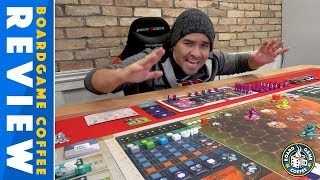
- Deep, brain-melting complexity that feels elegant once learned
- Excellent rulebook and iconography that serve as a translator for players
- Rich theme with meaningful interdependence and shared tech
- Multiple viable strategies and routes to victory
- Satisfying component quality and table presence
- Long play time (roughly 4–5 hours per session)
- Steep learning curve and heavy rules
- Can be exhausting and potentially punishing for casual players
- Interdependent colony-building and shared tech advancement
- Mars colony, in orbit and on the planet's surface
- Complex, mechanistic, and procedural storytelling through systems
Mechanics (from transcript analysis)
- Collaboration and lending — Tech owners can lend benefits; borrowed tech grants free resources or upgrades.
- Expansion and module building — Build out shelters, rocket hangars, rovers, and other facilities to grow the colony.
- Location-based actions (orbit and planet surface) — Actions available at two locations; travel via shuttle governs timing.
- Main vs executive actions — Two-action turns with main actions on the board and executive actions off-board.
- Personnel (scientists) recruitment and usage — Recruit scientists who can use facilities for free, possibly not your own.
- Resource management — Players balance multiple resources to fuel actions, tech, and colony growth.
- Technology development / engine-building — Develop tech that is shared by all players and can be borrowed for benefits.
- Temporal planning / trip timing — Timing shuttle trips and actions to optimize sequences.
- worker placement — Players assign workers to perform actions and gain resources.
Video topics + discussion points
Quotes (from this video)
- On Mars isn't just a mess of mechanics, it's a finely crafted timepiece with little bits of wood and cardboard moving here and there independently but still dependent on each other to function as a whole.
- There isn't just one road to victory, there's lots and different combinations of strategies that are just as viable as the next.
- This isn't a light four-page read; this is 24 pages loaded with information.
- I love all of it and I want more.
References (from this video)

- Complex gameplay
- Interesting action limitation mechanic
- Interactive board elements
- Feels somewhat familiar
- Very complex rules
- Space exploration and colony building
- Mars colony and space station
- Euro game resource management
Mechanics (from transcript analysis)
- Area movement — Players can move between planet and space station with limited actions
- Resource management — Collect and use resources to upgrade technologies
Video topics + discussion points
Quotes (from this video)
- House always wins
- We're pretty much suckers for small, really fun games
References (from this video)
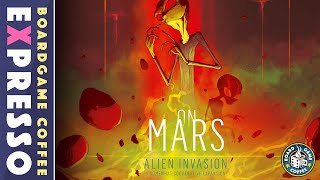
- adds four distinct play modes/chapters that refresh the base game
- maintains core rules, easing entry for existing On Mars players
- asymmetric play between alien and human players heightens tension
- each chapter introduces a clear objective and new components without overwhelming players
- good replayability through varied twists and strategies
- still requires the base game to play
- rulebook can be lengthy due to multiple chapters and interactions
- some chapters may feel similar or optional for short sessions
- component management may increase setup/teach time
- asymmetric conflict between humans and aliens during planetary development
- Mars colonization with competing human factions and an alien threat across multiple thematic chapters
- chapter-based, asymmetric play with a mix of cooperative and competitive elements
- On Mars
Mechanics (from transcript analysis)
- asymmetric roles — alien player has a separate command board with unique actions; humans operate with standard components
- chapter-based gameplay — the expansion is split into four chapters, each adding a twist and new rules to the base game
- cooperative-leaning with competitive tension — humans cooperate to defend Mars while the alien player acts against them; tension arises from opposing goals
- sabotage and disruption — aliens can perform actions to hamper human progress, including sabotaging builds and resources
- tech tree and upgrades — aliens develop their own tech tree to improve sabotage capabilities; humans gain countermeasures like sentry bots and shields
Video topics + discussion points
Quotes (from this video)
- this expansion offers you not one not two but four new ways to play on mars
- each chapter adds a new twist with its own set of rules
- you'll never need all of them all at once
- the rule book will let you know what you need and when
- chapter four monolith ... solo with a configurable difficulty level
References (from this video)

- deep strategic planning
- varied play paths
- steep setup and rules
- heavy experience for new players
- economic and technological development in harsh environment
- space colonization on Mars
- science-fiction economic simulation
- Terraforming Mars
- Power Grid
- Through the Ages
Mechanics (from transcript analysis)
- Resource management / engine-building — Develop infrastructure while managing scarce resources.
- Worker placement / action selection — Choose actions to advance projects and production.
Video topics + discussion points
Quotes (from this video)
- gloomhaven well everybody knows that right
- pandemic season one is a cooperative game
- it's the crew
- code names
- magic maze
- the correct answer is sheriff of Nottingham
- subscribe like and comment on this video
- time stories isn't it but time stories isn't as well so one point for you
- you don't know board games
- Terraforming Mars
References (from this video)

- space
- science_fiction
- colonization
Mechanics (from transcript analysis)
Video topics + discussion points
Quotes (from this video)
- everybody game your abc's start with a and end with z
- arkham horror that's a fright
- b is for battle or there's monsters to fight
- cosmic encounter that's right
- fury of dracula he turns into mist she is gone
- shown clever you'll feel so smart
- hogwarts battle defend against the dark arts
- jabberwocky you can't play it alone
- in that runner they don't make it anymore
- on mars get a galactic high score
- paladins for the kingdom
- quellenberg proportions the best
- space space if you like your sci-fi
- viticulture watch those wine grapes get smashed
- welcome to build a neighborhood
References (from this video)

- Complex gameplay with multiple victory paths
- Innovative scientist sharing mechanic
- Beautiful board layout and presentation
- Outstanding collaboration between designer and artist
- Intellectually satisfying puzzle
- High replayability
- 45-minute teach indicates heavy complexity
- Requires large gaming table
- Demanding mentally (brain burner)
- Economic engine building and resource management
- Mars colonization and development
- Abstract Euro game with thematic framing
Mechanics (from transcript analysis)
- engine building — Complex resource management and action combinations
- Multiple Roads to Victory — Numerous strategies and pathways for scoring victory points
- Scientist Recruitment — Players recruit scientists who work at facilities, creating shared benefits
- worker placement — Scientists placed at various facilities create cascading benefits
Video topics + discussion points
Quotes (from this video)
- if you enjoy deck combat games like like Magic the Gathering or anything like that but you don't want the effort of building your own custom deck each time and you just want to kind of level the playing field try out key Forge
- tapestry is one of the newer games on the list and honestly it made it on the list as soon as I played it
- I love the theme I loved having these giant robots going through this 3d city the table presence is amazing
- it's like reverse settlers of catan because basically you're the spirits of these of the island
- we have yet to lose but it always feels like you're gonna lose it's always one of those like it starts off well we're doing great then all things are going really bad
- the story in this game is just amazing
- anything these two do you tell Ian is just gold
- we're getting into the part of the list where like every game is my favorite
- do not judge a game by its box cover
- I'll play mysterium any time of the day
References (from this video)

- Tightly designed, engaging decisions
- Abstracted theme may not resonate with everyone
- Industrial base-building and colony expansion
- Martian colonization with resource management
- Strategic, euro-inspired
- Terraforming Mars
Mechanics (from transcript analysis)
- worker/role selection and action economy — Players select actions that influence future rounds with variable power.
Video topics + discussion points
Quotes (from this video)
- The hobby has become all about quantity.
- More stuff is always better.
- Bag building is a worse version of deck building.
- House ruling should only happen if a question scenario is not addressed in the rule book or BoardGameGeek.
- Ties in games are fine, especially if they're rare.
- Kickstarter exclusives will kill a game in the long term more than it helps the game in the short term.
- The great thing about board games is we can create new types of auctions that don't work in real life.
- Phase 10 is not as bad as some people make it out to be.
- I would rather air on the side of smaller boxes than bigger ones.
References (from this video)

- ambitious, heavy design with strong theme
- two-half board dynamic creates interesting decisions
- great for experienced players seeking depth
- very heavy; potential barrier for new players
- teaches slowly; game can feel sprawling
- colonization and resource management
- Mars colonization; space station vs. surface base
- intense, crunchy, heavy
- Gaia Project
- Terra Mystica
Mechanics (from transcript analysis)
- dual-board integration (space station and Mars base) — players manage actions and resources across two halves of the board
- resource cycle and escalation — life-cycle of resources across stations and digs
- worker placement with asymmetric effects — three workers with varied strengths influence actions
Video topics + discussion points
Quotes (from this video)
- it's a really intense game
- this is the meanest tree game out there
- it's the best trick-taking game of all time
- the economy in this game is probably one of the most interesting parts
References (from this video)

- immersive theme and dense decision space
- strong engine-building depth
- high rules overhead for newcomers
- long playtime can be punishing
- space exploration, colony management
- Martian colonization and base development
- engine-building with thematic sci-fi context
- Lisboa
- Through the Ages
- Gaia Project
Mechanics (from transcript analysis)
- dice_allocation — dice determine action access and costs, driving tension and planning
- engine_building — building a synergistic set of actions to maximize efficiency over the game
- tile_placement — placing and upgrading base structures on a map to optimize production
Video topics + discussion points
Quotes (from this video)
- Lisboa was about a 4.57 and on mars was 4.64 and through the ages was 4.41 so oh wow
- Viticulture viticulture yeah this is viticulture from the essential edition
- Navigator assured us that the island was indeed as yet uncharted
References (from this video)
- Massive presence on the table and impressive physical footprint
- Deep engine-building with many scoring avenues and emergent gameplay
- Rich interlocking subsystems that reward long-term planning
- Pleasant if powerful thematic flavor of Mars exploration
- Extremely complex with numerous rules, exceptions, and timing considerations
- Not approachable for casual gamers; beginner experience can be overwhelming
- Potential for slowdown due to action timing and technology interactions
- No built-in come-from-behind mechanic; early mistakes can be hard to recover
- space exploration, colony construction, and technological advancement
- A distant future colonization of Mars
- engine-driven, modular, emergent progression
- CO2: Second Chance
- Martians: A Story of Civilization
Mechanics (from transcript analysis)
- Board positioning and scoring tracks — colony track progression affects scoring and end-game condition
- Executive actions and contracts — activate optional abilities via executive actions and recruit scientists/contracts
- Resource management — gather and spend crystals and other resources to build and advance tech
- Rover/Bot movement — move rovers and bots to access locations and build ships
- Ship building and worker storage — build ships to add workers/robots and unlock extra actions
- Tech tiles / tech tree — acquire and advance technology tiles to unlock bonuses and enable constructions
- tile placement — place building tiles on Mars with adjacency and level requirements
- worker placement — activate locations by assigning workers to spaces, with some requiring no workers
Video topics + discussion points
Quotes (from this video)
- on mars is an intricately woven game that combines a lot of subsystems into a larger whole
- the best thing about this game is its presence on the table it's massive
- there are many rules there are many exceptions as well and timing of executive actions and taking into account who has what technology can also grind the game to crawl
- if you're someone who wants a game that they can really dig into, that is complex and reward system mastery you can really look at on mars
- there are a huge number of ways to score points and to build engines and the game follows its own emergent path each play
References (from this video)
- immersive space theme
- deep strategic depth
- heavy rules and long teach
- big footprint on table
- space exploration and resource management
- space colonization / planetary development
- heavy thematic experience with strategic depth
Mechanics (from transcript analysis)
- engine-building — build a production engine across planets
- worker placement — assign workers to colonize and optimize production
Video topics + discussion points
Quotes (from this video)
- There are so many just different things about this game that it's hard to manage all the decisions
- the theme is extremely strong in this one, you can feel it in every action
- the app integration in Mansions of Madness is great and speeds things up
References (from this video)

- Deep engine-building with many interacting systems
- High replayability across player counts
- Tense, competitive two-player play
- Strong thematic integration between mechanics and Mars setting
- Flexible end-game path via blueprints, ships, and missions
- Long play time, especially in two players
- Steep learning curve and heavy rule memory
- Potential for blocking and interaction frustration in tight games
- Mars colonization and self-sustaining habitats
- Far-future Mars colony
- cycle-driven resource production and engine-building on a two-sided board connected by a shuttle
- Lisboa
Mechanics (from transcript analysis)
- Blueprints / tech tiles / upgrades — Blueprints unlock upgrades and executive actions; tech tiles progress and influence scoring and capabilities.
- Resource lifecycle — A linked chain minerals -> batteries -> power -> water -> oxygen -> shelters; progress here enables more colonists and structures.
- Robots and rovers — Bots construct buildings; rovers explore and collect items; discovery and research tiles add new effects.
- Two-sided board with shuttle phase — Orbit and colony sections form a split board; the shuttle moves between sides and time management matters for production and movement.
- Worker placement / action spots — Players place colonists on board actions (orbit and colony) and can boost actions by spending additional workers or crystals.
Video topics + discussion points
Quotes (from this video)
- the two halves of the board and the shuttle phase
- the life cycle of stuff that you have to consider when building buildings
- two-player game highly competitive
- engine building and blueprints expand your menu of actions
- the theme with it is amazing
- this is the engine builder
- the ultimate synergistic engine-building game
References (from this video)

- Stunning cover
- Red and green combination works well
- Glowing red light bulb element
- Space man with blue helmet stands out
- Good text overlay
- Stylish and modern
- Exciting appearance
- Space colonization
- Mars
- Sci-fi
Mechanics (from transcript analysis)
- Strategy — Mars colony game
Video topics + discussion points
Quotes (from this video)
- The box cover makes a promise to the customer
- Every box cover tells me what I'm going to be doing and how I'm going to be feeling
- This artist is one of the best board game artists working in the industry right now
- This is how you do it
- This cover is a mess
- Striking iconic design
- The box cover is not selling the game