Onitama is a two-player, perfect information abstract game with a random starting set-up. On a 5x5 board, both players start with five pawns on their side, with the main pawn in the middle.
Each player has two open cards that each display a possible move for any of her pieces. There is a fifth card that cannot be used by either player. On a player's turn, she chooses one of her cards, moves one of her pieces according to the chosen card, then replaces the card she used with the fifth card. The other player then chooses one of his cards, moves accordingly, and exchanges that card with this fifth card — which is, of course, the card the first player just used.
Moving onto one of the opponent's pawns removes that pawn from the game. Taking the opponent's main pawn, or moving your main pawn into your opponent's main pawn's starting space, wins you the game.

- Different every time you play
- Easy to learn
- Quick gameplay
- Balanced player experience
- Martial arts combat
- Abstract strategy
- Chess-like
- Chess
Mechanics (from transcript analysis)
- Area Control — Capturing opponent's king
- Card-driven movement — Moving pieces using specific movement cards
Video topics + discussion points
Quotes (from this video)
- These games, I feel so close to them that I would invite them to my wedding.
- Deep down, you know, one or two of them you'll never see again.
References (from this video)

- Elegant abstraction that feels chess-like but more approachable
- Short, tense, highly replayable with rotating movement cards
- Excellent two-player experience
- Less accessible to players who dislike abstract strategy
- Limited player count (two players)
- master-student duel with movement cards
- Abstract martial arts-inspired battlefield
- elegant, chess-like but streamlined
Mechanics (from transcript analysis)
- Card-driven movement — Each card defines a unique set of moves; players exchange cards each turn.
- duel-focused abstract strategy — Two-player, king-like goal with tension similar to chess but simpler.
- turn-based tension with limited cards — Movement options rotate; players must anticipate opponent's card and respond.
Video topics + discussion points
Quotes (from this video)
- it's such a great dynamic in its information-driven setup; you are buying low and selling high and that extra insider trading twist means that you're always watching the other players
- this is one of my favorite party games
- there's backstabbing and it can be quite mean but I think as long as you go into it knowing that because it fits the theme I think people just really get caught up into it and enjoy it
- Onitama is my favorite two-player abstract game
- The Mind is one of the most fun I've had with some of my close friends; it really brings you together as a group
References (from this video)

- elegant, accessible two-player abstract
- tight playtime with deep strategic depth
- thematic connection may be weaker for some players
- abstract nature may deter some
- pure abstract strategy with moving and capturing
- Japanese-inspired martial arts duel
- sparse, elegant design; minimalistic theme
- Patchwork
- Arboretum
Mechanics (from transcript analysis)
- action card movement — Each turn you select a move from a shared pool of cards to maneuver your master or student.
Video topics + discussion points
Quotes (from this video)
- it's a lovely slice of bluff and Double Bluff
- the presidency can switch hand many times as players try to get the best deal for themselves
- how much corruption can you get away with
- it's very easy to get into it, plays in about 30 minutes and yet has an incredible depth of strategy
- Pantheon is a solid expansion; it adds a few extra elements without overcomplicating things
- the gods are powerful, copying symbols or boosting science can create big moments
- Checkpoint Charlie works well for what it is a simple speed deduction game
- there's so much going on in this game that it's very hard to pull off thought out moves
References (from this video)

- short, approachable, and teachable
- every game feels different due to card variety
- beautiful production and table appeal
- box is a bit larger than ideal for travel
- some players may wish for a travel-focused edition
- martial arts, dojo confrontation
- Japanese themed martial arts duel
- abstract strategy with elegant balance
- Chess
Mechanics (from transcript analysis)
- Card exchange and asymmetry — Using a card transfers its move to the opponent, creating tension and counterplay possibilities.
- Card-driven movement — Each card defines a unique move for a selected piece; once used, the card passes to the opponent.
- Objective-based win condition — Defeat the opponent's king or move to their home space to win.
Video topics + discussion points
Quotes (from this video)
- chess is like marriage it lasts forever you're always waiting for the other person to make a mistake and you get upset when she takes your porn
- Onitama is like chess it's a lot more fun it's over quicker and every time you try it it's a bit different
- The challenge is in reading your opponent trying to work out where they've hidden the winning card or what traps they've set for you
- 13 days captures its theme but it also transcends it
- this game completely delivers Twilight Struggle
- this would still be brilliant if it was themeless and that's what makes it a great couple's game
References (from this video)
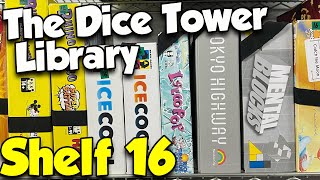
- Fantastic abstract strategy game
- Top favorite on second row
Mechanics (from transcript analysis)
Video topics + discussion points
Quotes (from this video)
- Shelf 16 is kind of a an odd mix here
- This shelf has twice as many games as most shelves
- one of my favorite two-player games, but it's very difficult to learn and play
- Fantastic abstract strategy game
- Such a classic game and I like it a lot
- I don't know why I like it so much, but I do
- one of the most beautiful dexterity/party games there are
- There are so many games on the shelf
References (from this video)
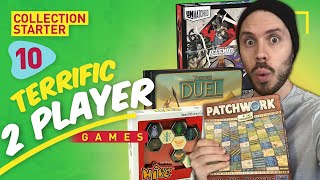
- sharp, elegant core idea; two-player abstraction with rich feel
- theme can feel abstract to some players
- discipline, movement, and strategy
- Ancient martial arts dojo
- punchy, quick duels
- Chess
Mechanics (from transcript analysis)
- Card-driven movement — each card dictates a unique move for any piece
- fog of knowledge — cards shift and replacement creates a shifting board state
- short game length — fast rounds emphasize deep calculation
Video topics + discussion points
Quotes (from this video)
- board gaming remains the best thing in a bad world
- this is a collection starter and this time we're looking at ten terrific two player games
- it's watertight... you feel like you're scraping your elbows on the sides of the game
- it's a wonderful little gem from Tim Fowlers and Ace Artist Ryan Goldsbury who channels that particular 50s and 60s era art...
References (from this video)
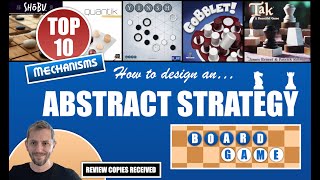
- hybrid feel with drafting
- replayable and accessible
- card swapping can be confusing at first
- Quarto
- Gipf
Mechanics (from transcript analysis)
- card-driven moves — each move is dictated by cards; rotating cards creates asymmetry
Video topics + discussion points
Quotes (from this video)
- these games have no theme
- it's a toolbox for you as a game designer which of these mechanisms do you want to employ in your own abstract strategy game
- product design is everything
- the single most impactful feature of connect 4 was that little hatch beneath the frame
- abstract strategy games are some of the most interactive games in existence