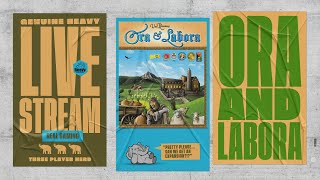
In Ora et Labora (Latin for 'Pray and work'), each player is head of a monastery in the Medieval era who acquires land and constructs buildings – little enterprises that will gain resources and profit. The goal is to build a working infrastructure and manufacture prestigious items – such as books, ceramics, ornaments, and relics – to gain the most victory points at the end of the game.
Ora et Labora, Uwe Rosenberg's fifth "big" game, has game play mechanisms similar to his Le Havre, such as two-sided resource tiles that can be upgraded from a basic item to something more useful. Instead of adding resources to the board turn by turn as in Agricola and Le Havre, Ora et Labora uses a numbered rondel to show how many of each resource is available at any time. At the beginning of each round, players turn the rondel by one segment, adjusting the counts of all resources at the same time.
Each player has a personal game board. New buildings enter the game from time to time, and players can construct them on their game boards with the building materials they gather, with some terrain restrictions on what can be built where. Some spaces start with trees or moors on them, as in Agricola: Farmers of the Moor, so they hinder development until a player clears the land, but they provide resources when they are removed. Clever building on your personal game board will impact your final score, and players can buy additional terrain during the game, if needed.
Players also have three workers who can enter buildings to take the action associated with that location. Workers must stay in place until you've placed all three. You can enter your own buildings with these workers, but to enter and use another player's buildings, you must pay that player an entry fee so that he'll move one of his workers into that building to do the work for you.
Ora et Labora features two variants: France and Ireland.

- engaging tile interactions and dynamic board states
- overbuilding rules add depth
- can be heavy and complex; presenter mentions learning curve
- building and farming with tile placement
- Medieval monastery resource management
- multi-layer engine with workflow
- Agricola
- Caverna
- Gaia Project
Mechanics (from transcript analysis)
- tile placement / worker placement — fields and buildings; grid-like board with revolt/war mechanics via colors.
Video topics + discussion points
Quotes (from this video)
- There is a lot of tension around the table with arcs; the tension is utmost.
- This is one of the more polarizing games, but I enjoyed it.
- Mechs versus Minions is pure fun; you are manipulating this mech by running your command line.
- Race for the Galaxy which for both of us is our most played game from a physical play standpoint.
References (from this video)
- dense strategic depth with a clear, disciplined tempo
- strong thematic cohesion around monastic economy and spatial puzzle
- high replay value via identical card decks (Irish vs French variants) and abundant build options
- greatly enjoyed by players who appreciate Rosenberg’s systems and careful planning
- rulebook described as terrible; the game can feel intimidating to newcomers
- heavy and long sessions require substantial time and space
- cluttered decision space can be overwhelming; missteps are easy and costly
- monastic production, resource conversion, spatial planning
- Medieval monastery economy and settlement building
- sandbox economic strategy with spatial adjacency scoring
- Agricola
- Black Forest
- Glass Road
- Gricola
Mechanics (from transcript analysis)
- coins as actions blockers/relays — coins can force another player to take an action, or be spent to unlock options
- land planning and terrain — buildings must respect hillside, coastal, and orthogonal adjacency constraints
- production wheel — resources rotate and produce according to wheel position; placement round ends trigger settlement phase
- Resource conversion — goods can be converted (e.g., grain to straw, meat from sheep, whiskey from malts) to meet needs
- set collection / scoring adjacency — settlements and adjacent buildings score based on red numbers and surrounding tiles
- tableau building and extensions — each player develops a personal board with buildable structures and optional extensions
- worker placement — clergyman workers are sent to buildings to activate effects, gather resources, or convert goods
Video topics + discussion points
Quotes (from this video)
- We desperately want expansions that are never going to happen, but maybe maybe it'll happen.
- This is Rosenberg's Magnum opus.
- This game is a phenomenal puzzle with a sandbox of options.
References (from this video)

- designed by excellent designer
- farming and trading theme
- rich resource management
- classic resource types (wood, corn, stone, sheep)
- very complex and convoluted
- possibly dated
- difficult to find in print
- high complexity barrier
- farming
- trading
- resource management
- religious medieval setting
- Glass Road
- Agricola
- Le Havre
Mechanics (from transcript analysis)
Video topics + discussion points
Quotes (from this video)
- you're listening to the broken meeple show a podcast that speaks passionately about board games
- i'm trying to keep this episode a little bit shorter
- i'm the sort of person who likes to play the sport not watch it
- i started my new job what two weeks ago now and it's going well
- all i hear about tsu is that if you play with anybody who knows how to play the game they're going to hate your guts afterwards
- ryan lockett what are you on so what are you seriously on
- this guy does not sleep this guy does not age
- this is just way too much stuff for one single person to undertake it's crazy
- i don't want to have to care anymore about sleep or aging
- convert me into a machine and i'll join the robot uprising
- it's only a game
- i am mainly just a case of i'll wait and see
- the amount of buzz that game has got has to put it at the top ten
- so many games so little time well who'd be a content creator with a job anyway
References (from this video)

- deep, thematic Rosenberg experience
- strong solo or 2-player play
- heavier for casual gamers
- resource management and construction
- medieval monastery
- historical farming/monastic economy
- Agricola
- At the Gates of Loyang
Mechanics (from transcript analysis)
- resource-management — balance food, wood, stone to build and expand
- worker-placement — send monks to gather resources and perform tasks
Video topics + discussion points
Quotes (from this video)
- I love the game Patchwork, a brilliant tile-laying game
- if Cottage Garden becomes something like that, then that's fantastic news for all of us
- the main Crux of the game is serving customers
- I love the artwork, it's a totally new style again
- Rattus is coming back after a while, out of print with all the expansions and a new expansion
- this big tin here I've been looking forward to this one for a long time because Sushi Go is just a magnificent game
- Skull King, a trick-taking dice game
- adults version of Code Names Not Safe for Work
- Evolution Junior, it's called Evolution the Beginning is only going to be available at Target for its first year