Come one, come all to the Silo System, the beating heart of our galaxy, for the race of the decade! We've recruited the best tourists in all the cosmos: travel-hardened explorers who will compete in the ultimate contest. These pilots must race to visit all the planets in the Silo System, surfing upon orbital paths, teleporting between hyper jump portals, and beaming through hyperspace. Enjoy your dream vacation on one of our luxurious planets or lavish space stations as you witness the ultimate interstellar marathon. All the eyes of the galaxy will be watching this decennial event celebrating the unification of our systems under Silo Supremacy.
ORBIT (Orbital Race Between Interstellar Tourists) is a 24th century tactical space race with simple turns, yet challenging possibilities. Players compete to visit all planets of the system, then return to their starting planet first.
On your turn, you play a card, activate its actions in any order, then draw back up to your hand size. Cards allow you to do a combination of things: move your ship, collect energy for bonus movement, advance planets along their orbit, or even reverse the orbital direction of a planet.
When your space ship is docked on a planet, the moving planet will carry you along its orbital path, helping you to traverse the map even faster. Planning your route wisely as you ride orbital currents and bounce between planets is the key to success — but your cutthroat competition will no doubt seek to spoil your plans and sabotage your tourism progress. It helps to be flexible and adapt on the fly, literally.
You shouldn't ignore the opportunity to upgrade your ship along the way. Visiting certain space stations and planets allows you to increase your hand size and energy storage capacity, so you must balance short-term efficiency against long-term advantages. The game board features additional tactical resources such as fuel depots, hyper jump portals, and hyper acceleration cannons.
Players can enjoy a randomized set-up across two unique game boards. The game also includes a few variants: a solo mode, four-player partnership mode, and a stationary planet.
ORBIT is the third and concluding game in the Cosmic Silos Trilogy by Reiner Knizia, and with the Nebular Expansion, you can add three modules to the game: navigation tokens, hyper accelerator engines, and artificial nebulas.
—description from the publisher

- clever use of cards to determine orbital dynamics
- engaging opportunities to interact and influence others
- compact yet crunchy engine-building feel
- may require careful teaching for players new to card-driven movement
- occasional analysis paralysis in planning long-term routes
- orbital mechanics and planetoid travel
- space around a solar system with moving planets
- clever, card-driven choreography of planetary movement
- Cosmic Encounter (team dynamics)
- Race for the Galaxy (hand-management card play)
Mechanics (from transcript analysis)
- Card-driven movement — the cards you hold determine which planets orbit and how you travel, impacting choices and interactions.
- hand management — you manage a hand of cards to influence orbit choices and movement opportunities.
- interaction-rich engine choices — you can affect other players’ plans as you seek efficient routes and better positions.
Video topics + discussion points
Quotes (from this video)
- the map has all these different ways, and where they're located is very deduction-based
- this is a nice marriage of the two—cooperative play and deduction
- I love the pieces on this
- it's a good heavy euro where you have action bidding; you don't just place out a worker
- the interaction of the player spaces and the gears that you put out that allow you to basically pick from adjacent action spaces
- everything in this game is so logical and cohesive
References (from this video)
- insanely chaotic and fun
- great party game energy
- not for everyone; can be chaotic to the point of randomness
- chaotic space race with unpredictable chaos
- space race chaos and chaos-driven chaos
- light, fast-paced, chaotic
- RAW
- Llama Party
Mechanics (from transcript analysis)
- player-interaction chaos — highly interactive, chaotic simultaneous actions that create chaos at the table
Video topics + discussion points
Quotes (from this video)
- This game is extra which is a very hard to find game.
- Chaos. I love it.
- Die Hard is a Christmas movie.
- The equals thing... you complete three in a row and you get a free check off.
References (from this video)

- Clear, accessible core with tense decisions
- Replayable due to variations and planet movement
- Some players may find it abstract compared to heavier euros
- Hyperspace exploration with moving planets
- Space race to visit planets
- lighthearted space adventure
- Bejeweled-style engine games
- Other abstract racers
Mechanics (from transcript analysis)
- abstract strategy race — planning routes to visit planets as they move
- varying tile/planet interactions — each planet offers different opportunities and challenges
Video topics + discussion points
Quotes (from this video)
- card dancing. It's a thing that I didn't understand and then I saw it happen and now it makes sense to me.
- An odd little game where a bird lays gems and gold.
- pirates and their inability to share properly.
- All hail the mind bug.
- I am such a fan of Tableau engine building games.
- How can you make a great gateway game and make it better? Add golems.
- Ah gosh, I want this. This is I I want this game because you start off with a yellow die and it's just who scores you score the face.
References (from this video)

- brain-busting puzzle
- innovative movement mechanics
- heavy to learn for new players
- orbital movement, resource gathering
- space / orbital mechanics
- brain-bending, puzzle-like
Mechanics (from transcript analysis)
- area control / movement mechanics — manipulate orbiting pieces and move resources around the board
- engine-building — build sequences that influence future actions
Video topics + discussion points
Quotes (from this video)
- I'm all for getting rid of board game boxes when needed.
- The more this has happened, the more I think I should do it to all my games.
- I feel like an assassin. The first one's hard, but then it gets easier.
- Keyside is it's the heaviest installment in this series. I think it's a masterpiece.
- Ticket to Ride is one of my all-time favorites.
References (from this video)
- breaks your brain in a good way
- innovative movement system
- complex rules may deter some players
- motion and orbit influence on scoring
- orbital mechanics / space
- brain-bending puzzle
Mechanics (from transcript analysis)
- engine-building — build a personal engine from card interactions
- movement / area influence — move and rotate components to change accessible actions
Video topics + discussion points
Quotes (from this video)
- I'm all for getting rid of board game boxes when needed.
- The more this has happened, the more I think I should do it to all my games.
- I feel like an assassin. The first one's hard, but then it gets easier.
- Keyside is it's the heaviest installment in this series. I think it's a masterpiece.
- Ticket to Ride is one of my all-time favorites.
References (from this video)

- Elegant, compact design with high interaction
- Strong two-player head-to-head feel
- Allows multiple decks and strategies for variety
- Can be punishing for new players
- Requires careful tracking of many moving parts
- Abstract space race with planetary movement
- Space exploration and planetary interaction
- Strategic, competition-driven
Mechanics (from transcript analysis)
- area control / route shaping — Players influence routes and positions to optimize scoring on various tracks.
- card-based movement — Cards drive movement and placement of planets; interactions shift scoring potential.
- dynamic interaction — Planet movement by all players creates shifting goals and opportunities.
Video topics + discussion points
Quotes (from this video)
- This is a roll and right or flipping right game.
- Energy bars let you duplicate actions.
- It's Christmas. This is Christmas.
- Chop chop till you drop.
- Undersea theme. Isn't it just calming?
- Orbit is a new Riner Knizia game.
- Azul Duel is a really engaging version of Azul.
- Tag Team is almost like an auto battler, but you program the order.
References (from this video)
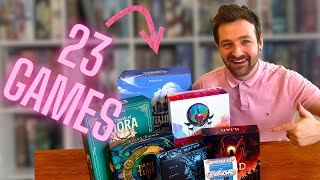
- very fast, smooth play
- clever card-driven movement
- player interaction can be tough to manage if misplayed
- exploration with route planning
- space racing and planetary travel
- dynamic, competitive, fast-paced
Mechanics (from transcript analysis)
- racing/route progression — players race to visit planets and return, moving via cards with special abilities.
Video topics + discussion points
Quotes (from this video)
- Starting off with the two-player game, Agent Avenue.
- It's a boatload of fun and it's another game which I've just brought out and it just never misses.
- This is another two-player abstract game that I can't stop playing and that's Zenith.
- Rival Cities takes Tug of War to another level.
- The production on Shackleton Base is through the roof.
- Ponzi scheme is one of the most stressful games you'll ever play and it's brilliant.
References (from this video)

- Clever, tight pacing in a space-themed package
- Strong three-game trilogy with distinct flavors
- Can be intimidating at first glance
- Plotting efficient routes through a grid of planets
- Space travel with planetary stops
- Silos
- Silos (Quanchoria)
- Orbit (part of trilogy)
Mechanics (from transcript analysis)
- Auction-style resource/card acquisition — Tradeoffs around when to acquire resources and cards for future moves
- Routing / timing — Move planets and your ship to stop at key locations; timing and card play affect movement
Video topics + discussion points
Quotes (from this video)
- "It's so simple, but it's really clever."
- "This is a two-player head-to-head card combat game."
- "We are the aliens."
- "Bot or Not has me laughing a lot more."
- "Gen Con party game of the show, Bot or Not, unanimous."
- "Flip Tunes is my Gen Con game of the year."