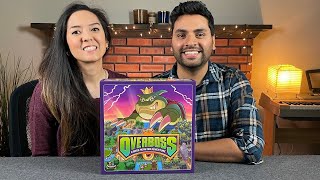
In Overboss, rival Boss Monsters emerge from their dungeons to conquer the Overworld. Each turn, players draft and place terrain tiles and monster tokens. Their goal: to craft the map with the greatest Power and become the ultimate Overboss!
Designed by Aaron Mesburne and Kevin Russ (Calico), this fast-paced game combines drafting, set collection, and puzzly tile laying. It's set in the retro-inspired pixel art world of Brotherwise Games' best-selling Boss Monster, but this is an entirely new experience.
Build your map by drafting Forests, Swamps, Caves, Camps, Graveyards, Dungeon Entrances and other landscapes. Each terrain type has a different point value, and some increase in Power as you acquire larger sets. Players must balance optimal placement, set values, and disrupt their opponents' sets. You'll also need to manage monsters, which award points when grouped together or placed on matching terrain.
The game includes everything needed for up to 5 players: over 120 terrain tiles, over 100 monster tokens, 5 double-sided player boards, a scorepad, and more.
—description from the publisher (updated for added content)
- thematic and engaging dungeon/overworld feel
- variety in scoring and layout decisions
- accessible entry point for tile-drafting fans
- component-heavy
- rule complexity may be daunting for casual players
- Monster bosscrafting and dungeon-building
- Fantasy dungeon and overworld
- Cartoonish, arcade-inspired fantasy
Mechanics (from transcript analysis)
- Portal tokens as one-time actions — Portals move monsters and allow strategic repositioning.
- Scoring by terrain and monster formations — Scores are computed from terrain types, monster alignments, and bands.
- tile drafting and placement — Players draft and place terrain tiles and monster tokens to craft a map.
Video topics + discussion points
Quotes (from this video)
- In times of stress the best thing we can do for each other is to listen with our ears and our hearts and to be assured that our questions are just as important as our answers
- The board game space is supposed to be a safe space
- we remove that cognitive bias
- the table is a great way where we can all be on equal footing
References (from this video)
- Very quick to learn and quick to play, enabling short sessions with strong engagement.
- High variability due to the combination of terrain types, tokens, and boss card abilities, encouraging different strategies each game.
- Advanced boss variant adds meaningful depth and personalization to the scoring dynamics.
- End-game scoring can be complex and intimidating for new players, especially with multiple terrain types and token interactions.
- Some terrain types (such as deserts and cloud islands) interact in ways that can create difficult timing decisions and potential score swings.
- boss-driven world-building and territorial scoring, with a retro-pixel aesthetic and modular terrain variations.
- A fantasy overworld where rival bosses draft terrain tiles to create the most valuable world, featuring boss monsters and mini-boss encounters.
- competitive strategy with boss-card driven incentives and end-game objectives.
- Boss Monster
- Calico
Mechanics (from transcript analysis)
- boss cards (advanced variant) — each player holds two Boss cards, secretly selects one, and reveals it later to gain a one-time benefit and to pursue a personal end-game scoring objective.
- dungeons — dungeons are guaranteed on every game and cannot have tokens placed on top; they send tokens to the lair and affect end-game scoring via adjacent terrain types.
- end-game scoring via terrain types and tokens — scoring relies on a mixture of terrain-based rules (forests, caves, deserts, cloud islands, volcanoes) and token-based patterns (monsters, mini-bosses, crystals, bands, lair interactions).
- portals — portals allow you to swap the position of two tokens on your board, enabling strategic realignment to maximize bands and scoring opportunities.
- tile drafting — players draft a pair consisting of a terrain tile and a token from a shared market, selecting from four available pairs each turn.
- tile placement and terrain scoring — drafted tiles are placed on a personal overworld board; terrain tiles score based on their type and surrounding features at the end of the game.
- token placement and adjacency rules — after placing a tile, the drafted token must be placed on any open terrain tile on the player’s board, with a few special exceptions (notably dungeons).
Video topics + discussion points
Quotes (from this video)
- this is a game that is very quick to learn
- very quick to play as well
- timing is everything for these volcanoes
- an advanced variant adds a lot more fun to the game
- we did mention earlier that we're going to be playing with these overboss cards it is an advanced variant but we think that it adds a lot more fun to the game
References (from this video)
- Art and theme are strong
- Replayable with varied boss layouts
- Kinda depends on group for pacing
- Kyle placement-style games may not hit for everyone
- Fantasy boss battles
- Boss monster vs heroes in dungeon-like encounters
- Campaign-ish, story-driven
- Skull King
Mechanics (from transcript analysis)
- Card placement and trap effects — Strategic card layout to influence outcomes and damage.
- Trick-taking / boss encounter twists — Competitive trick-taking elements with boss-focused play.
Video topics + discussion points
Quotes (from this video)
- my number 50 favorite game of all time is parks
- the production of this game is incredible
- it's a very fun take on you know worker placement
- I love this game it is beautiful and it is fun
- the artwork is beautiful
- Nightfall would boost that up higher
- this is kind of like an expanded version of fantasy realms with the theme of red rising
- the episode repeatedly emphasizes that these are personal favorites, not objective best games
- I would love to table this and maybe look into some of the expansions