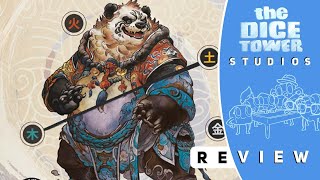
In Panda Spin, each player attempts to be the first to rid their hand of cards, collecting bamboo in the process to keep their pandas well fed.
In more detail, Panda Spin is a climbing game played with a special deck of "double-headed" cards. All cards start with the orange animals toward the top. Each player receives a hand of twelve cards, with the remaining cards placed in a deck.
During the game, players lay down cards to tricks as singles, in sets, in runs, or in formations (two consecutive pairs, two consecutive triples, etc.) If you're the first player in a trick, lead what you wish other than a bomb, that is, four or more cards of the same value. In turn, players must play a higher matching set of cards, e.g. a higher three-of-a-kind on a three-of-a-kind, or pass, after which they can no longer play in a trick. (A bomb cannot be lead, but can be played on any card combination.)
When you pass, if you've played cards and all of those cards have orange animals at the top, flip the cards so that the blue animals are at top. Each time you flip a card, you change its value depending on its suit: e.g., the water 4 becomes a pair of Qs, the wood 6 becomes a A+bamboo (and each time you play a card with bamboo, you take a bamboo token from the reserve), the earth 8 becomes a Q+panda (with you stealing a bamboo from an opponent for each panda you play), the fire 3 becomes a 10+fire, with the fire being a value of your choice when played.
If you pass and the cards you've played have at least one blue animal, you discard all of those played cards. The winner of the trick always discards all of their played cards, then they lead to the next trick. When you play an element card — Water, for example, beats any bid with3+ values — you immediately win the trick, and draw two cards from the deck.
When a player runs out of cards — that is, they "show out" — they score bamboo equal to how many cards are held by the player with the largest hand. When all but one player have shown out, the round ends, then you shuffle all the cards (including the winds) and deal everyone a new hand. The game ends, when, at the end of a round,a player has amassed 15 or more points. The player with the most bambbo points wins the game.
- Clear progression as cards become more powerful
- Dual-sided cards add depth without complex rules
- Requires careful tracking of card states
- Progression through spin-side of cards and dual-use faces
- Card shedding with card rotation mechanics
- Light, family-weight strategy
Mechanics (from transcript analysis)
- Card spinning / dual-face cards — Cards can be spun to reveal more powerful sides, effectively giving two cards in one.
Video topics + discussion points
Quotes (from this video)
- Actions always succeed in Vantage; the challenge is how much time, morale, and health you lose along the way.
- the limited information of I can see something that you can't see and how that encourages communication and cooperation.
- one player is playing a card and that card has instructions that the other player must follow or you lose.
- if you roll seven bells on your turn, you just instantly win.
References (from this video)

- unique spin mechanic
- depth via deck construction
- multiple play formats
- gimmick perception may deter some players
- spinning duel card game
- fantasy-themed duel
- declarative, table-focused
- Magic: The Gathering (via reference to spinning and deck depth)
Mechanics (from transcript analysis)
- Deck construction — build a 20-card deck with three formats
- spinners as input — face spinners replace dice in combat
Video topics + discussion points
Quotes (from this video)
- It's one of my favorite games of all time. It's one of the games that really got me into the hobby.
- Don't become a ghost. Every time you lose a round, you get a ghost card with a game-changing ability.
- Epic tin box dungeon crawling in a tin. Full adventure, zero bulk.
- I love spinning.
- Grassfed is a cozy deck building game for one to four players.
- Words are your weapons. Having that huge vocabulary will finally pay off and keep you alive.
References (from this video)
- Engaging core mechanism
- Fun to learn from Dice Tower West experience
- Rule depth may vary with player count
- pandas and card manipulation
- A playful panda-themed card shedding game
- cheerful and energetic
Mechanics (from transcript analysis)
- card shedding — Players shed cards to reduce hand size and manage power-ups.
- Hand evolution / upgrade — Discarded cards can be spent to upgrade to more powerful options.
Video topics + discussion points
Quotes (from this video)
- It's a stocking stuffer, to go under the tree, whatever it might be.
- The box will fit into a stocking.
- Wine Seller is the number one card game for Christmas.
- It's a really fun mechanism.
References (from this video)
- Exceptional production quality; foil cards and artwork look fantastic
- Unique upgrade/flip mechanic adds depth and strategic tension
- Chaotic but enjoyable interaction with the rotating panda powers
- Strong replayability due to power variations and different panda outcomes
- Pleasant aesthetic and approachable base rules despite added complexities
- Rules can be easy to forget, especially the details of elemental powers
- Many small symbols and powers require reference cards; novices may struggle
- Element cards can feel like rule bloat and complicate teaching for new players
- Some players may feel the learning curve and randomness overpower strategy in the short term
- pandas, bamboo, and a playful, chaotic racing to discard cards
- Panda-themed card shedding game with a rotating/flip mechanic and panda powers
- light, humorous, frenetic
- Big Two
- Ruins
- Custom Heroes
Mechanics (from transcript analysis)
- bombs (four of a kind) — Four-of-a-kind can beat a non-bomb play; bombs form a powerful play to reset the flow.
- card shedding — Players try to play cards that match or beat the previously played set; strategy revolves around upgrading and manipulating the set with white/blue card sides.
- element powers on cards — Special powers on certain cards (water, bamboo, panda, fire) modify play and scoring in various ways; some are wild or transformative.
- End condition — The round ends when a player discards all cards; the game continues until a player reaches the target 15 points.
- flip/upgrade system — Cards start white and can be flipped to blue (upgraded) where they gain different powers and capabilities.
- panda powers and rotation — Panda-related actions can rotate cards, steal or discard, and otherwise affect players’ hands depending on which panda is active.
- scoring with bamboo tokens — Players begin with bamboo tokens as points; upgrading or discarding affects the point economy and end-game trigger at 15 points.
Video topics + discussion points
Quotes (from this video)
- this is a game that calls itself a trick taker, but it's actually a card shedding game.
- Your cards come one way, but you can spin them to the other side where they are better.
- I like the chaos a lot. I mean, it's fun chaos.
- I'm giving it an eight out of 10.
- The production is fantastic.
References (from this video)

- great busy-group filler; in-person shines
- easy to teach; quick to play
- some may want more depth
- pandas and diplomacy among panda tribes
- panda-themed card shedding ladder
- light, family-friendly
- Scout
- King of Tokyo (lightness)
Mechanics (from transcript analysis)
- ladder climbing / shedding — play to lower the card value and shed cards; suits matter
Video topics + discussion points
Quotes (from this video)
- Don't tell me theme doesn't matter. Yes, it does.
- This is one of those games where drafting out different teams could be really cool.
- It's a banger.
References (from this video)

- vibrant table presence and strong thematic energy
- deep tactical decisions with big swing potential
- evolution of trick-taking concepts in a non-traditional form
- rule book not great
- terminology like 'tricks' can confuse purists
- pandas, martial arts, trick-taking-esque play
- Panda-themed arena
- card-shedding with dramatic swings
- Scout
- Tichu
- Teach
Mechanics (from transcript analysis)
- card shedding — players shed their hand by playing out cards to beat the previous hand, with upgrades and reversals available
- hand management — careful choice of when to upgrade or discard cards to control the flow of hands
- suits-based power-ups — thematic variants where suits grant different bonuses and play effects
Video topics + discussion points
Quotes (from this video)
- "This is my first Gen Con as an owner and it was really cool."
- "The table presence is exceptional."
- "Two-player games shine."
- "it's kind of a role playing game with words."
- "the hype is just incredible for Flamecraft Duel"
References (from this video)

- Great card shedding game
- Lots of powers and options
- Love the idea of upgrading cards
- Beautiful artwork
- Lot to crunch on with many unique mechanics
- Perhaps just a few too many powers
- Card game
- Abstract card game
Mechanics (from transcript analysis)
- card shedding — Card shedding game mechanics
- Card upgrading — Cards can be upgraded when flipped, like a single six becoming a pair of queens
- Hand order matters — The order of cards in your hand matters for gameplay
Video topics + discussion points
Quotes (from this video)
- The real Chris time is the friends we made along the way
- If you've played a lot of Arnak and you want to spice it up a little bit, this is a really good one
- This is just a fantastic version of this game
- It's a great formula. It's not a good execution
- It does almost nothing wrong, but it just doesn't do enough right
- This is such an outstanding card game
- One of my favorite dungeon crawls, period
- Star Wars is one of my favorite games