Police Precinct is a cooperative/semi-cooperative game where players are tasked with solving a mysterious murder while simultaneously working to keep crime on the streets under control, and to keep the city from falling into chaos.
Players take on the role of police officers with different areas of expertise. The players work together to solve the mystery by collecting evidence and eventually arresting the suspect.
Complicating matters (optionally) is that there may or may not be a corrupt officer that is being paid off by the murderer to suppress evidence, the same evidence everyone else is trying to uncover.
Players move around the city searching through randomly shuffled investigation cards for evidence in relation to the murder. The number of investigation cards drawn depends on the character’s rating as well as how many player cards are added by other players to boost the character’s rating for the current “search”. There are four decks of investigation cards (Interview Witness, Collect Crime Scene Evidence, Examine Body and Locate Murder Weapon) to be searched. These decks are shuffled and placed in different locations. So, a player might search the cards in one area and not find any evidence at all… or maybe the bribed cop, if there is one, did the searching and just said no evidence was found.
Players have to find all of the evidence cards from the investigation decks to be able to arrest the murderer.
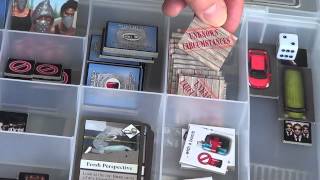
At the end of each player’s turn they draw an event card. These cards represent growing crime and emergencies that are happening in the city. Each one piles on top of the other, and if the cops don't stay on top of things, they will be buried in crime! These Event cards are placed on the game board at the locations where they occur. Some of them have “unknown circumstance” tokens placed face-down upon them, adding even more tension.
If too many criminals are located in one area, a gang is formed. Each gang has its own power and can cripple the police efforts if not handled quickly and carefully.
So, not only are the players investigating the murder, but they must also arrest street criminals and handle emergencies.
Sometimes when a character successfully completes a task, that character is rewarded with a doughnut token. These tokens can later be used to help with tasks. However, if the character does not complete the task in time, the city crime track advances. The track can also advance if street crimes grow so large that no more street criminals can be placed, when called for. If the Crime Track advances to the end, the murderer escapes justice and the good cops fail the game.
To add to the tension even further, The good cops only have so many days to complete the investigation. If time runs out, once again the murderer shall escape justice!
The pressure is great and the stakes are high!
- Varied event cards and upgrades provide dynamic play
- Replayability via parameter-based difficulty
- Satisfying victory condition when all evidence is collected
- Rules can be complex and require learning
- AI/murderer mechanic can be confusing for new players
- Police procedural, crime investigation
- Urban police precinct; crime scene investigation
- Cooperative, case-driven, narrative progression through events
Mechanics (from transcript analysis)
- Card-driven action selection — Players draft and play cards to perform actions like upgrades, investigations, moving units, and calling in support.
- cooperative team play — Players coordinate to arrest criminals, manage incidents, and respond to events.
- Investigation and evidence collection — Collect six pieces of evidence to solve the case; includes various card draws and resource management.
- Resource management — Doughnuts, supplies, and tokens are spent to upgrade abilities and perform actions.
- Time pressure / murderer’s progression — A murderer moves with hood turns; you must complete board and evidence before a deadline (turn 16 in the narrated scenario).
Video topics + discussion points
Quotes (from this video)
- massive investigation
- you immediately win the game
- the murderer counts as an extra street punk
- you can't take the murderer down until you've cleared all the street punks
- you need to make sure that this board is complete before you can arrest the murderer
- once you've got the rules down and you're playing and winning on this easy level you can vary parameters make the game a little bit harder
- great job guys great job
References (from this video)

- Open-world, free-roaming feel that gives players a sense of autonomy
- Donut economy adds strategic depth and a tangible reward loop
- Dynamic mix of perception, planning, and action with variable objectives
- Early onboarding can feel opaque; players may struggle to identify initial priorities
- Rule complexity around emergencies, urgency tokens, and vehicle movement can be daunting
- Cooperative police procedural with emphasis on investigation, emergency response, and street-level crime control
- Urban city at large, with districts like West Side, Common Ville Hotel, Luna Avenue; focus on crime scenes, morgue, and police infrastructure
- Open-ended, emergent play with freeform movement and player-driven objectives
Mechanics (from transcript analysis)
- Arrest and street-punk clearance — Arrests require dice checks, with success determined by meeting or exceeding the number of street punks present.
- Crew/vehicle management and movement — Players move patrol officers and vehicles across a city map, balancing reach and action opportunities.
- Emergency resolution with dice — Emergencies are resolved via dice pools determined by investigator abilities and assistance from other players.
- Event and police card draw — Each turn ends with drawing a police card and then an event card, introducing new modifiers and objectives.
- Investigation and evidence management — Players search decks for evidence to advance cases and progress the investigation phase.
- Upgrade and resource economy (donuts) — Donuts function as currency to upgrade investigators and influence dice results or actions.
- Urgent emergency tracking — Blue emergencies can create urgency tokens; resolving urgent emergencies is critical to avoid penalties.
Video topics + discussion points
Quotes (from this video)
- donuts are like the currency in this game
- it's an open world free roaming type experience
- you can go anywhere and do anything
- this is kind of got a free roam feel
- I think this is an emergency I ought to consider
References (from this video)

- Busy and hectic gameplay
- Multiple activities to balance
- Contains copaganda (presents police in unrealistic positive light)
- Unkempt aesthetically (described as 'kind of fugly')
- Fire-fighting co-op with police theme
- Police station
- Action-oriented chaos management
Mechanics (from transcript analysis)
- cooperative gameplay — Co-op game with limited time and resources
- Priority Management — Deal with gangs, respond to call outs, solve murders while managing priorities
Video topics + discussion points
Quotes (from this video)
- I've played about 300 solo games so this represents the top of all the solo games I've played
- These are entirely my opinions based on my personal play experience
- I think this is one of the cleverest solo modes on the market
- When you win a game of Robinson Crusoe there are very few things in solo board gaming more satisfying
- The closest experience in board gaming to being the captain on a bridge in a sci-fi movie where everything is going to shit
- I'm probably a solo board gaming masochist
- I just love Thunderbirds as a solo game
- It feels like Legendary Encounters was built for the Alien theme and was built as an upgrade to the original Legendary system
- Probably the best AI opponent in all of board gaming
- Few games have that genuine sense of exploration