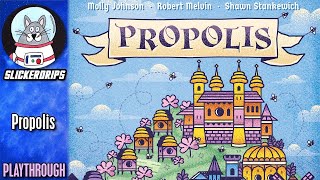
Propolis is a worker-placement, engine-building, area-control, and tableau-building game for 1-4 players. Players take on the role of competing medieval bee colonies and take turns deploying worker bees to collect pollen, fortify their positions, and construct their hives to appease their queen and become the most glorious in the land!
As bees compete over the realm's floral landscapes, they will be collecting pollen to create the propolis they need to build their hives. Attaining dominance in different realms provides additional glory and building materials. As hives expand, new structures provide additional resources, new scoring opportunities, and the prerequisites to construct a glorious palace for the queen. The player who dominates the realm and builds the most prestigious home wins.
From the team that brought you Calico, Cascadia, and Point Salad, this small box worker placement game is the perfect introduction to new gamers, but has enough strategic depth to be challenging for everyone!
—description from the publisher

Mechanics (from transcript analysis)
Video topics + discussion points
Quotes (from this video)
- What enters my collection is a whole another story.
- I'm absolutely hooked on it. I love Primal.
- If I add something to my collection, ideally I want to see it there a year from now, at least a year from now.
- It is such a good implementation of the Glass Road system.
- It's not forever, but it feels like a forever game for me.
References (from this video)

- Beautiful card design with great colors
- Interesting mechanic of placing and laying down bees for different rewards
- Splendor-like engine building effect with resource generation
- Component quality and visual appeal
- Majority control mechanics create interesting decisions
- Weak bee theme - doesn't feel like you're building a bee hive
- Rule clarity issues - majority and row completion rules split across three sections
- Bees are awkward to handle - too tall and naturally lay down when placed
- Limited thematic restriction of one queen per player feels arbitrary
- Engine never really takes off - underwhelming payoff
- Queen palaces hard to obtain but not exciting enough
- Row completion incentives misaligned - rarely worth finishing opponent's rows
- Engine building mechanics not as satisfying as Splendor
- Limited point values throughout the game
- bee theme
- hive building
- resource collection
- Splendor
- Flatout Games' Points series
- Other engine building games
Mechanics (from transcript analysis)
Video topics + discussion points
Quotes (from this video)
- This is not deja vu. You're like, did they already review this? Well, we did, but we uh we made a mistake on one of the rules.
- Finishing a row when you don't have majority is something you will almost never do. I don't care if I get a wild, I'm giving you a wild.
- I like a lot of what's going on, but I don't feel like this is a game that I'm going to come back to because I'd rather just play Splender.
- It's a good try and it's pretty as all get out. I love the motif. But that's about the most I can I can push on that end.
References (from this video)

- Vibrant, colorful components and artwork that reinforce the bee/medieval theme
- Accessible entry point with a relatively gentle learning curve for a worker-placement title
- Strong integration of theme with mechanics, making actions feel purposeful and thematic
- Supports 1-4 players and includes a solo mode, broadening play options
- Layered depth through engine-building, tableau-building, and area control that scales with player count
- Multiple interlocking mechanics can require careful planning and May feel busy for newcomers
- Pace may slow for players who prefer quicker, lighter filler games
- Component volume and storage considerations could be a bit burdensome for travel or small setups
- Bee-driven resource management and territorial competition that weaves together pollen collection, propolis production, and hive-building into a cohesive thematic arc.
- Medieval bee colonies nested in vibrant floral landscapes, where factions compete to expand their hives and craft the grand palace for the queen.
- Strategic, competitive progression with a playful, story-like thread about building a glorious royal bee domicile.
- Calico Cascadia
- Point Salad
- Point Galaxy
Mechanics (from transcript analysis)
- area control / majority — Regions can be dominated through fortification and placement, granting rewards and contributing to endgame scoring based on regional dominance.
- End-game trigger — The game ends when a player reaches the end-condition threshold (e.g., a line of progress or a resource/completion trigger), prompting final scoring.
- engine building — Gaining cards and permanent resources unlocks more powerful actions and sustained benefits, creating a progressively stronger engine as the game unfolds.
- Resource management — Careful balance of pollen, propolis, and other resources is required to pay for actions, construct buildings, and advance toward the queen’s palace.
- tableau building — Acquired buildings form a personal tableau that provides ongoing bonuses and strategic synergies, influencing future choices and resource flow.
- worker placement — Players assign their bees to action spaces to harvest pollen, gather resources, or trigger special effects that advance their hive, with careful positioning to optimize returns.
Video topics + discussion points
Quotes (from this video)
- this is propolis yes propess we are medieval bees constructing stuff
- propolis is a strategic board game for one to four players that blends worker placement engine building area control and Tableau building
- it is worker placement with your cute little bees
- this game is easy to learn and fun to play
- it's easy to learn, fun to play
- the game has a very logical hierarchy
- the bees that are fortified you get two points and the bees that are still upright you only get one
- the first person to get 10 of these will trigger the end of the game
- it's not overly hard no no it's not overwhelming
- it's colorful it's family friendly
References (from this video)

- fun mechanics
- beautiful components
- execution not fully satisfying
- rules occasionally unclear
- economic engine in a tiny ecosystem
- beekeeping / beehive development
- compact, strategic
Mechanics (from transcript analysis)
- Resource management — internal mechanisms with fun, but not fully satisfying
Video topics + discussion points
Quotes (from this video)
- This is a two-player head-to-head game set in the world of Gatsby, kind of. And you are, it's kind of a tug-of-war over three different areas. It's very abstract.
- Moonrise part is the sideboard with tiles that fill up and then they go to one of the players for victory points and then there's just more buildings.
- I recommend it for anybody who plays the game a lot. Though, again, the game is sort of the kind of game you buy at Target.
- This is a neat worker placement game played over two parts of the board on the moon and on the planet. You're trying to blast an asteroid coming.
- the cursing was a little over the top and unnecessary. It didn't really bring anything to the table.
- Star Trek Captain's Chair. Wow, what a game. Nine out of 10. This game takes Imperium, a deck building game, adds a Star Trek theme to it, and does a really good job in that regard.
- Very mass market kind of racing game. You're playing out cards whether you're moving your own ships or your opponent's ships.
- I came in at a six on this game. Ultimately, I did enjoy this as a trivia game. It's a marriage of trivia and blackjack, right?
References (from this video)

- Doesn't quite work
- Many other games do it better
- Rule corrections didn't improve experience
- bee-themed
- nature
- Splender
Mechanics (from transcript analysis)
Video topics + discussion points
Quotes (from this video)
- It's really lightning fast
- The expansion is fantastic
- Just tremendous card game
- I quite enjoyed Brink
- Real great production, very solid game
- Absolutely fabulous game
- Eight great characters
- The expansion that we always needed but didn't know we wanted
References (from this video)
- Short, approachable playtime with deep engine-building.
- Clear, tense progression and emergent strategies.
- Accessible to new players with a Splendor-like core mechanic.
- Strong solo mode with defined constraints and achievements.
- Varying scoring via structures and permanent resources.
- Pink resources can be difficult to obtain early on.
- Color distribution and reliance on shuffles can stall progress.
- Early game may require careful resource planning to avoid gridlock.
- Hard mode can feel unforgiving as cards are removed.
- Worker placement, area majority, and building structures to score
- Bee-centric resource management in a field-driven board
- Factual/engine-building flavor with light thematic storytelling
- Calico
- Verdant
- Cascadia
- Point Galaxy
Mechanics (from transcript analysis)
- area_majority — Majorities determine rewards when rows are filled.
- deck_refill_and_majorities — Full rows trigger majority checks; cards refill from the same deck as they are removed.
- permanent_resources — Building cards grant permanent resources used for future builds.
- queen_palace — One unique high-value building among the Queen's Palace.
- resource_swaps — Swap one resource for another at a cost to adjust resource mix.
- solo_variant — Solo mode uses a dedicated deck to control a bot; two cards removed for medium difficulty.
- structure_building — Buy standard or Queen's Palace buildings to score points and gain powers.
- worker_placement — Place bees on empty cards to harvest resources and trigger card effects.
Video topics + discussion points
Quotes (from this video)
- I'm Tom. I'm going to be playing some propolis tonight.
- Propolis tonight, which is a worker placement area majority gathering resources and building things.
- snappy solo game
- it's not an enormously long game
- the game is snappy and fast and there's still meat to it.
- we're going to deploy our beles, our worker bees to these fields