Québec puts you at the head of a rich family that wants to leave its name in history by building Québec city. The game spans four centuries during which you erect the most prestigious buildings and places of the city, but construction alone is not enough; you also have to ensure your presence in the great spheres of power. It is up to you and your opponents to build Québec City in your colors!
A game takes place over four centuries, and each player takes 5-7 turns per century. On each turn, players choose one of these actions:
Start a new building with their architect
Complete part of a building
Send a worker to a zone of influence
Take a leader card
By contributing to the numerous buildings, players acquire influence with the authorities of the time: religion, politics, commerce, and culture. Players also help build the famous Citadelle.
During a scoring round at the end of each century, players earn points for the workers they managed to place in the five zones of influence. Québec introduces a unique and addictive majority rule. The player with the majority in a zone cascades half of their workers by moving them to the next zone. Workers moved in this way allow a player to score even more points. If a player still has the majority in the next zone, their workers cascade again – a potentially devastating ripple effect. This mechanism illustrates the interrelationship between the great zones of influence. Players must not only fight to get majorities, they must also erect the most prestigious buildings.
The game ends after the fourth century, then players receive points for the buildings they completed. The player with the most points wins.
Québec won the Plateau d'or 2007 and was shortlisted at the 2007 Boulogne-Billancourt International Designer Contest.
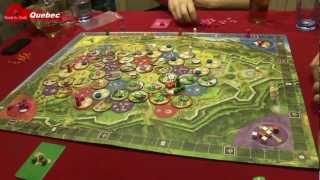
- Dynamic board with different setups each game
- Rich player interaction and strategy
- Strong production quality and art
- Multiple paths to victory and replayability
- Potential for steamrolling if players neglect others
- Bonus actions take time to learn; learning curve present
- Architectural development and city-building with political, religious, and economic themes
- Historical-urban development in Quebec across four centuries
- Historical-economic, abstract strategy
Mechanics (from transcript analysis)
- Architect movement — Move an architect to a new building to unlock actions and advance the century.
- area progression and scoring — Contributions and power area scoring across five power fields per century; scoring of buildings and clusters.
- color-coded building tiles — Tiles colored by themes (religion, politics, economy, entertainment) affect scoring and actions.
- leader cards and event cards — Leaders and events add unique abilities and dynamic changes per century.
- scoring and victory points — Scoring rounds yield victory points based on workers, clusters, and stars.
- worker placement — Players place active workers to perform actions, build buildings, and gain new workers.
Video topics + discussion points
Quotes (from this video)
- 15% tax on everything
- Quebec rocks 15% tax not included
- there's a lot of strategy and very little luck
- it has nice artwork and good production quality
- we liked it
- we're giving it an8 out of 10
- the board is different each game
- good player interaction
- the scoring mechanic is nice
- steamrolling if players are not paying attention to other players