The abstract game of Qwirkle consists of 108 wooden blocks with six different shapes in six different colors. There is no board, players simply use an available flat surface.
Players begin the game with six blocks. The start player places blocks of a single matching attribute (color or shape but not both) on the table. Thereafter, a player adds blocks adjacent to at least one previously played block. The blocks must all be played in a line and match, without duplicates, either the color or shape of the previous block.
Players score one point for each block played plus all blocks adjacent. It is possible for a block to score in more than one direction. If a player completes a line containing all six shapes or colors, an additional six points are scored. The player then refills his hand to six blocks.
The game ends when the draw bag is depleted and one player plays all of his remaining blocks, earning a six point bonus. The player with the high score wins.
- simple entry point to tile-laying concepts
- high accessibility and quick play
- low player interaction beyond competition for lines
- color/shapes symmetry
- abstract tile matching
- abstract puzzle
- Quarrel
- Scrabble
Mechanics (from transcript analysis)
- set_collection — score for completing lines and sets
- tile_laying — place tiles to form lines of matching shapes or colors
Video topics + discussion points
Quotes (from this video)
- I like building the machine which is all done instantly grabbing tiles racing the other players to build your spaceship better than theirs
- number ten on the list is real time tile laying games
- tessellation is the absolute epitome of the tile laying
- patchwork is beautiful and accessible and plays in a short duration
- it's a brilliant game in all its forms
References (from this video)
- Super easy to play
- Similar to Scrabble
- Doesn't take a lot of time
- Can be played at your own pace
- Small and compact
- Easy to travel with
- Word-based puzzle
- Scrabble
Mechanics (from transcript analysis)
- Word building — Similar to Scrabble, players build words
- Word games — Word-based gameplay mechanics
Video topics + discussion points
Quotes (from this video)
- I play Qwirkle every morning - it's a perfect way to start my day
- The art is just beautiful and I'm really proud to own and show off to people when they come over
- The game is whatever you create it to be
- This game blew my mind
- It feels like you can do anything and because of that I was just blown away
- You can play a hundred different ways and you could probably still win
- This is not gonna get old - we may not play it a ton but when we do play it it's always a blast
References (from this video)
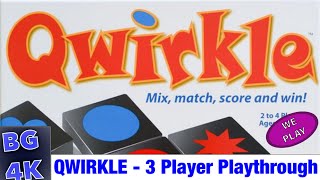
- Rules are simple to learn, but the strategic depth grows with play
- High player interaction through blocking, planning, and tile choice
- Satisfying scoring system with a clear sense of reward (line points + six-tile bonus)
- Learning curve for new players around line rules and 6-tile bonus details
- Length and pacing can vary with the number of players and tile draws
- Requires table space for the grid and tile pool, which can be awkward in very small setups
- pattern recognition, spatial planning, and tile matching
- abstract, grid-based tiling with color and shape attributes
- non-narrative abstract strategy
Mechanics (from transcript analysis)
- draw_and_refill — After placing, players draw from a bag to bring their hand back up to six tiles.
- line_constraints — A line must be all the same color or all the same shape; mixed attributes within a single line are not allowed.
- multi_line_scoring — A move can score points for more than one line if the placed tiles contribute to multiple lines.
- scoring — Score equals the number of tiles in every line you complete or extend; bonuses apply for completing a line of six.
- tile_placement — Players place tiles to form lines that share a color or a shape, extending the grid.
- tile_trading — Players may trade in some of their tiles for new ones drawn from the bag.
Video topics + discussion points
Quotes (from this video)
- you score one point for each tile in the line
- the line is either all one shape or all of one color
- you score six points for completing a line of six tiles
- the six tiles must either be all the same color or all the different shapes
- there's a six point bonus when you complete a line of six
- you draw tiles from the bag to replenish your hand
- you can trade in some of your tiles instead of that into the grid
- lines must connect to the grid and form a continuous row or block
References (from this video)
- great family game
- easy to teach
- can be repetitive over many plays
- colorful, family-friendly abstract strategy
- abstract color/shape matching
- abstract
- Dominion family variants
- Tile-laying abstract games
Mechanics (from transcript analysis)
- set collection and pattern completion — players create rows of tiles that share color or shape patterns
Video topics + discussion points
Quotes (from this video)
- This is not necessarily a list of games that suck and just we keep them around because we have connections to them.
- opening to the rabbit hole.
- Jaws is a better game than your game, dude.
- Bang was our thing. Bang was the party game that our family played.