Ambition and a thirst for wealth have driven humanity to strive for ever greater progress. In America, during the 19th century, battles were waged between huge railway corporations that sought to connect state to state and coast with coast… making themselves filthy rich in the process. Railroad Revolution drops you straight into the middle of these tempestuous years; a time that changed America forever.
In Railroad Revolution, you will manage your own railroad company, ruthlessly competing to be the most powerful railroad tycoon across all America. You will build railroads, establish stations in your connected cities, expand the network of telegraph lines, and chase your objectives, increasing the value of your company with every action you take.
You start with mainly a team of non-specialized workers, but during the game you can hire additional ones with specific skill sets. The cost or effect of an action is determined by the type of worker that does it. To complete your company objectives, you will have to remove some of your workers from your active pool, promoting them to managerial positions. You must carefully assign each of your workers to perform the right action at the right time in order to exploit their specializations in the best way. You need to decide which ones to promote and which are instead still needed to take actions, as your priorities will change from turn to turn.
Railroad Revolution is a fast paced game with relatively simple rules, and it provides you with interesting and challenging decisions. Having a good strategy and finding the correct timing to implement it, is the key to winning the game.
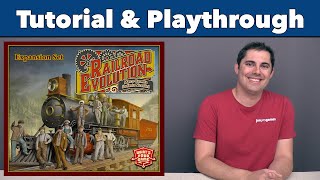
- Expansion adds new board elements and mechanics (left/right tiles, side boards)
- Increased strategic depth with deals, stock management, and milestones
- Clear incentives for early expansion via first-player bonuses and flexible worker colors
- Performance tiles and rewards broaden endgame scoring options
- Increased complexity may be challenging for new players
- Longer playtime due to expanded mechanics
- Potential for analysis paralysis with many options per turn
- Railroad expansion, logistics, and deal-making
- United States expansion with telegraph lines, railroad tracks, and train stations
- Tutorial narration woven with playthrough elements
- Railroad Evolution expansion
Mechanics (from transcript analysis)
- Advancement track and performance tiles — Advance along a board track to acquire performance tiles and unlock new options; tiles grant VP and special actions
- Build stations — Place stations in cities; first-player bonuses and ongoing bonuses on city-specific icons
- Endgame scoring — Points come from trains, completed milestones, Telegraph/Western Union bonuses, reward tiles, and performance tiles
- Lay tracks — Connect cities; mountains add cost; track placement supports up to four players; cannot place a second track on an occupied spot
- Milestones and promote actions — Promote workers onto milestone cards to earn VP; thresholds require specific worker colors and may impact future actions
- Rewards / reward tiles — Reward tiles provide free or discounted actions and influence future building or track placement
- Stocks and deals — Collect stocks via city bonuses and Western Union actions; use stocks to pay for deals or modify actions
- Train flipping / upgrades — Flip trains between colored and gray sides to activate abilities; colored side grants endgame VP; gray side is a neutral state
- Western Union / telegraph network — Expand telegraph network for bonuses and stock-related deals; some spots require sacrificing a worker to access higher-value options
Video topics + discussion points
Quotes (from this video)
- this changes a few things compared to the base game in particular we have a new board out here
- this means we can take two stocks as a benefit for being the first player to build here
- trains are also worth eight points at the end of the game if they are on the colored side
- you are never allowed to have less than four workers
References (from this video)

- Huge variety of options each turn and forgiving engine that allows repeated actions.
- Colored workers add depth and planning without complexity.
- Milestones guide and motivate map expansion, with multiple plausible paths.
- Two to four players and variable boards support replayability.
- Money is abundant and accessible, with multiple routes to resources via Western Union and deals.
- Western Union can dominate the scoring, reducing variation and making other strategies less appealing.
- Milestones occasionally feel luck-dependent; A2 starting milestones are imbalanced and punishing.
- The art/design aesthetics are drab, with large areas of brown; not visually compelling.
- End-game balance can feel skewed toward Western Union, reducing variety across games.
- Variability is average; board state changes exist but aren't transformative between games.
- Industrial expansion, railways, telegraph, urban growth
- United States, late 19th century railroad expansion and telegraph networks
- Historical economic strategy simulation with route-building and milestone-chasing
Mechanics (from transcript analysis)
- Action selection with workers — Players place workers on four action spots to perform building, telegraph, or trade actions; workers come in color variants with specialized bonuses.
- Deals/telegraph stock economy — Deals tokens allow exchanging telegraph stock for actions or bonuses, influencing pacing and strategy.
- End-game scoring via tracks and connections — Scoring tracks along Western Union, number of stations, level five city connections, and adjacency bonuses.
- Market-like money management — Money and telegraph stock act as currency with penalties for crossing thresholds.
- Milestones deck — Milestones provide goals and can be drawn and pursued, with A, B, C, D stacks affecting end-game scoring.
- Railroad/Station building — Build stations and rail lines to connect cities and earn bonuses, while incurring costs.
- Trains and flipping — Trains can be flipped to gain bonuses; some flips are necessary to maximize scoring.
- variable setup — Shuffled city bonuses and Western Union tokens create different boards each game.
- Western Union network — A side track where players gain stocks and bonuses by placing and connecting telegraph-related buildings.
- Worker color bonuses — Colored workers (purple, teal, gray, orange) grant different bonuses at each action spot, adding planning depth.
Video topics + discussion points
Quotes (from this video)
- there are so many different paths to think of and I often feel like I have four different great options
- this game is so good this game is so cool
- it's a very forgiving system as far as allowing you options
- the colored worker mechanic is wonderful
- the Western Union is rather strong
- I think there is a great game here that just needs a little bit of tweaking
- it's pretty disappointing that I have to dig around and try to develop that great game for myself
- I really love the decisions that come from this