Collection Status
Your Rating
Description
Railways of the Lost Atlas is an 18xx-style game set in a shifting landscape. The map, built by players as part of set-up, is different for each play. Players take on the role of individual investors who launch minor companies, build infrastructure, and generate revenue to increase their stock value or reinvest in the company. Minor companies eventually merge into major ones that have more freedom to expand their operations.
The twelve minor companies have distinct abilities that persist even after merging into a major to make for different combinations and unique company identities.
Enjoy multiple game modes and modular options that allow groups to tailor the game to their needs.
Year Published
2024
Transcript Analysis
Browse transcript mentions, sentiments, pros/cons, mechanics, topics, quotes, and references.
Total mentions: 2
This page: 2
Sentiment:
pos 2 ·
mix 0 ·
neu 0 ·
neg 0
Showing 1–2 of 2
Video C0h9St76jRo
Heavy Cardboard playthrough at 0:00 sentiment: positive
video_pk 6784 · mention_pk 20117
Click to watch at 0:00 · YouTube ↗
Overall sentiment (raw)
positive
Pros
- Engaging, map-building focus with a strong sense of place and whimsy (donut map, water, mountains).
- Accessible entry point into the 18xx system for new players, while still offering deep strategic depth for veterans.
- Dynamic merger mechanic and stock market add bite and dramatic potential in stock rounds.
- Humor and persona-driven play adds to table presence and entertainment value for streams.
- Strong thematic flavor through names, tiles, and narrative flourishes (e.g., capital upgrades, bridging).
Cons
- Rules and math can be intimidating; participant dialogue reveals a learning curve during live play.
- Potential for long stock rounds and heavy decision-making can extend playtime, especially in a group setting.
- Some mechanical interactions (e.g., mergers) require careful tracking and can lead to moments of confusion in-the-moment.
Thematic elements
- Infrastructure development, competition, and merger-driven corporate strategy in a whimsical, map-building world.
- A modular, donut-shaped atlas where players build rail networks across islands connected by bridges and waterways.
- Playful, humorous, and improv-heavy with live-stream flavor
Comparison games
- Shackleton Base
- 18 Royal Gorge
- Age of Steam
- 18xx family of games
Mechanics (from transcript analysis)
- Adaptive / tunneling / special tiles — Special tiles (adaptive, tunneling, etc.) provide unique effects and require players to weigh long-term map implications.
- Bridging / water routes — Bridging tiles enable connections across water and land, introducing chokepoints and strategic planning around routes.
- Company tokens / hubs / capital upgrade — Companies place tokens on cities; basic cities upgrade to capitals, altering income potential and strategic value.
- Edge destinations / destination cards — Players select destination tiles that shape map topology and route planning, creating incentives to reach certain areas.
- Map-building / tile placement — Players collaboratively lay out hex tiles to form a playable map, including water features, mountains, and islands (donut-shaped layout).
- Mergers / emerging companies — Two companies can merge into an emerging company, with presidency determined by share ownership; affects control and revenue paths.
- Stock market / shares — Players buy/sell shares, par prices, and manage treasury; ownership affects presidency in mergers and payout potential.
- Train ownership and upgrades — Trains of various values (2s, 3s, 4s, 5s, etc.) are purchased and run for revenue; trains rust or are upgraded, influencing endgame dynamics.
Video topics + discussion points
No key topics recorded for this video.
Quotes (from this video)
- Railways of the Lost Atlas was my number one game of last year.
- Choke points are great.
- This is a damn good game. So good. So good.
- The map building is so special because yes, it's not rooted in any sort of historical background.
- I think it's a home run.
References (from this video)
No references stored for this video.
Video gNXOMBTuuSY
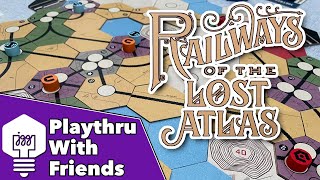
Jonget's Games playthrough at 0:00 sentiment: positive
video_pk 6653 · mention_pk 19779
Click to watch at 0:00 · YouTube ↗
Overall sentiment (raw)
positive
Pros
- Engaging two-player strategic depth with direct interaction via auctions and mergers
- Reasonably fast-paced for an 18xx-style game, especially in the short variant
- Clear visual and thematic cues with hub mechanics and track tiles
- Interesting merger dynamics and asymmetric minor companies add variance
Cons
- Rule complexity and a learning curve can be steep for first-time players
- Rust mechanics and train-buy timing demand careful bookkeeping and can swing outcomes
- Balance and optimal strategies are nuanced and may require multiple plays to master
Thematic elements
- Railway expansion, stock market speculation, and corporate mergers. Trains, routes, and hubs drive revenue and strategic positioning.
- A tile-built atlas map where players assemble a railway network using hub tiles, minor and major companies, and a variable map layout. The short game uses four rounds with a two-player setup.
- Competitive, modular, with explicit economic and spatial puzzles (tiles, tracks, hubs, and mergers) that drive both market and map control.
Comparison games
- 1830
- City the Big Shoulders
- Wabash Cannonball
- Chicago Express
Mechanics (from transcript analysis)
- Merger of minors into majors — During merger rounds, connected minors combine into a single major company; presidencies merge, then shares consolidate under the new major.
- Operating rounds and route running — Minor and major companies operate in rounds; routes generate revenue based on train stops and phase values; local routes are allowed in this rule set.
- Payouts and stock-price adjustments — Earnings per share are distributed; payouts influence stock price (rising if payout > price, falling otherwise). Issuing shares and treasury payouts affect prices.
- Phase shifts and track upgrades — Phases (yellow, green, gray) unlock new track types and train limits; upgrades and track placements impact future payouts and route options.
- Rule variants for accessibility and length — Introductory map, short game, micro game options, and rule guardrails to smooth play for newcomers, with a slower or longer long-game variant.
- Stock rounds and auctions — Players bid for minor company charters; the president share yields control; stock prices and treasury flows influence future actions.
- Tile-based map construction with hub tokens — Maps are built from tiles; each company must connect to its hub; hub tokens can be placed to unlock future route options and influence payouts.
- Train acquisition and rusting — Trains cost money; players must purchase trains (with potential forced purchases); trains rust and disappear, affecting future earnings.
Video topics + discussion points
No key topics recorded for this video.
Quotes (from this video)
- This is an 18xx game but it is essentially marketed as like an introductory 18xx game.
- we're going to play a full short two-player game of Railways of the Lost Atlas
- the short game is four rounds
- capital is more lucrative and upgrades are important
- two yellow tiles per track laid in yellow phase
- merger rounds are coming, where minors merge into majors
References (from this video)
No references stored for this video.
Transcript Navigation
Showing 1–2 of 2