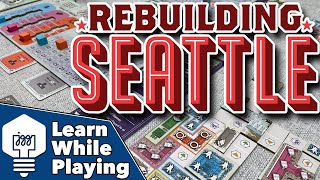
The great fire of 1889 has burned down most of downtown Seattle, and you are the city planner tasked with rebuilding it. Manage economic resources to improve neighborhoods, erect new buildings and iconic landmarks, and address the needs of an ever-growing population to make Seattle better than ever!
In Rebuilding Seattle, you're responsible for managing the zoning and expansion of a major neighborhood! Each round your population grows, and you can either build a new building, expand into a new suburb, activate an event, or build a landmark, before earning profit based on your neighborhood's commerce. You'll buy building types from a shared market, looking to find shapes that fit your grid and types that fit your strategy. Triggering citywide events can change the tide of the game, offering points, money, and expansions for the players ready for it. You can even enact laws to give yourself the advantage! At the end of the game, whoever's neighborhood has earned the most points wins.
Build! Carefully fit buildings into your neighborhood grid, and construct landmarks on the right tile combinations.
Expand! Suburb tiles connect to your grid however you like, creating uniquely shaped neighborhoods!
Score! Earn points for building types, upgrades, landmarks, events, and remaining cash!
Rebuilding Seattle also comes with a solo player deck so you can still compete to build the best version of Seattle even with just one player! Enjoy gameplay against a deck designed to simulate the actions of a second player to discover strategies and configurations you can use to improve Seattle!
—description from the publisher
- Engaging city-building flavor with meaningful asymmetry between players
- Clear track-based scoring and tangible, visible progress
- Multiple viable strategic paths via events, landmarks, and card Market choices
- Dynamic interaction through population management and expansion tiles
- Component costs can be high, requiring careful resource management
- Strategic depth may lead to analysis paralysis for new players
- End-game scoring depends on multiple track interactions; can be complex to track mid-game
- urban planning, city-building, population growth and resource management
- Seattle, just after the Great Fire of 1889
- expository/tutorial
Mechanics (from transcript analysis)
- amenity tracks and scoring — tracks such as Shopping, Entertainment, Restaurants, and Banking drive rewards and end-game scoring through population-amenity interplay.
- asymmetry / district boards — each player has a unique district board with different law options and action effects, creating asymmetric strategy.
- card market / market buying — players purchase face-up cards from a market to gain buildings and ongoing effects, with some cards upgrading via bottom-half profits.
- End-game scoring — points are tallied from multiple sources (money, landmarks, schools, etc.), with tie-breakers including population centralization.
- Events — rounds feature six events that activate in a rotating sequence, providing rewards or global effects.
- landmarks and expansion tiles — landmark cards provide powerful, often end-game-oriented benefits; expansion tiles (suburbs) extend districts and grant bonuses.
- laws — each district can enact laws from a bottom-half card area, persisting for the round and shaping options each turn.
- population track — players manage a population token that increases by round, influences scoring and event outcomes.
- profit phase — a dedicated phase after building where players earn money and potentially points from their assets and upgrades.
- tile placement — players place district-building tiles and landmarks within a grid, with placement rules and adjacency considerations.
Video topics + discussion points
Quotes (from this video)
- it is set in Seattle just after the Great Fire of 1889
- the game takes place over three rounds and within each round every single one of these six events will be activated once
- we are going to spend our money in order to purchase various cards
- the profit phase happens after we finish the build phase and in the profit phase we're hopefully going to get a bunch of money
- these are quite expensive but when you buy them you can put these down and activate the various effects that are printed on those cards
- the starting population is 11
- we're going to increase our population in order to do this we focus over here on the round tracker
- the game is going to take place over three rounds and once we finish that third round the player with the most victory points will be the winner
- and it's important to remember that scoring is driven by amenity tracks and the difference between population and those tracks
- final scoring converts money into points and tallies up end-of-game effects from landmarks and schools
References (from this video)
Mechanics (from transcript analysis)
Video topics + discussion points
Quotes (from this video)
- Void Fall is my number one game of 2023.
- I will be donating all ad revenue to charity; it’s a long-running commitment of mine.
- Kickstarter print runs can be problematic when issues are discovered after release.
References (from this video)
Mechanics (from transcript analysis)
Video topics + discussion points
Quotes (from this video)
- 2023 was the greatest year in board game history for my tastes
- Conveyor belts are my favorite board game mechanism period
- This is a technological breakthrough for Games
- The greatest bag building game of all time
- Ode to the power and resiliency of Science and cooperation
- Wall-to-wall optimism and an Ode to the power and resiliency of Science and cooperation
References (from this video)
- Contains neat ideas and a strong tutorial potential
- Appealing aesthetic
- Has not been actively played yet
- Hard to fit into busy play sessions
- city-building, rebuilding a city after disaster
- Seattle, urban redevelopment
Mechanics (from transcript analysis)
- Polyomino-style placement — City-building with modular placements and shared incentives.
Video topics + discussion points
Quotes (from this video)
- I'm really curious to see how people react to it.
- The idea is that maybe I do this near the end of a month and then the update vlog obviously is a week later.
- It was a really fun time; it was a blast.