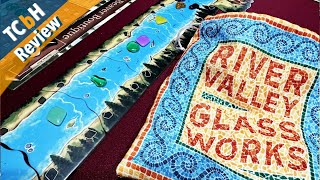
Welcome to River Valley! The beautiful pieces of glass that can be found along the river here have attracted the most entrepreneurial of woodland creatures to set up shop.
In River Valley Glassworks, you play as one of these pioneers, drafting glass from the market of river tiles. To do so, you have to play a piece from your inventory into the river. Each river tile can take only a specific shape, and you must play into a space adjacent to where you want to draft from. After you pick up your glass, the river shifts forward, revealing new pieces and new opportunities.
Store the glass you pick up strategically in your shop. Depending on how the glass pieces are placed, your score will change drastically. Fill in rows and columns to gain bonus points, but don't draft too many of one type to avoid negative points!
-description from publisher
- Quick and clever puzzle that remains interesting and solvable
- Satisfying tactile interaction with moving river tiles
- Strong rhythm and momentum that rewards repeated play
- Clear visual identity and potential for premium production (special edition, playmat, acrylic tiles)
- Limited lateral interaction with other players during play
- Scoring feels narrow (focuses on rows and two tallest columns) and could benefit from additional objectives or asymmetry
- Prototype stage with potential component changes; production quality may shift
- Tile-laying puzzle centered on color gems and river flow
- River valley environment with glassmaking imagery and chips representing river resources
- procedural abstract puzzle feel with tactile components
- Sagrada
- Azul
Mechanics (from transcript analysis)
- Chip drafting and placement — On your turn you take one chip from your hand and place it on a river section that matches its shape
- Color rarity and column value — Colors have differing rarities; placing rarer colors up front increases value but risks gaps or wasted space
- Hand limit overflow penalty — If you exceed the hand limit when gathering chips, overflow chips score a negative penalty
- Permanent tableau growth — Gained chips become fixed to your tableau, expanding your color set and bottom rows for future scoring
- River section replenishment — Cleared river sections refill from the tank behind the river, introducing new chips/colors into your options
- Scoring rule constraints — Score is calculated for rows with no gaps, and only the two tallest columns contribute to final score with leftmost tie-breaks favoring less valuable columns
Video topics + discussion points
Quotes (from this video)
- a quick and clever Puzzler that gets down to Glass tax
- there's something really nice about the physical act of moving the river tiles
- Thematic Resonance of pulling these chips and seeing more flum and jets them come Downstream
- I'd love to see another Avenue of interacting with the game
- the potential is here
- production values and will have a special edition down the road with a playmat and acrylic tiles
References (from this video)

- Strong art direction and theme
- Robust solo mode with five AI variations
- Unclear distribution path beyond Kickstarter Deluxe edition
- crafting glass art with whimsical woodland visuals
- River Valley industrial town with a glassworks motif and forest creatures art
- story-forward with charming visuals
Mechanics (from transcript analysis)
- art-driven engine — strong thematic integration with art by Andrew Bosley
- solo mode and variable player count — supports 1-5 players with a robust solo mode and five AI players
Video topics + discussion points
Quotes (from this video)
- we are a company that believes in game night
- Kickstarter is the platform there is no pledge management service tied to it
- all play is just going to be a better fit for the company
- we are a small company
- River Valley Glassworks... this is going to be a big product Focus
References (from this video)

- Fast and accessible solo mode
- Thematic and charming components (glass, beaver boutique theme)
- AI provides a solid solo challenge with clear rules
- Tight, quick rounds that promote strategic planning
- Prototype-specific quirks noted (AI satchel size in prototype) which may be refined in final production
- Potential complexity for new players despite quick rounds
- Luck of the draw can influence early momentum
- glassmaking, resource management, color matching
- River Valley, featuring a beaver boutique crafting glass items
- procedural/puzzle-like with AI interaction
- Three Sisters Fleet the Dice Game
- Motor City
- French Quarter
Mechanics (from transcript analysis)
- AI opponent rules — the AI follows fixed placement order and has an hourglass that causes the AI to skip its next turn when covered
- draw action — draw four stones from the lake into your satchel, with a five-slot satchel limit in multiplayer and a three-slot limit in the solo AI variant; excess goes to the AI satchel in solo play otherwise to the opponent in multiplayer
- endgame conditions — the game ends when a player reaches 17 glass pieces or the AI satchel holds 3 pieces
- pattern/column scoring — score is based on the two tallest columns and completed rows; colors and columns influence scoring and endgame conditions
- place and gather — on your turn, place a color tile into the river grid and gather all tiles from an adjacent space into your satchel
- surplus and waste — colors that cannot fit into a column go to a surplus (positive points) or waste (negative points) depending on the actor; overflow adds penalties
Video topics + discussion points
Quotes (from this video)
- River Valley Glassworks a new game from allplay
- this game goes by so quickly even in a multiplayer game you can easily kind of set up and play a bunch of different rounds
- That is River Valley Glass Works I would love to know down below if you've had a chance to try this out
- I demolished him I did so much better
References (from this video)