Rune Stones is a deck-building, hand management game by acclaimed designer Rüdiger Dorn. In Rune Stones, every card has a unique number on it. Two cards are always played together, and the higher numbered card is removed from the player's deck. You have to be careful which cards you buy and how you play them to not lose your best cards. Players will use their cards to gather gems, forge them into Artifacts, then combine those into Rune Stones, which grants a special ability for the rest of the game. The more artifacts used in making a Rune Stone, the more points it scores, so players must decide whether it is best to gain abilities early or save to score more points.
On your turn, you may choose from one of three options:
1. Summon Creatures: Take new creature cards from the display by playing the appropriate amount of spell power from cards in your hand.
2. Play Cards: Play two cards from your hand, which will give you resources, new cards, or points. However, every card has a unique number, and the higher numbered card of the two is removed from the game (the other is placed in the player's discard pile).
3. Forge Artifacts: Players spend gems at the 6 different Dwarf forges to make an artifacts. Once they have at least two artifacts of different colors, these may be made into a Rune Stone, which grants a special ability and a significant number of points.
The first player to 65 points triggers the end of the game, and then the player with the most points at the end of the round is the winner.
—description from the publisher
The time has come to find the most powerful druid, that they may claim the throne!
Players will take on the role of druids who must prove their skills handling the powerful rune stones. Summon creatures by magic and benefit from their abilities, all in a search to gain precious gems. These gems must go to the talented dwarfs, who know how to use them to make a rune stone.
As their collection of artifacts grows, the druid's rune stones become more powerful. Each stone gives the druid a permanent ability (as well as power points). The abilities will aid in acquiring gems and artifacts, and the power points increase the player's chance to claim the coveted throne.
The druid with the most power points at the end of the game ascends the throne and is the winner of the game.
—description from the back of the box
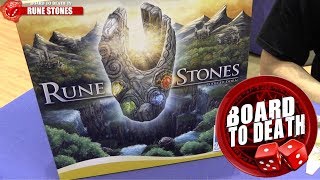
- Clear three-action turn structure: buy cards, play actions, or buy artifacts
- Artifact and rune-stone system adds depth and variability to engine-building
- Wilds and color management create engaging decision space
- End-game trigger creates a tense, race-like finish
- Rune stones offer varied powers and meaningful late-game growth
- Deck thinning can be punishing if high-value cards are discarded early
- Complex color/artifact interactions may be intimidating for newcomers
- Rune-stone slot limits can force early commitment and constrain choices
- collecting gems to purchase artifacts, which grant rune stones that provide points and powers
- fantasy world built around gems, artifacts, and rune stones
- deck-building driven with hand management and engine-building implications; progression via artifacts and runes
Mechanics (from transcript analysis)
- artifact economy — artifacts grant bonuses and can be bought up to two per turn; some artifacts provide immediate effects or end-game benefits.
- deck-building / hand management — on a turn you have four cards and choose one of three actions; purchased cards go to discard and cycle back into play.
- dice bonus — certain actions allow using a dice bonus to gain additional points.
- end-game trigger and race — the game ends when one player hits 65 points, triggering a final round for others.
- resource management / color-coded gems — gems come in colors; you spend them to buy cards or artifacts; wilds and color rules influence purchasing power.
- rune stones — rune stones grant powers that affect your deck and scoring; some increase hand size, others affect purchasing or card play.
Video topics + discussion points
Quotes (from this video)
- you are collecting these gems to be able to purchase artifacts which you will then used to buy rune stones which gives you points and special powers
- you can play all cards of one color you have some wild symbols here
- unlimited buy so you know you can buy a three and a one with the four purchase price
- after that you can convert your gems into wild gems and you can get the top card for free
- it's a bit of a race as well and it's end when one player reaches 65 points
References (from this video)
- clever engine-building
- tight race to a target score
- early-stage deck-building may feel clunky
- engine-building through combination of cards
- gem collection and deck-building
- engine-building abstraction
Mechanics (from transcript analysis)
- deck-building — build a deck to generate better engine effects
- resource-gem collection — collect gems and use them to fuel engine improvements
Video topics + discussion points
Quotes (from this video)
- this is the best area control game out there
- a perfect 10
- I adore El Grande
- really nice game I taught this to a complete non-gamer
- I love Feld games this one is just an absolutely brilliant one
- it's one of the best two-player games ever made
- overproduced to say the least
- one of my favorite dice games and it's actually just broken into my top 100 for the first time
- the sudden death mechanism where if you are the first player to collect three buildings then you'll instantly win
- really cool decisions