Rurik: Dawn of Kiev is a euro-style realm building game set in an 11th century Eastern European Kingdom. It features area control, resource management, and a new game mechanic - "auction programming."
You play as a potential successor to the throne following the death of your father, Vladimir the Great, in 1015. The people value a well-rounded leader, so you must establish your legacy by building, taxing, fighting, and accomplishing great deeds. Will you win over the hearts of the people to become the next ruler of Kievan Rus?
Rurik brings to life the ancient culture of Kievan Rus with game design by Russian designer Stanislav Kordonskiy and illustrations by Ukrainian artist Yaroslav Radeckyi.
In Rurik, players openly bid for actions with their advisors. Stronger advisors earn greater benefits at the cost of performing their action later than other players. Conversely, weaker advisors earn lesser benefits but perform their action quickly. This planning mechanism ("auction programming") adds a fun tension to the game.
—description from the publisher

- deep strategic depth with multi-layered decision-making
- tight interplay between bidding, area control, and action sequencing
- strong component quality and aesthetically pleasing inserts
- excellent scalability and balance between player counts
- flavorful leaders and regional mechanics that feel thematic
- steep learning curve for new players
- table space requirements can be significant
- periodic AP in planning and sequencing can slow down play
- territorial influence, governance, resource management, and warfare across rival polities
- Medieval Eastern Europe (Kievan Rus; locales like Kiev, Novgorod, Polotsk)
- historical-epic, emergent through player decisions and regional control
- Inish
- Gear Works
Mechanics (from transcript analysis)
- area_control — players vie to rule lands; majority in a region determines influence and score
- auction_bidding — strategy board auction for action order and powerful advisor tokens; higher bids grant more actions but cost currency
- coding_action_phase — resolve actions in an order that can chain into other actions, creating planning depth
- end_game_deeds_and_agendas — hidden/deed cards and agendas grant scoring opportunities and end-game bonuses
- engine_building — sequence of actions and card/deed interactions to improve your options over rounds
- worker_placement — placing advisors to activate actions in an ordered sequence, with laddered power
Video topics + discussion points
Quotes (from this video)
- This is easily one of my favorites this year.
- It's a top ten of the year.
- The decisions in this arc because you had to plan your turn out before you take your turn.
- This game is unbelievable.
- The insert is absolutely fantastic.
- I love area control.
References (from this video)
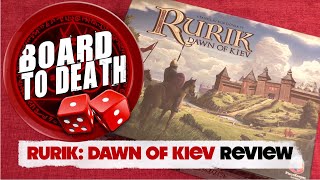
- Multiple viable paths to victory
- Tight end-game scoring
- Balanced actions and strong strategic depth
- Great solo mode and replayability
- Thematic and elegant area-control design
- medieval power struggle and area control
- 11th century Kievan Rus
- leader-based, asymmetric, strategic conquest
Mechanics (from transcript analysis)
- area_control — Players compete to control regions and tracks; victory points earned through control and deeds.
- combat_resolution — Attacks resolve with casualties drawn from scheme cards and garrison conditions.
- deck_of_scheme_cards — Scheme cards modify outcomes and limit casualties; some cards drawn based on control conditions.
- resource_management — Mustering troops, taxation, goods, and coins are used to fuel actions and schemes.
- round_phases — Each round has strategy, action, and claim phases with top advisor actions more powerful.
- secret_agendas_and_deeds — Players complete deeds and secret agendas for end-game points.
- worker_placement — Advisors are placed on strategy board columns; strength determines the action and order.
Video topics + discussion points
Quotes (from this video)
- Rurik Dawn of Kiev is probably my favorite area control game.
- End points were always really really tight.
- I promise you you won't regret it.
- It's a beautiful game.
References (from this video)
- exceptional action programming system
- engaging mix of area control, building, resource gathering
- high production values and clever storage system
- well-designed hero figures and components
- action programming can be overwhelming and AP-prone for some players
- victory progression can prevent late-game comebacks due to no backward movement on tracks
- production complexity may intimidate lighter gamers
- political intrigue, area control, resource management
- 11th century Kiev (Kyiv) during empire fragmentation and succession struggles
- historical/strategic
- Scythe
- Roborally
Mechanics (from transcript analysis)
- action programming / worker placement — place and bid workers on action tracks; higher values yield more efficient actions and determine resolution order; values can push other workers down or be reset; coins can increase value
- area control and building — control regions with units and buildings; build structures to strengthen control and gain rewards
- auction and bidding on actions — actions resolve in order of worker values; bidding influences order and outcomes of actions
- combat emphasis vs. planning — combat exists but the game emphasizes planning, positioning, and timing over large-scale battles
- draw and use scheme cards — draw scheme cards granting additional actions and effects; some cards impose costs when drawn
- Movement and combat — move units across tracked spaces; muster soldiers; engage rebels or opponents
- public and private goals — points gained through public and private objectives; progress tracked toward end-game scoring
- resource management and taxation — gain resources via tax in regions; manage goods for income and markets; tax areas you control or contest others
- storage and production systems — well-regarded production/storage design contributing to component quality
Video topics + discussion points
Quotes (from this video)
- I think this is an exceptional game system
- the best thing about this game is the action programming
- that action programming system will overload some people
- Rurik's production values and wonderful storage system
- it's a game of planning, positioning and knowing the best time to act
- it's simple to comprehend yet will cause steam to come out of your ears as you plan the best possible moves with it