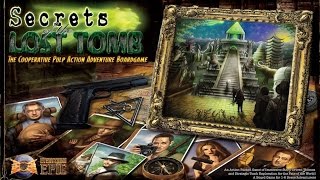
Secrets of the Lost Tomb is a cooperative game of thrilling action-adventure and discovery. Players assume the roles of stalwart expedition members working together to investigate ancient mysteries, while surviving dangers and shielding humanity from the supernatural powers of The Tomb—an ancient vault filled with primeval powers perpetually struggling to be set free upon the world. Powers that mankind should never behold…
Secrets is a tile laying game that allows players to build the tomb tile by tile, creating a new game board and adventure every time. The game is designed for one to six people, each of whom plays one of six possible Adventurers, each with unique powers, abilities, starting items, and attributes.
With the main Cooperative Story Mode and 2 Competitive Modes of Play, many unique Adventurers to choose from, over 50 unique and detailed room tiles, over two hundred tokens, and over three hundred cards, Secrets of the Lost Tomb offers an Ever-Evolving, EPIC, Tomb-Crawling adventure every time you play.
- Story-driven, campaign-like feel with a clear objective (recover the staff of Ra and related talismans).
- Cooperative two-player setup with room for two companions per player, enabling interesting partner dynamics.
- Rich exploration with many triggers, status effects, and artifacts that influence strategy and replayability.
- Dramatic narrative cues and scenario-driven pacing, encouraging decision trade-offs (e.g., whether to risk Zeus's bolt).
- Tangible sense of progression via unlocking effects (Fearless) and tiered dungeon depth (levels 1–3).
- Production quirk noted in the video: printed covers were misaligned and required manual adjustment, signaling potential setup friction in some releases.
- Rule complexity is high, with numerous checks, effects, and token interactions that may overwhelm new players and slow early plays.
- Tile and dungeon management demands careful setup and organization to avoid misreads or misplays during flow.
- Narrative cards and scenario book can lengthen games for beginners who are learning the interaction rules and timing.
- Adventure, exploration, artifact collection, curses and destiny, teamwork against a narrative-driven threat.
- An undisclosed island tomb where Pharaoh Razul Ahamed is interred; adventurers explore a multi-level tomb to recover talismans to prevent a resurrected catastrophe.
- Story-driven, scenario-based progression with trigger events and evolving discoveries as you traverse levels.
Mechanics (from transcript analysis)
- Audacity check — A 12-sided dice pool where the number of dice equals the current audacity value; successes (primarily 5-6) yield rewards, with boosts possible by spending audacity; rerolls available via audacity expenditure.
- Combat and weapon loadout — Characters carry weapons and combat effects; trades between players can occur, affecting the group’s tactical options.
- Companions and items — Each character provides starting stats and can have companions; items and artifacts alter combat and exploration capabilities (e.g., Zeus's Bolt, grappling hook).
- Exploration effects — Entering a room can trigger immediate effects (e.g., a curse, a reward, or a scenario cue) that shape the next steps.
- Movement and exploration — Tiles form a dungeon; players move up to a set number of tiles per turn, with level progression (level 1 to 3) and stairs used to descend.
- Mythos and knowledge checks — Non-audacity checks for lore/mystical effects; success thresholds drive narrative outcomes and potential misadventures.
- Scenario effects and misadventures — The scenario book provides a structured sequence of events, including adventure and misadventure cards that impact the room state and narrative.
- Status effects and upkeep — Rewards grant ongoing effects (e.g., Fearless) that modify future checks; upkeep phases refresh items or affect possessions and companions.
- Tomb phase and monster spawning — During the tomb phase, spawn rules create monsters (base and elite) in red-bordered rooms, with placement affecting threat level and tempo.
- Trap tokens and room hazards — Certain rooms accumulate trap tokens that trigger with movement, requiring checks to avoid penalties like being slowed.
Video topics + discussion points
Quotes (from this video)
- we're going to demonstrate the introductory scenario for you and we're going to do that with two players
- this is the scenario book to get read out
- story driven Dungeon Explorer which is the thing that attracted me to it really
- Fearless... that's a pretty good effect
- Zeus's bolt