Only in a few corners of the world is the memory of magic still alive, even though a few centuries ago its healing power permeated everything. Witches, its last remaining practitioners, have always been outcasts and could help human society only in strict secrecy. The leader of their people, the Septima, has always been the wisest, most knowledgeable witch. Now, as her time is coming to an end, witches from all over the world gather at Noctenburg to leave their mark on the hostile town and prove to the Septima that they are her worthy successor.
Septima is a competitive, highly interactive strategy game of witchcraft. As the leader of your coven, you must prove your worth in the town of Noctenburg to become the successor of Septima, the High Witch. Practice your craft and gain Wisdom by collecting herbs, brewing potions, healing the townsfolk, mastering charms and rescuing your fellow brothers and sisters from the trials. But beware: magic, even if used for good, invokes suspicion in the townsfolk...
Simultaneous action selection with positive player interaction: Septima’s central mechanism revolves around the simultaneous, secret selection of one of nine Action cards each turn: Move, Collect, Brew, Heal, Recruit, Plea, Chant, Rite and Remember. Each Action gets a powerful bonus if it is chosen by multiple players, but performing them together also raises suspicion in the townsfolk and attracts the attention of the Witch Hunters. Decisions of when to do a shared action (and who to do it with) adds a fresh, semi-cooperative touch to a competitive game, and lots of player interaction.
Rescue witches to build your Coven: Heal, enthrall or convince the townsfolk and amass enough support to sway the periodic Witch Trials in your favor. If the hostile witnesses are outvoted, the convicted witch is absolved and joins the coven that rescued them. You start small but you can grow your coven to up to four witches this way, each with their own personality and special ability to help your cause. Reckless Witches caught by Witch Hunters are also put to trial, so with enough support from the townsfolk, even witches from other, less careful players’ coven can end up in yours.
Accessible, intuitive and familiar: Septima is Mindclash Games’ most accessible title to date, with beautiful, hand-drawn art style by Villő Farkas and with the character art of Barbara Bernát, wooden components and intuitive, theme-inspired mechanisms. It is very quick to teach and set up, and takes less than 2 hours to play, even with four players.

- Beautiful theme and autumnal feel
- Dynamic tension between cooperation and accusation
- Complex for casual players
- Can require careful table management
- witchcraft, trust and suspicion, trial/witch-hunter tension
- autumn witch coven feel with a witchy aesthetic
- action selection with competitive tension among coven members
- Witch-themed area-control games
- Other competitive-cooperative hybrids
Mechanics (from transcript analysis)
- asymmetric collaboration within competition — teams cooperate in some aspects while competing in others
- Simultaneous action selection — actions are chosen by players at the same time
Video topics + discussion points
Quotes (from this video)
- This is a perfect Halloweeny kind of game cuz it's a horror themed game.
- Septima is a cool game that we haven't really played as much as we frankly should have.
- There's zombies and they're coming at you and you're blasting your way out.
- The look particularly is absolutely incredible.
- 10 out of 10 adorable. Amazing.
- Mysterium is a really really interesting game
- it's a hand management card game where to do the various actions you have to spend cards
- it's so Halloweeny
References (from this video)
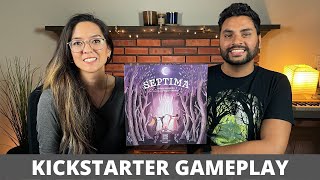
- Engaging two-player rules with tight asymmetry and the cat/fox animal-form twist
- Rich mix of actions (move, collect, brew, heal, recruit, plead) with matching/collect bonuses
- Dynamic right-board and charms provide powerful one-time bonuses
- Tension from suspected witch hunter encounters and trials
- High variability via divination cards and modules like Shape-Shifting
- Steep learning curve and prototype rules may shift in final copy
- Complex component setup can slow first plays
- End-game scoring can be confusing without careful tracking
- witchcraft, trial, secrecy
- Witch town and surrounding forest during witch trials
- episodic, coven-driven competition
Mechanics (from transcript analysis)
- action card drafting and simultaneous reveal — Players secretly choose actions from identical hands and reveal together, with bottom actions triggering when cards match with others or septima.
- resources gathering and potion brewing — Collect ingredients from hexes, use them to brew remedies and practical potions, which drive healing, movement, and scoring.
- seasonal cycle and moon phase tracking — The game unfolds over a year divided into four seasons; each season has rounds and a moon tracker that guides scoring and actions.
- septima tokens and right-board synergy — Septima tokens flag ideal actions per round; matching actions with septima or other players yields additional effects and progress on the right board.
- shape-shifting animal form — A coven member can transform into an animal form, altering powers, blocking leader abilities, and affecting which actions can be taken.
- trial resolution and crowd management — End-of-season witch trials determine guilt/innocence, yielding wisdom points and shifting citizens between the crowd and chambers.
Video topics + discussion points
Quotes (from this video)
- it's a one to four player experience that plays in roughly 50 to 100 minutes
- animals never raise suspicion because they're animals
- the year is divided up into four rounds or seasons
- witch hunters are patrolling their own zones
References (from this video)
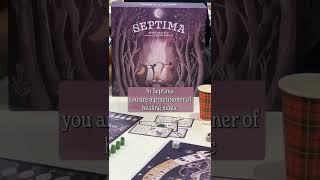
- Engaging witch-themed atmosphere with a strong narrative thread
- Tense decision-making from simultaneous actions
- Distinct powers boost replayability
- Beautiful artwork and components that support immersion
- Mechanics align well with the theme of healing and trials
- Potential learning curve due to multiple interacting mechanics
- Balance of powers may vary with player count
- Theme-heavy direction may not appeal to all audiences
- Witchcraft, covenant leadership, healing, and political intrigue in a town under siege by hunters.
- A witch-hunter town in a fantasy medieval setting focused on trials, covens, and healing.
- Thematic, procedural progression through trials and town needs with a focus on role-specific powers.
Mechanics (from transcript analysis)
- action_resolution_and_scoring — Progress and points come from healing townsfolk and brewing potions, aligning with the witch-trials theme.
- simultaneous_secret_action_selection — Players secretly select actions each round; actions resolve in parallel, creating tension and uncertainty.
- thematic_integration_and_aesthetics — Artwork and components reinforce the witch-hunting atmosphere and immersive experience.
- variable_player_powers — Each player has a distinct power that influences strategy and interacts with town dynamics.
Video topics + discussion points
Quotes (from this video)
- simultaneous secret action selection
- variable player powers and beautiful Aesthetics
- you'll need to survive the witch trials
References (from this video)

- Strong thematic pull for folklore vibe
- witchy / witchcraft vibes
Mechanics (from transcript analysis)
- engine building / strategy — thematic blend of worker/engine optimization
Video topics + discussion points
Quotes (from this video)
- Ticket to Ride is also many people's debut into board games
- you got to go fast
- you got to be swift
- Fearless is the Trailblazer album for Taylor
- Familiar Tales for me is giving me Speak Now vibes
- Bark Avenue because when you say speak a dog Burks
- the gates of Loyang … the box is red
- it's the era of Taylor Swift where she started to not really care and started to make fun of herself
- London boy
- Phantom Ink right because I don't know not only like the name of the game but the vibe
- the longest board game name I can think of
References (from this video)
- Covers additional depth via expansion modules
- Thematic and lore-friendly for fans of the setting
- Complex learning curve
- Not all modules may appeal to every group
- rituals, witches, and occult-adjacent tableau
- Witch/dark magical theme; ritual boards and omens
- story-forward with modular components
Mechanics (from transcript analysis)
- deck-building / modular expansion — uses a ritual board and multiple modules (omens, animals) to add depth
- modular board expansion — expansion-style depth via ritual board and modules
Video topics + discussion points
Quotes (from this video)
- "we're going to do quarterly Vlogs"
- "If you are in the US feel free to be part of the giveaway"
- "the Meep store is closing"
- "two copies of this game"
References (from this video)

- Witchcraft, coven diplomacy, potion brewing, ritual objectives, and occult trials.
- A coven-based witchcraft setting unfolding across the four seasons within a town, with moon phases guiding actions and consequences.
- Array
- Array
- positive
Mechanics (from transcript analysis)
Video topics + discussion points
Quotes (from this video)
- Septima players lead a coven of up to four.
- There are also eight different actions that are part of the base game.
- Shape-shifting and Omens that introduces new animal tiles.
- There you have it that is how you play Septima.
References (from this video)

- Excellent thematic implementation
- Positive player interaction through coordinated actions
- Beautiful visual design and look
- Shared consequences feel thematic rather than punitive
- Competitive without being adversarial
- Coordinated actions attract witch hunters, adding some risk
- Good witches in a coven helping townspeople while being misunderstood
- Small town with witch hunters
- Simultaneous action selection with theme of persecution
Mechanics (from transcript analysis)
- Ally rescue mechanic — Players can get others off trial as part of the game
- Cooperative thematic elements — Players are good witches helping townspeople, not opposing each other thematically
- Semi-cooperative — Competitive scoring but thematically aligned goals
- Simultaneous action selection — All players choose actions simultaneously; matching actions with others create stronger effects
- Witch hunter escalation — Powerful joint actions attract witch hunters, creating a shared consequence
Video topics + discussion points
Quotes (from this video)
- If I'm interacting with people, I want it to be that we're each getting a little something something.
- Any game where you get to kind of mooch and be like, 'Hey, great. Thanks for doing that. I'm going to do this over here and score these points. That's fantastic for me. Makes me feel good.'
- I don't particularly enjoy just blocking in games. I don't really find that kind of interaction to be fun or interesting.
- You're always engaged with the game. You're always playing. You're always making decisions and doing things and that's super duper satisfying.
- There's never a time where you don't really want one.
- It's that positive interaction where you're always, every single turn, people are always going to be giving you cards.
- It's that constant stress of like making sure I get out of this a little bit more than you because we're both going to benefit.
- You're still trying to win the game. It's not a cooperative game by any means, but it's the fun tension of you're going to get something out of this.
- Hey, I get to use your stuff. That's really really cool.
- Everyone's infrastructure kind of works for you. It's just really really good.