The shadows of the Sixth World have every kind of danger you can imagine: ultra-violent gangers, flesh-eating ghouls, mages that summon spirits from toxic waste, backstabbing corporate raiders, hard-nosed police officers, and even dragons. You don't have much — mainly your guts, your wits, and your friends — but maybe that's enough. Between you and your teammates, you can sling spells, hack the Matrix, talk a tiger out of his stripes, and bring down a charging ork from a hundred yards away. Will that be enough to face down the worst the mean streets can throw at you? You're about to find out.
Shadowrun: Crossfire is a cooperative deck-building card game for two to four players set in the gritty, cyberpunk fantasy world of Shadowrun. Play a shadowrunner team and take on tough jobs such as protecting a client who's marked for death, shooting your way out of downtown when a run goes sour, or facing down a dragon. In each game you'll improve your deck with a mix of strategies, while earning Karma to give your character cyber upgrades, physical augmentations, magical initiations, weapons training and Edge.
Shadowrun: Crossfire includes two obstacle decks, a black market deck, a crossfire event deck, mission sheets, role cards, runner cards, and upgrade stickers.
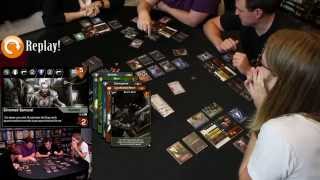
- strong cooperative puzzle-solving and team coordination
- high replayability via multiple scenarios and expansions
- deep, emergent deck-building with many combos
- scaling difficulty through karma and Crossfire levels
- accessible theme integration with flavorful cards and art
- steep learning curve and rules complexity
- turns can be lengthy and planning-heavy
- requires good group dynamics to maximize synergy
- expansion content can grow the game size quickly
- cooperative problem-solving under escalating pressure within a shared universe
- Shadowrun universe (cyberpunk-fantasy cityscape blending hacking, magic, and street-level realism)
- scenario-driven with multiple scenes that increase difficulty and emphasize teamwork
- Warcraft (video game)
Mechanics (from transcript analysis)
- assist and special abilities — assist cards provide ongoing or instant benefits to teammates, sometimes affecting an obstacle this turn
- cooperative obstacle management — players collectively attack and damage obstacles on the board, coordinating to defeat them before round end
- Crossfire and scene progression — the Crossfire deck introduces a rising difficulty level over three scenes; completing each scene ends it and advances to the next
- damage and tier system — obstacles have multiple tiers of damage; a gun symbol can count as generic damage to overcome tiers, with colors representing damage types
- deck-building — each player starts with a fixed hand based on class and can buy cards from a central Black Market; purchased cards go directly into hand rather than discard pile
- karma and character progression — players earn Karma (experience) to unlock new abilities; upgrades change tactics and deck interactions
- money distribution and buying — defeating obstacles yields money distributed around the table; money is used to buy additional cards that improve future turns
- Scalability by player count — the game supports 2-4 players with pacing and strategic differences that shift with player count; difficulty scales with Crossfire and encounters
Video topics + discussion points
Quotes (from this video)
- It's a card game and we were talking about the theme earlier and how it's ... solving a puzzle together as a team.
- The difficulty is right on to it's definitely randomized.
- Coordination attack.
- It's scalable and there's four different scenarios that come with the game.
- One of the coolest parts of this game is the character progression.
- Everybody should have a sniper rifle.