So you’ve picked up a new game, eh? Or did you finally get your eager hands on that expansion you’ve been waiting on for the past year? Well now the real game begins — how on Earth will you fit it into your alphabetized, colour coordinated and divinely crafted new board game shelf? Well, what does it really matter? It’s probably going to just sit there in shrink for the next six months anyway — sorry, too real? Let’s just move on then...
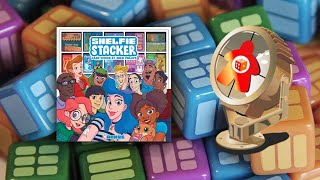
In Shelfie Stacker, players compete to accumulate the most illustrious board game collection, by carefully filling their shelf with their most recent purchases.
The game is played over the course of 7 rounds. Each round, groups of 3 dice are randomly rolled and placed into piles. These dice represent groups of board games. From their hand of 8 action cards, players must select 1 card to play facedown. These cards will not only determine turn order, but also provide a one-time ability to help players better stack their shelf.
There are specific rules around how dice can be placed into players' shelves, so careful planning is required. At the end of 7 rounds, the player with the best shelfie wins!
—description from the designer
- Accessible and quick to teach
- Interactive decision space with card-powered synergies
- Thematic and visually appealing components (dice with game titles, travel-case feel)
- Prototype status may affect early production perception
- Potential for table-prone chaos in multi-player scenarios
- board game collecting and shelf-building
- A tabletop shelf-building scenario where players stack dice representing board games
- humorous, lighthearted
- Raiders of the North Sea
Mechanics (from transcript analysis)
- card powers / abilities — Cards associated with dice grant abilities that can be activated later in the game, enabling strategic combos.
- color-column placement — Dice must be placed so that each column contains only one color and values ascend without duplicates.
- dice drafting — Players draft dice cards to place on their shelf, with each card carrying a die value and a special ability.
- endgame scoring variants — Points are awarded for top dice in columns and for satisfying specific patterns or bonuses, with variable endgame goals.
- Pattern Building — Players aim to form patterns or shapes on their shelf to claim bonuses and end-game scoring opportunities.
- shelf of shame — Dice that cannot be placed go to a penalty shelf, contributing negative points at the end.
Video topics + discussion points
Quotes (from this video)
- The boxes are cool by the way.
- This is a prototype all the way through.
- I love the color scheme that are the people that are on it it's just really really good.
- The artwork on this is super cool I love every bit of it.
- Prototype status aside, Shelfie Stacker looks incredible and the dice are very cool.
References (from this video)
- Incredibly easy to teach and learn, making it accessible to newcomers and casual players
- The scoring aid is a standout feature that keeps players focused and clarifies objectives
- Visually striking with a charming theme and a roster of character cards
- Cards enable interesting chain interactions and strategic depth for more experienced players
- Solid synthesis of popular systems (dice drafting, pattern/placement, and card manipulation) without overreaching
- As a lightweight puzzle, it may not satisfy players seeking deep or highly thematic strategy
- Not a revolutionary design; it blends familiar mechanisms rather than innovating new ones
- Collecting and arranging a shelf of games; the tactile act of stocking crates mirrors real-world shelving
- A home shelf or display area themed around organizing and showcasing board games on a 5x5, Kallax-like shelf.
- Practical, lighthearted, relatable to hobbyists; emphasizes everyday shelf-management
- Sagrada
- Azul
Mechanics (from transcript analysis)
- color-based placement and stacking — Dice must be placed into the bottom-most available space within a color-maded column, encouraging strategic stacking and color organization. Purple dice must sit atop others of the same color, enforcing vertical order.
- dice drafting — On each turn players draft one of the available crates of dice, representing game titles to be placed on their shelf. This creates a dynamic balance of immediate gain vs. future spacing and color needs.
- goal-based scoring with public and private goals — Points come from meeting private and public goals, plus penalties for shelf mismanagement (the shelf of shame). The seven-round cadence provides a compact, puzzle-like arc.
- hand/resource management and scoring aids — Players hold an 8-card hand and tap cards to show usage. The game includes a dedicated scoring aid that clarifies goals and helps track progress across seven rounds, tying card play to scoring opportunities.
- value-based placement restrictions — A die cannot be placed on a space with a value that is less than or equal to the target die, unless an allowed modification occurs. This creates tactical value management and planning ahead.
- wild dice and value manipulation via cards — Sixes act as wilds and can be changed to any value; cards in a player's hand can flip dice, swap values, or otherwise alter the dice to fit placement needs, enabling chain interactions across turns.
Video topics + discussion points
Quotes (from this video)
- Shelfie Stacker is a dinky dice drafting game that is incredibly easy to teach and learn
- the best thing about this game is the scoring aid
- this is very much a lightweight puzzle game in the mold of Sagrada or Azul
- like the idea of placing dice on patterns you could try Sagrada
- if the drafting system appeals to you take a look at Azul