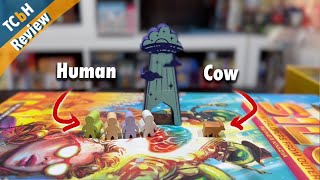
It is the year glork-too-vleep, or mid-20th century according to Earthling time. We recently stumbled across this planet called Earth and discovered intelligent, albeit primitive, life. The most intelligent and valuable of these specimens are the creatures known as cows. Many precious secrets of the universe have already been discovered through our studies of these cows, but to our frustration, we've found these particular Earthlings to be far too tranquil to harness for our political purposes. Alas, for our galactic goals we must settle upon the second-most intelligent form of life on Earth: the human being. These creatures are just intelligent enough to meet our puppetary standards. Their brains appear eager to be molded, and their civilization perfect for our siloing, so we've selected a small municipality to begin our trial invasion.
Aliens have come to silo humans — brainwash, steer, and preserve human civilization — for their cosmic purposes! In SILOS (Secret InterLopers from Outer Space), players control competing factions of aliens who abduct and brainwash humans and cows while secretly invading their community. Players tussle for majority influence in the key locations of this small town as they seek to activate location powers and control human specimens for societal power.
Players take turns repositioning their alien figures and activating an event card. The objective is to collect a complete set of humans: politicians, government operators, influencers, and professionals. A complete set will earn a player a societal power emblem, and the first player to earn five emblems wins the game. Cows are particularly valuable and thus count as wild tokens toward forming a complete set.
SILOS is a remastered edition of Reiner Knizia's Municipium that introduces many innovations by:
Restructuring the player psychology via clear, public, and easy card counting
Increasing the gameplay variety and strategies with modular location power tiles
Enhancing tactical considerations with powerful leader figures
Broadening the appeal of the theme and presentation with wacky alien conspiracy art by Kwanchai Moriya and Brigette Indelicato
Enlivening the production with disguised alien figures, abductable cows, and a roaming UFO
The separate Crop Circles Expansion introduces more elements of long-term strategy through the crop circles module, while also featuring diverging asymmetry through the permanent skill tiles module.
—description from the publisher

- innovative re-skin and streamlining of a classic Knizia layout
- clear, thematic shift to an alien abduction/retro-futurist vibe with strong art by Quan Moria
- tight tempo with a race-to-endorser-like climax; tension builds toward a five-emblem end condition
- theme may be less accessible to players seeking a traditional fantasy/Euro vibe
- heavy emphasis on timing and probability may frustrate players who love pure luck or pure strategy
- alien abduction, brainwashing, and territory majority strategy
- 1980s small-town America with alien influence
- cosmic-alien satire meets strategic tension
- El Grande
- Quo Vadis
- Age of War
Mechanics (from transcript analysis)
- area majority — competing for control across multiple locations to gain emblematic benefits
- area movement and placement management — players influence which locations they can dominate as the UFO token moves and powers activate
- card-driven power timing — cards determine which majority benefits will trigger next, creating a predictive push-your-luck cadence
- multi-tier majority rewards — three levels of majority (local, secondary, and power emblems) that unlock different benefits
Video topics + discussion points
Quotes (from this video)
- Silos is all about area majority and being in the right spot at the right time because the UFO is moving around the board and you have to predict where it's going.
- It's basically a meeting of a strategy game and a pure party game; it's hilarious.
- The Cosmic Silos Trilogy—Silos, Ego, Orbits—launched as a bundled Kickstarter with big box content.
- El Grande is a classic; Silos flips the idea by making the card actions feel like a slot machine, more frequent and dynamic.
- I love the retro Quan Moria art; it's quirky and visually striking.
References (from this video)

- Accessible, light-to-midweight
- Fun theme and quirky components
- Prototype feel; may differ in final production
- Some players may prefer heavier euro strategies
- Aliens capturing cows; strategic polling influence
- Retro UFO-themed area control
- Lighthearted and humorous with sci-fi flavor
- El Grande
Mechanics (from transcript analysis)
- Area control with moving UFO piece — Positioning UFO affects control and scoring.
- Minimalistic, streamlined rules — Focused on quick rounds and interactions.
Video topics + discussion points
Quotes (from this video)
- it's an epic game it's a follow-up to dwellings of everdale
- it's a space themed and the idea is you're at you're in Andromeda the Galaxy Andromeda
- there's a lot of replayability in terms of stuff to explore
- the deluxe edition is so well made
- Layers you are creating a dungeon behind a privacy screen
References (from this video)
- Simple and streamlined
- Fun theme with comedic touches
- Prototype stage; final version may vary
- Aliens capturing humans and cows with humor
- Retro UFO capture theme
- Light, humorous sci-fi action
- El Grande
Mechanics (from transcript analysis)
- Area control with UFO piece — A moving UFO piece influences control as it travels
Video topics + discussion points
Quotes (from this video)
- it's an epic game it's a follow-up to dwellings of everdale
- it's a space themed and the idea is you're at you're in Andromeda the Galaxy Andromeda
- there's a lot of replayability in terms of stuff to explore
- the deluxe edition is so well made
- Layers you are creating a dungeon behind a privacy screen
References (from this video)

- Clever asymmetry and thematic execution
- Beautiful art and quirky theme
- Some learning curve due to multiple faction abilities
- Aliens masquerading as humans navigating a grid
- Retro UFO-themed area control
- Orbit
Mechanics (from transcript analysis)
- Area Control — Compete for influence on locations; timing and movement matter
- Turn order and impact — Factions influence different areas with various powers; aliens can gain advantages through placement
Video topics + discussion points
Quotes (from this video)
- "It's so simple, but it's really clever."
- "This is a two-player head-to-head card combat game."
- "We are the aliens."
- "Bot or Not has me laughing a lot more."
- "Gen Con party game of the show, Bot or Not, unanimous."
- "Flip Tunes is my Gen Con game of the year."
References (from this video)
- Accessible and quick to learn, with tight area control focus that remains engaging throughout.
- Minimalist design logic clicks early: personal cards feel powerful but require timing and restraint.
- Strong thematic flavor through goofy, stylized 90s sci-fi aesthetics that support the feel of play.
- Smart design choices like board-area prompts and visible future options offset potential passivity from the deck.
- Theme may not feel essential to some players, making it harder to classify as a 'must own' despite solid mechanics.
- Some players may wish for more direct interaction or higher drama beyond strategic positioning rather than pure contest.
- Cosmic efficiency and social manipulation through area control, with playful nods to 1990s sci-fi tropes.
- A retro-futuristic, tongue-in-cheek sci-fi setting where alien agents invade a society of cows and humans to recruit specimens and score galactic points.
- Playful, quirky, and thematic, blending humor with strategic tension.
- Municipium (2008) - original reimplementation lineage
Mechanics (from transcript analysis)
- Area Control — Players vie for control of locations using a mix of pawns, with scoring determined by control thresholds and token allocation (two for the leader, one for the second place).
- Deck visibility and planning — The game design places remaining common cards around the board, allowing players to gauge future options before the deck exhausts and reshuffles.
- Deck-driven actions — A common deck drives most activations. Top cards move the Mother Ship, place humans, or trigger location powers, creating cascading effects on the board.
- Graduation caps (influence multipliers) — Graduate-cap tokens upgrade teams, doubling their influence and impacting end-game scoring dynamics.
- Location powers — Locations grant special abilities that can rearrange pawns, influence tiebreakers, or alter the order of play, adding depth to planning.
- Personal power cards — Each player has a small set of personal one-time-use cards that can be flipped to create strategic opportunities at critical moments.
Video topics + discussion points
Quotes (from this video)
- Silos is an incredibly tactical.
- It's incredibly easy to pick up, and the goofy, very stylized '90s sci-fi aesthetic makes the game a charming breeze.
- Without attachment to the theme, it's hard to call Silo a must own with a myriad of other incredible output by this designer.
- it's a tight area control game that's still light on its feet and veers more towards contest than conflict