THE GREAT RETURN
Over generations and generations the ancient woodland of Børe prospered and grew. The world was bestowed with great spirit, which lifted the animals of the land to new heights. Unfortunately, over the years these clans lost touch with the spirit of the land and faction warring developed. The Foxen Kingdom of Skulk Hollow in the South, The spiritual Red Pandas of Cupboard in the North, the Mischievous Mice of Multon in the West, and the colony of Blackheart Bunnies in the East. As skirmishes started breaking out across the continent, lives lost, there was a monstrous shake and then The Great Return. No one quite knows why, but the Guardians have risen - but not the kind, life-giving Guardians of spiritual legend. Dark, ferocious, versions that are now attacking all the kingdoms of the land.
OBJECTIVE
In Skulk Hollow, two players take the roles of either a towering behemoth of a Guardian trying to eliminate the clans of foxes who have been causing havoc on the countryside, or a band of foxen heroes out to vanquish the evil beast that has been terrorizing the land and reunite the four kingdoms of Børe.
The Guardian wins the game by either eliminating the Foxen King, or by gaining enough Tribute.
The Foxen Heroes wins the game by eliminating the Guardian.
GAMEPLAY
Skulk Hollow is a 2-player, asymmetric, tactical combat game. Player use action cards to move their units, summon, and use special abilities. Taking down a guardian requires the Foxen player to leap onto the Guardian player board and take out different parts of the character.

- Part of the early career in board game content creation; strong social/community angle
- Little concrete mechanical detail provided in the interview; uncertain publisher/designer data
- Exploration and social interaction within a thematic world
- Fantasy woodland setting implied by a prior mention and general vibe of the game, discussed in context of first contact with the designer/producer
- Open-ended, campaign-like potential with a strong narrative component
- Unknown
Mechanics (from transcript analysis)
- Campaign progression — Implied long-term arc when referenced as a first contact game in early career
- Social/initiative play — Player interaction and persuasion dynamics implied by early discussion and crossing paths
Video topics + discussion points
Quotes (from this video)
- i decided i was going to do a lot of promoting of other people's products
- the energy that i can give to a product
- we're a team we're a great team
- just do it man just do it
- the next ones we're gonna loosen it up attack too hard
- you make content here that's it and when i joined man vs meeple i was very clear
References (from this video)

- Gorgeous production values, with striking art and a standout insert that organizes components efficiently.
- Strong, well-executed asymmetric design that provides deep tactical decisions for both sides.
- Clever board geometry and tentacle-based win condition create satisfying spatial gameplay.
- Deck design and multi-use cards enable flexible action planning and effective cycling.
- Beautiful thematic flavor, with inspirations drawn from epic fantasy and iconic visuals like Shadows of the Colossus.
- Expansion potential (relics) offers a path to extend the two-player experience without breaking the core balance.
- Limited to two players, which excludes larger-group play and may deter some players seeking variable player counts.
- Learning curve can be steep for newcomers to asymmetric, card-driven duels, and there can be analysis paralysis on complex turns.
- Some players may prefer a faster pacing; the deep planning required can slow down the flow in casual sessions.
- Asymmetric duel in a mythic-fantasy setting, focusing on territory control, direct interaction via positioning, and a tense, escalating contest between two distinct play styles—rapid, aggressive expansion for the Fox in Heroes and stout, patient defense for the Guardians.
- Skulk Hollow is set in a dark, creature-infested realm where two factions—the Fox in Heroes and a family of Guardians—contend for control of a patchwork, hex-ish board. The map is designed with a corner-to-corner orientation rather than a traditional edge-to-edge layout, emphasizing tactical placement, ambush opportunities, and territorial defense. The Guardians occupy lairs and space across the board, while the Fox in Heroes defend their homeland and attempt to strain the Guardians’ hold by extending their influence through tentacle-like growth and controlled incursions.
- A compact, descriptor-driven fantasy narrative inspired by classic epics and monster-hunting folklore. The game evokes Shadows of the Colossus feel through the sense of vertical scale, climactic confrontations between colossal foes and lone defenders, and a focus on dominating space through calculated, dramatic maneuvers.
- Lord of the Rings: Confrontation
Mechanics (from transcript analysis)
- Action economy — On a turn, players receive a limited number of actions and must decide how to allocate them among moving, attacking, healing, or manipulating the board. The combination of top/bottom actions and card cycling creates a rich set of tactical possibilities each turn.
- area control / tentacle placement — The Fox in Heroes attempts to place six tentacles on the board across Guardians’ spaces. Each tentacle placement advances the Fox toward victory, while Guardians may counter by blocking or targeting opponent pieces to thwart progress.
- Asymmetric play — Skulk Hollow is designed so that the Fox in Heroes and the Guardians do not share the same victory conditions, abilities, or deck compositions. Each side has a unique set of actions, goals, and interactions that shape strategic choices and shift the balance of power as the board state evolves.
- board orientation and geometry — The board’s 90-degree corner-to-corner orientation creates a distinctive spatial dynamic. This layout influences how players plan routes, block lanes, and exploit distance for ranged versus melee interactions.
- combat resolution — Damage and wounds are tracked on individual units. Defeating key enemy pieces or disabling their abilities can swing the course of the game, with some actions capable of removing or reducing enemy options.
- deck cycling and draw — Discarding cards allows players to draw more cards, enabling faster access to critical actions. This mechanic reduces the chance of being stranded with unusable cards and keeps the rhythm of play steady.
- hand management — Players manage a hand of multi-use action cards. Each card typically provides a top action and a bottom action, and players must choose how to sequence these options across turns. Discarding can draw new cards, enabling deck cycling and targeted searches for key tools.
- leader and guardian interaction — Guardians and Fox units feature unique leadership abilities and guardian-specific events. These systems reward careful timing and positioning, and create moments of dramatic turn-tabling interactions.
- Movement and interaction — Movement is governed by action cards and may involve leaping, pulling, or shock effects. Interacting with opposing units can disable or modify their abilities, adding a layer of direct confrontation beyond pure positioning.
- resource cubes and healing — Power cubes serve as a resource that can be spent for extra actions or healing. End-of-turn distribution to characters provides ongoing strategic value and encourages careful resource management.
Video topics + discussion points
Quotes (from this video)
- This is my favorite pencil-first game yet.
- I love this game; I think this is one of the best two-player games that came out this year.
- This game is absolutely gorgeous.
- The insert is amazing; you have a spot for all the top boxes and it fits in the box with everything else.
- If you're into two-player games and you love asymmetric design, this game is totally worth it.
- It's a fantastic two-player game if you play mostly two-player games.
- This game is a knockout for two players who want deep, tactical duels with beautiful components.
- I think this is one of the best you-player games that came out this year.
References (from this video)
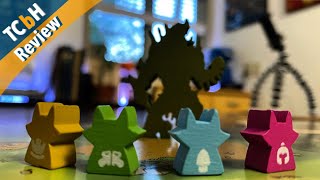
- Strong thematic cohesion: the foxen versus guardians premise is immersive, with striking visuals and a cinematic feel that pulls players into the world.
- Distinct guardian asymmetry and victory conditions encourage varied playstyles and high replay value.
- Aesthetic quality is excellent: large, wood-toned guardian minis with tactile design and evocative tentacle motifs that enhance immersion.
- Approachability and clarity make it accessible to a broad audience, including families and newer gamers.
- Power-cube mechanic introduces meaningful, scalable decisions that influence multiple future turns.
- Foxen unit roles offer tactical choices within a compact action space, allowing for meaningful planning and counterplay.
- Even in defeat, watching the unfolding board state remains engaging and satisfying due to the cinematic feel.
- Despite its simplicity, the game rewards thoughtful positioning and timing, yielding satisfying micro-decisions.
- Foxen flavor and long-term strategic depth feel thinner than the guardian side, creating an asymmetry in perceived weight.
- Deck randomness can undercut long-term planning and reduce predictability, potentially diminishing the sense of mastery for some players.
- Limited expansion of fox hero options may restrict flavor variety and asymmetrical storytelling across games.
- While accessible, some players may crave deeper systems or more dynamic interactions between foxen and hero integrations.
- The emphasis on theme and quick rounds can sometimes come at the expense of broader strategic tension compared to heavier asymmetric titles.
- Small, cunning forest dwellers engage in a high-stakes stand against massive, otherworldly guardians, blending forest folklore with cinematic combat.
- A sacred forest battleground called Skulk Hollow where a heroic foxen army defends their homeland against colossal, elemental guardians that embody the land itself.
- cinematic, story-driven, and highly thematic through action animation, unit placement, and guardian behaviors
- Shadows of Colossus (video game)
Mechanics (from transcript analysis)
- asymmetry — Foxen and guardians operate under different rules, with distinct victory conditions and action flows that drive tension and counterplay.
- Climb and disable mechanics — Foxen can ascend onto guardian locations to damage specific sites, hindering or preventing certain guardian actions and advancing toward victory.
- Deck-driven actions for guardians — Each guardian uses its own action deck, steering its aggressiveness, timing, and threat level in ways that require different responses from the foxen.
- Foxen unit roles and space-based interaction — Units have distinct roles (archers, sentinels, etc.) with different spatial rules, which creates tactical depth around positioning and coverage.
- Guardian asymmetry and ranged/melee balance — Guardians vary not only in powers but also in how they impose threat ranges, vulnerabilities, and win conditions, creating diverse matchups.
- Luck and deck randomness — Card draws introduce a level of randomness that affects early-to-mid game flexibility and long-term sequencing, influencing risk management.
- Power cubes and future-turn planning — Power cubes act as a resource to unlock bonus actions on future turns, rewarding foresight and careful commitment of current actions.
- Single foxen deck with board-population — The foxen side relies on a single deck but can populate the board with an increasing number of foxen meeples, creating escalating pressure and crowd control decisions.
- Turn economy and action limits — Foxen typically has three actions per turn while guardians have two, creating a squeeze between doing more now versus preserving options for later.
Video topics + discussion points
Quotes (from this video)
- this is so incredibly thematic
- the guardians are big and stompy and moving about the board
- the mechanics reverberate that thematic immersion so well
- it's a nice approachable head-to-head game
- even on the losing end it's so cool to see things unfold
- cinematic story that's unfolding in front of you
- I would have liked a little bit more depth and complexity but overall I like this game
- the simplicity and approachability does work in its favor
References (from this video)

- beautifully asymmetric
- accessible
- exciting
- plays quickly
- lots of variety with different leader units and elemental forces
- fantastic cinematic element
- asymmetric gameplay
- inspired by Shadow of the Colossus
- cinematic struggle
- Shadow of the Colossus
Mechanics (from transcript analysis)
Video topics + discussion points
Quotes (from this video)
- there are a lot of great games and there are a lot of great games that play excellently at two players
- so simple and so elegant and so refined and yet so puzzly and ingenious
- one of the best tactical miniatures games out there without any miniatures whatsoever
- the thing is is that if you sell in bulk you get extra bonuses but if you sell early then you get the most valuable versions
- it gives you so much to consider and be cognizant of as you are drafting every single card but it is incredibly indelibly accessible