Small Samurai Empires is an action-programming area-control game for 2-4 players, where players are fighting for control of Japan with their armies of Samurai!
A game of Small Samurai Empires is played in 3 Eras, each consisting of 2 rounds. Each round, players will take turns placing order tokens facedown on one of the slots available in the 4 regions of Japan. When all players have placed their tokens and filled all the token slots, they will be revealed and resolved one by one by the owner of the token. These order tokens will enable the players to recruit mighty Samurai armies, move their armies to conquer provinces, build castles to defend and maintain control of their provinces and do other meaningful actions.
At the end of each of the three Eras, players will score points depending on the regions they control and their value, which can change during as the game progresses. Finally, the player with the most points at the end of the game is the winner!
—description from the publisher
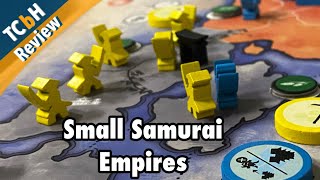
- Bonkers and incredibly good action resolution system
- Simple, accessible actions that still create crunchy decisions
- Elegant balance between planning and anticipation across regions and eras
- Visual presence and table presence despite small components
- Destiny cards provide agency without overcomplicating information
- Limited long-term strategy due to point-based, multi-path scoring
- Lack of asymmetry and development path for factions
- No expansion content included by default; potential for future expansions
- Variants may shift player experience toward short-term tactical grabs
- area control and influence through fate and destiny cards in a feudal Japan setting
- Feudal Japan archipelago, three eras
- historical/fantasy, elegant, restrained
Mechanics (from transcript analysis)
- action programming — Players lay out actions to be resolved in a fixed order, creating a planning puzzle.
- area control and influence — Control territories and influence in regions to score points and gain advantages.
- castle building and regional development — Castles boost influence in regions; acquiring tokens creates strategic pressure.
- destiny cards — Destiny cards chosen at the start of each era augment regional potency and create short-term goals.
- hidden action selection and linear resolution — Actions are revealed and resolved in sequence depending on placement, with region-based effects.
- resource management via Bushido and Food tokens — Harvested food and bushido amplify action potency and strategic options.
Video topics + discussion points
Quotes (from this video)
- the linear action system is bonkers in how well it works for this sort of point-based area control game
- it's such a beautifully done game
- the simplicity works so much in its favor
- destiny cards add agency without overcomplicating the core