Space Alert is a cooperative team survival game. Players become crew members of a small spaceship scanning dangerous sectors of the galaxy. The missions last just 10 real-time minutes (hyperspace jump, sector scan, hyperspace jump back) and the only task the players have is to protect their ship.
During play, the central computer will announce the presence of various threats on one of the supplied 10 minute soundtracks that also acts as a game timer. The threats vary from space battleships and interceptors to different interstellar monsters and abominations, asteroids or even intruders and malfunctions on the spaceship. Players have to agree who will take care of which task and coordinate their actions (moving around the ship, firing weapons, distributing energy, using battlebots to deal with intruders, launching guided missiles, etc.) in real time to defend the ship. Only a well-working team can survive 10 minutes and make the jump back to safety.
The game offers several difficulty levels, huge variability and a unique experience for one to five player teams. One mission lasts only about 30 minutes, including setup and evaluation.
(Based on a description from Czech Games Edition)

- Dynamic tension when functioning smoothly
- Tough setup and complex teach
- Cooperation under time pressure
- Space station under threat, simultaneous crises
- Real-time suspense with emergent events
Mechanics (from transcript analysis)
- Communication-intensive — Clear, quick coordination is essential for success.
- Real-time cooperative play — Players perform actions in real time to avert disaster.
Video topics + discussion points
Quotes (from this video)
- Don't keep games around unnecessarily because soon 5 years turn to 10 years turns to 20 years.
- The space on the shelves has been replaced by something new and exciting.
- Think of all the hundreds you've saved in insulation.
- Just focus on 100, 200 that you think are amazing rather than like being overwhelmed with indecision.
References (from this video)
- Innovative real-time cooperative experience
- CD soundtrack enriches immersion
- Steep teaching curve
- Hard to revisit after first play
- Sci-fi tactical coordination under time pressure
- Spaceship under threat in real-time
- Pandemic
- Descent: Journeys in the Dark
Mechanics (from transcript analysis)
- real-time coordination — Players issue commands to their ship in real time, risking missteps.
Video topics + discussion points
Quotes (from this video)
- this is a terrible game I have done a video about why you should never play Monopoly
- this is a cooperative word building game this is quite a clever idea you've got letter cards you can't communicate and you're trying to
- this is a big group game a massive group game that you can play with like 30 people
- Sushi Go Party is a brilliant gateway hand drafting game where you're trying to eat the best meal of sushi
- Forbidden Island this is a very simple cooperative game from Matt Leacock the designer of pandemic
- Santorini is a wonderful abstract game it looks amazing on the table
- Mysterium does an incredible job of showing how different and exciting board games can be to new audiences
- I love Pandemic the original game which is now in this box
- it's a huge entertainment experience that has a lot of storytelling potential and a social component that keeps people engaged
References (from this video)
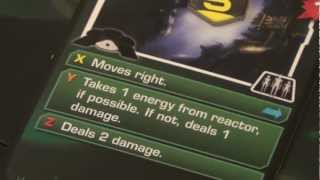
- intense tension and pacing that ramps as phases progress
- strong cooperative feel and clear escalation of threats
- clear feedback on reactor energy and shield status
- interplay between offense, defense, and maintenance creates satisfying decisions
- steep learning curve for new players
- solo play is exceptionally challenging and may require house rules
- component fiddliness and setup can slow early sessions
- cooperative crew coordination under time pressure, defense and repair balance
- Inside a starship during a multi-phase defensive operation with external and internal threats
- procedural, tactical, simulation-driven
Mechanics (from transcript analysis)
- Combat systems and interception — Battle bots, rockets, and interceptors provide offensive options against threats, requiring piloting coordination.
- Cooperative real-time coordination — Players coordinate actions in a high-tidelity, time-sensitive environment to maximize effect and avoid systemic damage.
- phase-based progression — The game unfolds across distinct phases (second phase, third phase) with escalating threats and changing player actions.
- Resource and energy management — Energy from reactors and energy cells must be allocated to weapons, defenses, and repairs, with limited supply and strategic timing.
- Threat encounter and resolution — Threats include saboteurs, cryo shield fighters, and the Man-of-War, each with movement, hit points, and special effects.
Video topics + discussion points
Quotes (from this video)
- it's so intense
- wow
- if you can do that solo then you're a better man than me
- live action phase and it was intense
- mission complete
- jumping to hyperspace
References (from this video)
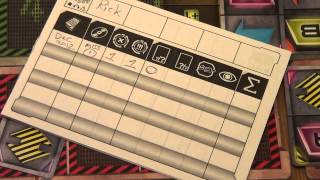
- Engaging real-time cooperative gameplay
- Excellent solo playability
- Interesting tactical decision-making with weapon selection
- Well-designed threat management system
- Fair and rewarding scoring system
- Clear rules structure (well-explained in playthrough)
- Replayability with difficulty adjustment
- Battle bot system adds strategic depth
- Complex rules with multiple scoring categories
- Requires careful tracking of multiple systems
- Real-time aspect may cause stress for some players
- Ship damage tracking can be fiddly
- Science fiction
- Space combat
- Spaceship defense
- Cooperative survival
- Real-time action
- Alien threats
- Other cooperative board games
- Real-time board games
- Tower defense games
Mechanics (from transcript analysis)
Video topics + discussion points
Quotes (from this video)
References (from this video)
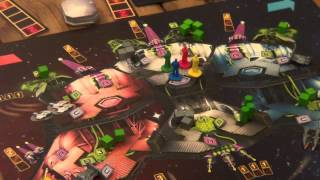
- Immersive real-time cooperative play
- Clear top-level teaching during play
- High tension and strategic planning
- Solid solo-play support
- Complex rules requiring substantial setup
- High pressure may be stressful
- Possible ambiguity in certain resolutions
- High-stakes space exploration with crew coordination
- A cooperative, time-sensitive mission aboard a spaceship under threat
- Procedural, mission-focused with escalating threats
Mechanics (from transcript analysis)
- Card-driven actions and A/B triggers — Action cards with A or B triggers to execute heavy weapons.
- Energy/shield management — Central reactor powers shields; energy can be allocated to boost shields.
- Planning board and non-verbose planning — A planning board for staging actions, with room for mis-planning.
- Real-time cooperative play — Players act in real-time to plan and execute actions in phases.
- Threat management and trajectory tracking — Threats (asteroids, fighters) advance on trajectory tracks with X/Y/Z danger zones.
- Tiered action phases — Actions are organized into phases; some phases lock positions.
- Weapon systems and ranges — Cannon, heavy cannon, rockets; range limitations and simultaneous fire for maximum damage.
Video topics + discussion points
Quotes (from this video)
- this is one take of playing out 10 minutes of game time
- there's no rules and regulations to limit what you can do on this board
- we're free to move as much or as little as we want
- it's imperative that you're organized
- heavy Cannon does five damage
References (from this video)
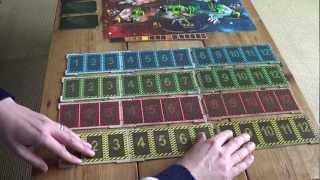
- Strong teamwork and communication emphasis in a real-time setting
- Modular ship layout with distinct roles and capabilities
- High replayability due to random mission and threat layouts
- Audiovisual real-time cues via CD or cards to pace gameplay
- Complex setup and rule surface that may intimidate newcomers
- Real-time pressure may be stressful; coordination is crucial
- Solitaire play reduces the team dynamic and may feel less engaging
- Cooperative real-time space survival and management
- A contained spaceship in space under threat from internal and external dangers during a ten-minute action phase.
- Educational walkthrough with live narration; emphasis on setup and real-time play
Mechanics (from transcript analysis)
- CD/audio-driven gameplay — A CD soundtrack or card cues provide the real-time instruction for threats and sequence of events.
- Combat and weapons variety — Heavy/light cannons, shields, battle bots, rockets, and interceptors offer a range of defensive/offensive options.
- Damage tokens with subsystem effects — Damage tokens personalize and modify subsystem performance as damage accrues.
- Deck-based actions with phase limits — Two decks of action cards (regular and advanced) govern permissible actions per phase, with multiplayer hand limits.
- Real-time action selection — Players perform actions in real-time as threats are described, using timed CD/audio cues or instruction cards.
- Resource and energy management — Central reactor powers lateral reactors and shields; energy tokens manage shield strength and weapon readiness.
- Station-based ship layout — The ship has three color-coded stations (red, white, blue) with upper/lower decks connected by a lift; players move to respond to threats.
- Threat tracks and trajectories — External and internal threats advance along threat tracks; reaching certain points triggers attacks or alarms.
Video topics + discussion points
Quotes (from this video)
- this is a very interesting game you're going to enjoy this playthrough
- it's an interesting challenge for me because it means I'm going to have to play in real time
- we'll go back to my usual format for that stage of the game
- the premise of the game is this is your spaceship
- it's a survival game
- communication and working as a team
- it's going to be a ton more fun with multiple players
References (from this video)

- thrilling, fast-paced teamwork
- high engagement and tension in real-time play
- requires strong communication and setup
- potentially challenging for new players
- cooperative real-time space operation
- crew of a spaceship executing missions
- urgent, time-pressured teamwork with synchronized actions
Mechanics (from transcript analysis)
- cooperative play — team members work together to complete objectives
- multi-task management — various ship systems require attention and action
- real-time coordination — players perform tasks simultaneously under time pressure
Video topics + discussion points
Quotes (from this video)
- Nations is this big box civilization game which sounds really intimidating when in fact it really isn't
- it's just a really big card game
- you're building your city with animals
- it's a rock paper scissors thing
- this is a game that's the closest to being real detective as i have ever played
- you have five different cases that continue the story
- it's stressful but it's also really fun
- one player is the architect he draws a card and he sees what needs to be built
- the monkey in the middle is telling the monkey in the end who cannot see what needs to be built
- you are a witch you're brewing