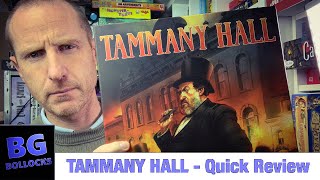
"The way to have Power is to take it" - William "Boss" Tweed
Tammany Hall is a game of backstabbing, corruption, temporary alliances, and taking power at all costs. If you want to rule New York, you are going to need to play the city's growing immigrant populations against one another. Help the immigrant groups who owe you political favors, call in those favors to slander your rivals, and win elections.
In Tammany Hall, players help immigrants settle in New York, collect political favors from those immigrant groups, send ward bosses into Manhattan to secure votes, and slander political opponents. An election is held at the end of every fourth year, and the player who uses his power base best will be elected mayor. The Mayor's grip on the city is tenuous at best. After every election, the Mayor must pay off his political rivals by placing them in offices that they can wield to try to take control of the city. Every player is your friend, every player is your enemy.
Tammany Hall was the political machine that dominated New York City politics by organizing the immigrant populations. While the organization's influence spanned from its founding in the 1790s to its collapse in the 1960s, this game is set in lower Manhattan roughly between 1850 and 1870 – the era of Boss Tweed.

- tight interaction
- unfriendly for some groups
- urban power dynamics
- political maneuvering
- mean-spirited negotiation
Mechanics (from transcript analysis)
- blocker/negotiation — mean interaction and negotiation with adversaries
Video topics + discussion points
Quotes (from this video)
- One of the greatest experiences I've ever had playing a board game ever.
- It's all about board games, but especially the people who play them.
- This is Look Back, a series that I do where I talk about games that I reviewed one year ago, 5 years ago, 10 years ago, and 20 years ago during this time frame.
References (from this video)

- Translates well to high school setting
- Politics thematic element works for younger audiences
- Dark original theme with corruption and violence
- Political corruption and manipulation
- 18th century New York politics
- historical simulation
- Tammany Hi (proposed high school version)
Mechanics (from transcript analysis)
- Area Control — Vicious politics and gang control of neighborhoods
- Player manipulation — Deceiving other players for political advantage
Video topics + discussion points
Quotes (from this video)
- the most fun part is building the castle itself
- kids love hearing the same stories over and over
- a giant space exploration game with ships like this I doubt I would have left the house for at least a year
- the vicious politics of 18th century New York translated exceedingly well to the average American high school
- if any game out there needs a kid-friendly version its Kingdom death monster
- a wonderfully wholesome game already but a kids version of this game would be amazing
References (from this video)

- treacherous and thematic for experienced players
- may be tough for families or newcomers
- Political intrigue and treachery
- New York political machine era
- Treacherous, negotiation-driven
Mechanics (from transcript analysis)
- social deduction / negotiation — players vie for influence in a political scheme
Video topics + discussion points
Quotes (from this video)
- it's a gateway game
- the artwork will make you hungry
- we love talking to you guys we do we love it
- awesome to see the final product
- Parks just looks beautiful
- we're going to check it out
References (from this video)

- clever theme execution
- shorter playtime than many strategic titles
- often overlooked; availability varies
- Political influence and coalition-building
- New York political machine
- Historical-political strategy
- Chinatown
Mechanics (from transcript analysis)
- auction/coalition-building — Players bid and form alliances to advance influence.
Video topics + discussion points
Quotes (from this video)
- you are correct the answer is b
- it's actually a board game not an rpg
- Hanabi you actually got that in just in time
- new york zoo… happy birthday
- through the ages
- your latest game working circuits it's only 20 dollars
References (from this video)
- excellent at 5 players with distinct roles for each
- four immigrant types prevent one player from settling on a single nationality
- tight contests with no easy wins
- increases table talk and political negotiation
- known to bring out 'terrible behaviors' in players
- can lead to nasty arguments and tension
- may be difficult to find in print
- area control games encourage confrontational play
- politics
- immigration
- area control
- 1800s New York
- Agricola
Mechanics (from transcript analysis)
Video topics + discussion points
Quotes (from this video)
References (from this video)
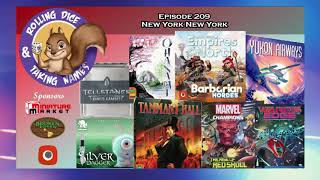
- Tightly integrated area-control with high player interaction
- Satisfying “ketchup” mechanic where powerful actions can be granted to others, balancing play
- Clear, thematic map and rule presentation; approachable for a mid-weight game
- Can feel mean-spirited and highly negotiable; heavy interaction may exhaust some players
- Requires careful tracking of influence and ward status; could be fiddly for new players
- Political influence, district control, backroom deals
- Mid-1800s New York politics; immigrant districts; political machines
- Area-control with social maneuvering and voting mechanics
- Imperial Settlers
- Lord of the Rings: The Card Game (LCG) style campaigns
- Risk
Mechanics (from transcript analysis)
- area control / area influence — Players contest districts on a map, placing influence and using special powers to sway elections.
- Election-phase resolution with arrows on a map — End-of-round voting/territorial resolution uses a map with directional arrows to indicate who wins each district.
- Slander and influence management — Players can spend resources to slander opponents and push influence across wards/districts.
- Two-actions-per-turn engine — On a turn you pick from two possible actions, shaping your immediate and future options.
Video topics + discussion points
Quotes (from this video)
- it's a memory game i mean if you say it's not
- barbarians adds a whole new element to it you've got all these different expansions
- the production is top notch
- two actions you can do on your turn
- the board is basically a map and the map shows you how elections will be resolved with arrows
- rise of red skull came out and the reason why we're so excited about this was because this is it was introducing campaign elements
References (from this video)

- Heard very good things about it
- Political maneuvering
- New York City politics
Mechanics (from transcript analysis)
- Area Control
Video topics + discussion points
Quotes (from this video)
- We love trick taking games
- This game is so much freaking fun
- I adore GMT games, they are becoming one of my favorite game publishers
- If you remember Vast Crystal Caverns is in my top five games of all time
- We bloody love it
- We can't stop playing
- It's a blimp game not a train game
- That's just work
- I don't think I want to play it
- I'll get it eventually
References (from this video)
Mechanics (from transcript analysis)
Video topics + discussion points
Quotes (from this video)
- it's a lifestyle it's a lifestyle we've just committed
- we're all human
- stay positive don't let the travels of this country get you down
- we want everybody to be at the table contributing at that table
- this is a tall order
- we're counting down this is 20 and 21
References (from this video)

- Simple rules to learn
- Deep, meaningful decisions with long-term planning
- Clever come-from-behind mechanic via mayor powers
- Strong thematic setting and artwork
- Meanest, most cutthroat and brutal feel may deter some players
- Can feel dry or overly dry thematically to some
- Area-control focus may feel repetitive compared to other themes
- political corruption, immigration, ward politics, mayoral influence
- 19th-century New York City during waves of immigration; political machine Tammany Hall
- historical political intrigue with cutthroat rivalry
- El Grande
- Mission Red Planet
- Utopia Ethnos
Mechanics (from transcript analysis)
- Area Control — Control 14 wards with ward bosses; each ward yields votes in elections.
- bidding/influence — Spend political influence tokens to bid for control and actions.
- elections and scoring — Four citywide elections determine ward outcomes; wards award votes to the leading players.
- immigrant management — Immigrants are recruited from Castle Garden and spent to influence ward outcomes.
- mayor power dynamics — The mayor distributes powers to opponents, enabling comeback mechanisms and disruption.
- Slander tokens — Use a slander token to remove an opponent's ward boss, costing one political favor.
Video topics + discussion points
Quotes (from this video)
- one of the meanest most cutthroat and brutal games around
- the mayor has to give out amazing powers to their rivals
- it's a clever come from behind mechanic that rewards the mayor for winning the election by giving the mayor's opponents the means to take them down
References (from this video)
- Map growth over the game provides evolving strategic options and tension.
- Strong blend of public and private information creates meaningful decisions and risk management.
- Slander tokens introduce backstabbing flavor without over-reliance on luck.
- High tension and nail-biting moments as the game progresses.
- Thematic cohesion with policy maneuvering and immigrant population mechanics enhances immersion.
- High complexity and many moving parts, especially at higher player counts.
- Late-game permutations can be hard to track, increasing cognitive load.
- Office benefit tokens are single-sided, which is a minor production nitpick.
- The game can feel like a relic of older Euro design to players seeking newer mechanisms.
- Political influence and backroom maneuvering in Tammany Hall
- New York City political machine era, immigrant population influence, elections
- Direct, tactical area-control with hidden information and slander mechanics
- El Grande
Mechanics (from transcript analysis)
- Area Control — Players vie for influence in wards using ward bosses and immigrant tokens.
- Bluffing and information balance — Public ward presence vs hidden immigrant cubes creates strategic uncertainty.
- Election phase — End-of-round elections determine control of wards and mayor status, driving scoring and board state.
- Map expansion and timing — Zones unlock progressively; the map grows in scope, altering strategy and targeting choices.
- Office benefits — Positions like council president, deputy mayor, and precinct chairman grant recurring powers and scoring bonuses.
- Slander tokens — Tokens can be spent to expel opponents' ward bosses under adjacency and matching cube conditions.
- Token economy and immigration cubes — Cubes populate wards and are drawn from a bag, creating a mix of public setup and private draw results.
Video topics + discussion points
Quotes (from this video)
- this game is an area control game it consists of two phases the first phase is the castle garden phase
- the map increases in size the further into the game you get
- there's a really clever mix of public and private information
- the slander tokens add just enough take that into what otherwise wouldn't be that much of a backstabbing game
- this is without that one of our favorite area control games that we've played in a very long time
- it's a fantastic area control game
- we wholeheartedly recommend tammany hall for you