Unlike in other cultures, the desert Tuareg men, known as Targi, cover their faces whereas women of the tribe do not wear veils. They run the household and they have the last word at home in the tents. Different families are divided into tribes, headed by the ‘Imascheren’ (or nobles). As leader of a Tuareg tribe, players trade goods from near (such as dates and salt) and far (like pepper), in order to obtain gold and other benefits, and enlarge their family. In each round their new offerings are made. Cards are a means to an end, in order to obtain the popular tribe cards.
The board consists of a 5x5 grid: a border of 16 squares with printed action symbols and then 9 blank squares in the centre onto which cards are dealt. Meeples are placed one at a time on the spaces at the edges of the board (not including corner squares). You cannot place a meeple on a square the opponent has a meeple on already, nor on a square facing opponent's meeple. Once all meeples are placed, players then execute the actions on the border squares the meeples are on and also take the cards from the centre that match the row and column of the border meeples.
The game is predominantly scored and won by playing tribal cards to your display. These give advantages during the game and victory points at the end. Usually cards are played (or discarded) immediately once drawn. A single card can be kept in hand but then requires a special action to play it (or to discard it to free the hand spot for another card). Each card has a cost in goods to play. Goods are obtained either from border spaces or from goods cards.
The display (for scoring) consists of 3 rows of 4 cards that are filled from left to right and cannot be moved once placed (barring some special cards). There is also a balance to be found between the victory point score on the cards themselves (1-3 VP per tribal card) and in the combinations per row (a full row of 4 identical card types gets you an additional 4 VP, and a full row of 4 distinct card types gets you 2 VP).
The winner at the end of the game is the player with the most victory points.

- tight, blocking-driven push-your-luck decisions
- accessible for two players yet deep in strategy
- engaging interaction with direct competition
- learning curve around border-card timing
- can feel harsh due to blocking and resource denial
- resource management within a border-grid system
- desert trading caravans and tribal competition
- abstract yet thematic trading
Mechanics (from transcript analysis)
- grid/intersection effects — actions happen at intersections of workers on a central grid
- set collection — collect goods and tribe cards to sequence scoring
- worker placement — players place workers on border cards to gain resources
Video topics + discussion points
Quotes (from this video)
- it's a really good two-player game
- the production value of this game is so good
- it's a tight game that feels tense especially with the drafting
- this game can be quite mean because you're going to be blocking each other a lot
- it's the kind of game that stresses me out like in a good way
- it's got a lot of luck it's not too heavy
- it's another game of historical World War II simulations
- sometimes the dice just aren't on your side
- it's a brain burner
- it's that time you killed me
References (from this video)
- deep two-player strategy
- modular board variety
- steeper learning curve
- resource management and set collection
- Saharan trade
- deep strategic
Mechanics (from transcript analysis)
- tableau building — build a personal set of cards to produce resources.
- worker placement — players place workers on actions to gain resources.
Video topics + discussion points
Quotes (from this video)
- cheap games yes again
- here's some games under 25
- it's a two-player game
- open drafting and set collections
- it's trick taking and bidding
References (from this video)

- Unique grid system
- Strategic blocking
- Tight two-player gameplay
- Limited interface on Board Game Arena
- Resource management
- Nomadic tribal trade
- Watergate
Mechanics (from transcript analysis)
- worker placement — Players place meeples on grid to collect resources and complete objectives
Video topics + discussion points
Quotes (from this video)
- I am the season one Champion
- Play some games will you
References (from this video)

- highly unique two-player experience
- strong blocking and planning decisions
- not ideal with very large player counts
- can feel long at times
- economic strategy with its own unique trader dynamics
- Tuareg traders and border interactions
- heavy on strategic positioning and blocking
Mechanics (from transcript analysis)
- constrained worker placement — place pawns to take actions while blocking opponents' rows/columns.
- set collection and resource conversion — collect resources and gold to acquire cards scoring in multiple ways.
Video topics + discussion points
Quotes (from this video)
- D's not a rules follower
- on each person's turn you know one person draws calls out a resource and then everyone has to place that resource
- it's a gateway game and it looks beautiful on the table
- the alien player is giving the human team a word and saying this is the score for this word
- Lost Cities is tense and cutthroat in a very clean, simple way
- this is basically Dominion but with words in Paperback
References (from this video)
- Two-player worker placement
- Unique crossing mechanic
- Strategic depth
- Does not win frequently at the game
- trading
- desert_nomads
- economic
Mechanics (from transcript analysis)
Video topics + discussion points
Quotes (from this video)
References (from this video)
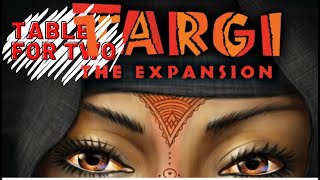
- Expansion reinvigorates interest in Targi, adding depth without weakening the core game
- Sand Dune adds powerful asymmetric abilities on border cards
- New goods (water, coins) and expanded tribe interactions increase strategic choices
- Noble action and Sand Dune changes improve flexibility and pacing
- Raid/score changes lead to more varied end-game decisions
- Additional rules can cause initial confusion (especially around Sand Dune and raid interactions)
- End-game round count shift (12 vs 16) may require recalibration for some players
- Increased complexity may slow down learning for new players
- Trade, negotiation, and crowding/intersection strategy across a 3x4 grid of cards
- Desert border market with caravan tribes and resource exchanges
- abstract-economic
- Targi (base game)
Mechanics (from transcript analysis)
- Border-area worker placement — Place workers on the outside border to create intersections and claim cards.
- Card drafting and set collection — Acquire tribe or goods cards to build a 3x4 grid and aim for patterns.
- End-game pattern scoring — Bonus points for four of a kind or four different cards in a row.
- Hand size and discard dynamics — Typically one card in hand; discarding can yield rewards and unlocks additional options.
- Noble and raid interactions — Use noble actions and raid cards to modify plays and scoring; expansion tweaks these systems.
- Resource management — Gaining goods (salt, pepper, dates, water) and coins to pay for cards and actions.
Video topics + discussion points
Quotes (from this video)
- This expansion has reinvigorated my love for this game
- I really love how things change like the dunes and the nobles; it makes the game feel new
- The raids are different in the first game; now they are specific goods or victory points
- I love the updated noble card where discarding your card gives you water and a good of your choice
- The chargia gives you basically a wild good; you might hit gold or water or the victory point one
References (from this video)

- Tight two-player interaction and blocking
- Innovative use of intersections that makes every placement meaningful
- Balanced engine-building and scoring opportunities
- Solid length for a two-player game; good date-night option
- Thematic depth could be stronger; history and culture not deeply explored
- Occasional complexity without a heavy thematic payoff may turn off some players
- Trade, resource management, and strategic interaction
- Desert trading camp among the Tuareg
- Light thematic flavour; mechanical gameplay takes precedence
Mechanics (from transcript analysis)
- Crossing point resource/cards — Workers also collect goods and tribal cards at the intersections between your workers.
- Edge worker placement — Three workers are placed on edge cards (excluding corners) with constraints against occupying opponents' cards and blocked edges.
- endgame triggers — Game ends when the robber reaches the final raid or a player completes three display rows.
- Noble/robber raid mechanic — A tracker advances each turn; when it hits a raid card, players lose valuable items.
- Resource management — Goods are earned and spent to acquire tribal cards and to build up victory points.
- set collection scoring — Rows of tribes yield bonus points, with same-tribe rows and all-different rows both awarding points.
- Tribal cards deployment — After paying costs, tribal cards are laid out in a 3x4 display, affecting scoring and abilities.
- Witch/Enchanter action — Special action that allows repositioning a tribal marker to alter future options.
Video topics + discussion points
Quotes (from this video)
- This is a very clever mechanic as every worker placement matters a lot more than what it actually gives you
- This creates a very interesting dynamic between the two players
- I really enjoyed this game and I think it's perfect length for what I'm looking for in the two-player game
- It's a game I totally recommend
- I think it's a very good idea to play all on a date
- This game would appeal to anyone who's looking for a good two player experience
- The gameplay lived up to my expectations
References (from this video)

- beautiful
- refined
- elegant design
- shows that less can be more when designing for specific player count
- demonstrates interconnected ecosystem of choices
- desert setting
- dune-inspired ecosystem
Mechanics (from transcript analysis)
Video topics + discussion points
Quotes (from this video)
- there are a lot of great games and there are a lot of great games that play excellently at two players
- so simple and so elegant and so refined and yet so puzzly and ingenious
- one of the best tactical miniatures games out there without any miniatures whatsoever
- the thing is is that if you sell in bulk you get extra bonuses but if you sell early then you get the most valuable versions
- it gives you so much to consider and be cognizant of as you are drafting every single card but it is incredibly indelibly accessible
References (from this video)
- clever tempo and blocking create tense two-player duels
- highly strategic with strong tension
- can feel punishing or salty due to blocking mechanics
- resource management and strategic placement in a tribal market
- border-market style game with market cards on the outskirts of a board
- abstract economic conflict with direct competition
- Patchwork
- Hive
Mechanics (from transcript analysis)
- card placement on the board's outskirts — Place pieces to gain resources and influence which cards become available
- direct interaction and blocking — Your placements deny or limit opponent options on adjacent cards
- scoring via central intersections — Points are earned from key cards and intersections created by placement
Video topics + discussion points
Quotes (from this video)
- it's just a great game at getting people to talk to each other because it's always obvious what your opponent is doing when they've done it but it's not obvious until they've done it
- Luna means the space between things
- the idea isn't that different from Magic the Gathering you have followers which are kind of like creatures and then you have these location cards
- the nuclear option as in you blow everything up
References (from this video)
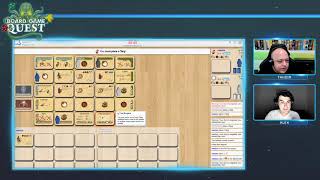
- Deep strategic decisions from placement and blocking
- Rich player interaction via intersection actions
- Clever scoring through symbol alignment and card drafting
- Tightly designed two-player experience with meaningful choices
- Meeples are visually underwhelming (production/readability issues)
- No undo feature in the playthrough
- Can be heavy or punishing for new players due to resource/hand management
- Trade, resource management, and strategic block-and-intersection interactions
- Desert trading camp where two players build a caravan tableau by placing workers and collecting tribe cards
- Strategic, abstract economic negotiation
- Stone Age
- Eclipse
- Baron Park
- Code Names Live
Mechanics (from transcript analysis)
- Blocking and interaction — Opponents block each other by occupying spaces; some spaces cannot be opposite your opponent.
- endgame conditions — Game ends when a tableau is full or the robber completes a cycle around the track.
- resource management and trading — Manage goods (dates, salt, pepper, etc.) and trade via trader caravan to gain points.
- Tableau building and symbol matching — Acquire tribe/goods cards to form a row/column tableau with the aim of having all symbols identical or all different.
- worker placement — Place three workers on the outer border to activate actions at intersections.
Video topics + discussion points
Quotes (from this video)
- the spaces you're placing on have their own abilities too
- normally worker placement is kind of like oh i'm going to go here that was where you wanted to oh no
- the rule regarding you're limited to ten resources and three gold comes up
- there's a lot more decision making in your tactics in the placement around the three and three and three
- you can't come out strong the timer noise is not pleasant
- this is one of the nice ones, it's just an easy pickup
- the rule regarding uh you're limited to ten resources and three gold comes up, so you're gonna have to discard a lot of stuff here
References (from this video)
- cool grid-based resource system
- interesting card-placement interactions
- too tight/restrictive; can shaft opponents deliberately
- options diminish as the game progresses
- card-driven resource management and intersection-based choices
- desert frontier trading with caravans
- tight, strategic, highly structured
Mechanics (from transcript analysis)
- cross-grid card selection — cards placed on grid intersections grant resources and abilities when chosen
- set collection — accumulate sets of resources/cards for scoring and bonuses
- worker placement — players place workers on a shared grid to acquire resources and activate effects
Video topics + discussion points
Quotes (from this video)
- This is probably one of my favorite Uwe Rosenberg games I've played to date.
- it's a weird one because it's kind of like a full-size game but didn't quite feel like it
- the rules overhead was quite high in terms of remembering what they do
- usually trying to build these routes and establish these with blocks and then get the cards
- it's a pretty much a paint by numbers deck builder game