Travel back in time to the greatest city in Mesoamerica. Witness the glory and the twilight of the powerful pre-Columbian civilization. Strategize, accrue wealth, gain the favour of the gods, and become the builder of the magnificent Pyramid of the Sun.
In Teotihuacan: City of Gods, each player commands a force of worker dice, which grow in strength with every move. On your turn, you move a worker around a modular board, always choosing one of two areas of the location tile you land on: one offering you an action (and a worker upgrade), the other providing you with a powerful bonus (but without an upgrade).
While managing their workforce and resources, players develop new technologies, climb the steps of the three great temples, build houses for the inhabitants of the city, and raise the legendary and breath-taking Pyramid of the Sun in the center of the city.
Each game is played in three eras. As the dawn of the Aztecs comes closer, player efforts (and their ability to feed their workforce) are evaluated a total of three times. The player with the most fame is the winner.

- Deep, multi-layered system with strong thematic feel
- Lots of strategic depth and planning
- Very heavy; long teaching time
- Can suffer downtime and analysis paralysis
- urban development and temple ascent
- Ancient Teotihuacan city-state
- heavy euro with modular tracks
Mechanics (from transcript analysis)
- Multiple scoring tracks and variability — Temple tracks, Avenue of the Dead, masks, and pyramid scoring
- Pyramid building and temple tracks — Upgrade workers and ascend temple tracks for rewards
- Resource management and symbol matching — Collect resources to build pyramid and gain points
- Worker movement and action selection — Move three workers along eight locations to collect resources or perform actions
Video topics + discussion points
Quotes (from this video)
- this game is so much fun because it gives you such a wide variety of things that you could do
- I think this is a game of skill and you don't see games of skill very often with very short
- Isle of Skye Journeyman adds a lot to this game but it detracts from some of the greatness of the original game
- Lisboa is a heavy game; there's a lot going on
- Teotihuacan has a lot going on
- Western Legends is a sandbox with tons of directions you can go
References (from this video)

- well-regarded in the nomination pool
- strong thematic presentation
- urban planning and pyramid-building
- Ancient Mesoamerican city-building
- n/a
- Airship City
- Underwater Cities
Mechanics (from transcript analysis)
- Dice placement / worker placement — dice-based actions to develop the city and score through area control
Video topics + discussion points
Quotes (from this video)
- this is a book that claims to have a hundred different mechanisms and 100 different diagrams to go with them
- I think this is going to be a great resource
- they are big fans of magic
- what is there there's like Jace and Chandra and Lilith and carne and chub toad
- I'm not sure exactly what Snap is maybe that has to do with shuffling
- I grew up playing Magic I was obsessed with it
- yo there's this article but you should go and check out which could describe this so much better than I could
- I really wanted to spend some time just emphasizing yo there's this article but you should go and check out
References (from this video)
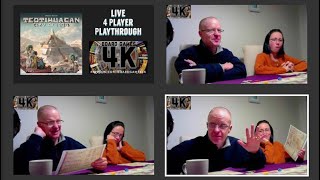
- Rich thematic integration with temples, pyramids, and discovery tiles.
- Deep action-selection with multiple interactive tracks and strategic options.
- Engaging ascension and endgame scoring that rewards planning across rounds.
- Rules can be dense and potentially confusing for new players.
- Table contention and downtime can be noticeable in larger groups.
- Tracking costs (Cocoa/coco, color requirements, and power-ups) can be intricate.
- Urban planning, religious symbolism, pyramid construction
- Ancient Mesoamerican city Teotihuacan; pyramids and temples; Avenue of the Dead
- mythic/abstract
- Imperial
- Ticker
Mechanics (from transcript analysis)
- Avenue of the Dead progression — movement and scoring along the outer board track that influences end-game scoring and rewards.
- dice worker placement — players place and manage their colored dice on action spaces; dice can be locked or unlocked; unlocked dice can be moved and activated.
- discovery and decoration tiles — discovery tiles provide one-time or persistent bonuses; decoration tiles are placed on the pyramid for points and symbol matching.
- discovery tiles with masks — collect sets of masks on discovery tiles to gain point bonuses; larger sets yield greater rewards.
- pyramid construction — tiles are placed to build a multi-level pyramid; the top level ends the game; costs vary by level.
- Resource management — resources are wood, stone, gold (conquer) and other tokens; these power actions and purchases.
- temple tracks and ascension — advancement on temple tracks yields bonuses; ascension of workers triggers additional rewards and compass-like choices.
Video topics + discussion points
Quotes (from this video)
- the main currency of the game is conquer
- three eclipses so there'll be three score and phases in the game
- Avenue of the Dead
- decorations and putting tiles on the pyramid adds points
- you can decorate the pyramid and you'll get points
References (from this video)
- Cool rondelle mechanic
- Multiple paths to victory
- Excellent variety with expansions
- Strong player board customization
- Great multiplayer game
- Very heavy game with many rules
- Complex solo mode
- Cacao resource management is frustrating and thematically odd
- Packed storage with two expansions
- Aztec/Mayan Theme
- Inca Style Pyramid
- Te Kenu (ranked 101-102, close runner-up)
Mechanics (from transcript analysis)
Video topics + discussion points
Quotes (from this video)
- it's a unique twist on a genre that has you know like i say i love deck building but it has been bloated with a lot of uh entries
- it's a breath of fresh air it's like oh no one's really tried this before
- thank you viewers because you kept banging on at me to play this game finally i did and you were right
- my god do i i mean i love coffee i love coco but man do i hate the stuff i have to play this game
- it's like inside out the board game as in the pixar movie which is vastly underrated
- wow for someone like me who loves like variety as the spicer life this is certainly one where you've just got so many different ways to tailor the game
- tainted grail is one of the best story world settings for any campaign game i have played forget dissent forget gloomhaven
- gameplay imperium is sound it really is a good fun deck builder it would be so much higher on this list if it was just a bit more streamlined
- this is a really streamlined game that works with six players you don't get many of those
References (from this video)

- engaging rondelle mechanic with thematic integration
- solid core gameplay that rewards planning and timing
- can be quite heavy and complex for newer players
- city-building and ritual scoring
- Ancient Mesoamerican city; temple construction and urban development
- thematic and strategic with strong tactile components
- Eclipse
Mechanics (from transcript analysis)
- dice drafting — Dice act as workers and are drafted to activate actions, with sun/shade dynamics affecting value
- grid/track scoring — Multiple scoring tracks and a central grid contribute to victory points
- round-the-board rondelle — A rotating action wheel/track dictates available actions and sequences
Video topics + discussion points
Quotes (from this video)
- the best way to make me do a top 10 list is to have that be voted up as the contributing producer level supporters
- there is a world where i try it again, especially with the second edition changes
- the communal deck building style work replacement game
- the dice drafting mechanic in Tekenu is really fascinating
- I started playing board games in 2008
References (from this video)

- rich, thematic engine-building
- great chunky components and layout
- rule clarity can be challenging
- city-building and pyramid construction
- ancient Mesoamerica
- engine-building
- Lords of Hellas
- Dune: Imperium
Mechanics (from transcript analysis)
- Dice-driven actions — dice outcomes influence action costs and timings
- worker placement — assign workers to build and activate locations
Video topics + discussion points
Quotes (from this video)
- we are raiding our last 16 games yes from 2022
- we slept on that one too
- it's a gateway game
- I love the little wagons
- I love the Terracotta soldiers
References (from this video)
- Deluxe Master Set
- Huge component package
- Fifth player expansion
- Included card sleeves
- Detailed map components
- Excellent component quality
- Very large/heavy game
- Ancient Mesoamerica
- History
- Civilization Building