Emperor Qin Shi Huang has passed away. To protect him in the afterlife, a great army in the form of statues of faithful warriors must be assembled to stand guard in the Emperor's tomb. You will be among those tasked with building this magnificent army.
In Terracotta Army, you represent talented craftsmen and artists laboring to build the wondrous assembly of statues. During the game, you collect resources, upgrade your workers, and seek favor with the Emperor's advisors. Your goal is to play a crucial role in the process of creating the terracotta army, and your success is measured in victory points (VPs). During the game, you and your fellow players build the army together, but after the fifth round of the game is over, only one of you — the one with the most points — will stand as the winner.
During the game, you place warrior miniatures within the mausoleum, forming groups. A group's miniatures may belong to multiple players as denoted by the player bases on those miniatures. Multiple separate groups consisting of the same type of miniature may exist within the mausoleum.
You will have many opportunities to score points based on domination and presence. To achieve domination, you must be the only player with the most of the specific resource or type of statue currently being scored. (If you are the only player, you have domination.) To have presence, you must have at least one of the specific resource or type of statue currently being scored.
At the end of the fifth round, the player with the most VPs wins.

- strong thematic tie to art and history
- compact engine for terra cotta production
- rule clarity and pacing may vary by player experience
- artisans and monumental statuary
- ancient China; creation of terracotta statues
- historical, with artistic presentation
Mechanics (from transcript analysis)
- area majority / influence — controlling key regions or actions to gain influence
- Resource generation and income — gaining resources to fund builds
- Worker placement or action selection — allocating actions to develop statues and structures
Video topics + discussion points
Quotes (from this video)
- we're going to live vicariously through our fellow content creators
- we're giving away games y'all
- the five games coming out of Gen Con that we can't wait to get our hands on
References (from this video)
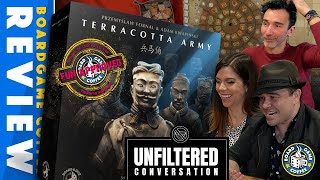
- Stellar aesthetics and component quality; minis and statue designs paired with an elegant box design
- Innovative rondelle mechanic that rotates actions and keeps play dynamic
- High table presence; setup is accessible with intuitive reference sheets
- Strong replayability due to rotating rondelle, variable quadrant scoring, and Masters variety
- Balanced gameplay with multiple viable strategies; no runaway leader in observed sessions
- Clear iconography and in-game references make scoring and rules approachable
- Engaging interaction, mostly indirect; players influence each other through planning and blocking without direct malice
- Endgame scoring and grouping rules can be tricky to learn and track for beginners
- Potential downtime or AP if players overthink moves in later rounds
- Weapon flipping and Master costs can feel restrictive if coins are tight
- No expansion yet; some players may desire more variability beyond Masters and wheel setups
- Learning curve around end-round thresholds and presence/dominance concepts may require a first playthrough or two
- Terracotta Army figure construction and placement to score points
- Ancient China; Qin Dynasty; mausoleum construction and Terracotta Army assembly
- historical-themed euros with monumental, statuary-driven scoring
- Viticulture
- Gaia Project
- Terraforming Mars
- Dead of Winter
- Zombicide
Mechanics (from transcript analysis)
- end_of_round_and_end_of_game_scoring — Achievements grant round-based points; dominance/presence scoring by row/column; groupings of matching pieces score at game end
- group_scoring_and_tiebreakers — Scores can shift when multiple players contribute to the same group; kneeling Archer breaks ties in some conditions
- master_actions — Masters provide unique primary actions and a secondary end-of-round ability; acquiring a Master requires a cost that can be paid once and then used for free thereafter
- resource_management — Manage wet vs. dry clay (wet dries end of round); coins and clay used to pay costs for statues and Master actions
- rondelle_rotation — A rotating wheel determines which actions are available and their sequencing, creating evolving options each round
- set_collection_and_assembly — Collect statues and place them on quadrants; some units score based on proximity, groups, or presence in rows/columns
- statue_building — Use clay (wet/dry) to build Terracotta Army statues; statues occupy space and grant points via placement and groupings
- weapon_and_upgrade_mechanics — Weapons on Masters can be flipped to unlock additional abilities; upgrading and timing affect scoring opportunities
- worker_placement — Players place workers on action spaces to trigger top-to-bottom actions; wheel (rondelle) rotation changes available actions each time
Video topics + discussion points
Quotes (from this video)
- I would recommend it for some people especially like worker placement; it's a very pretty game with a ton of variety.
- The rondelle spins; it's gorgeous and changes the space you have to work with each round.
- I don't think there's any runaway leaders in this game; it's balanced and you can come back even if you're behind.
- This is the board game coffee seal of approval; Terracotta Army earns it in my book.
- It's very welcoming; the iconography and setup are approachable, and you can see what you get at a glance.
References (from this video)
- Interesting wheel-driven action selection that rewards planning and adaptation
- Master abilities add depth and provide multiple viable strategic paths
- Solo mode presents a solid, puzzle-like challenge
- Theme is largely non-existent; the terracotta premise feels forced and mechanically superficial
- Rulebook and supplements are not as user-friendly as they could be; lack of a proper in-box reference sheet
- Scoring can be fiddly and endgame evaluation is labor-intensive, especially with four players
- Components can feel budget-oriented for a mid-weight game (coins, clay tokens, and crowded miniatures)
- High analysis paralysis risk in multiplayer, particularly with a crowded board and a dense wheel system
- Domination and presence through building statues, weapon-equipped warriors, and master abilities
- Ancient China around a terracotta army and ritual statue-building activity on a shared grid
- Abstract, history-inspired veneer with a focus on logistics and scoring rather than immersive storytelling
- Teotihuacan
Mechanics (from transcript analysis)
- action_wheel — Two outer wheels that players twist to reveal actions; players can spend money to rotate wheels, altering available actions each turn
- area_control — Presence and domination scoring based on inspector pawns and rows/columns around a central grid with clusters of warriors
- master_abilities — Masters provide powerful yet costly effects; availability and cost scale with game progression, influencing late-game strategy
- tile_and_token_building — Build statues, warriors, and weapon tokens on a grid to gain points and unlock abilities
- worker_placement — Tiny workers sit on the wheel and around the outer grid; placement and rotation drive resource generation and action resolution
Video topics + discussion points
Quotes (from this video)
- the theme in this is just gone
- it's an analysis paralysis generating machine
- Terracotta Army is fine it's okay
- the endgame scoring takes a couple of read-throughs to really understand
- this is not a game in their usual t series
- the solo mode itself it's a david turksey design
References (from this video)

- interesting core ideas and strong thematic concept
- board congested and overly fiddly
- terribly meticulous scoring can be tedious
- statues and city-building with a historical flavor
- ancient China, Terracotta Army
- public scoring and action selection
- Bruges
Mechanics (from transcript analysis)
- grid-based statue building — placing statues to score per round objectives
- public scoring targets across rows/columns — end-of-round scoring based on majority in various areas
- worker placement on an action wheel — rotate a wheel by spending clay to unlock actions
Video topics + discussion points
Quotes (from this video)
- There is a lot going on here, way more than I can summarize in a short clip like this
- this took us over five hours to play with a teach, and that's unforgivable
- an older Martin Wallace game, paint-by-numbers and ultra generic
- it's not my favorite of the racing genre
- five minutes to play and it's just a different Unique Style game
- the core system is brilliant and it keeps you engaged throughout
References (from this video)

- Historically flavored theme with engaging engine-building
- Strong production value
- Could be heavier for some players
Mechanics (from transcript analysis)
- Worker/tiles with resource management — historical-theme game with strategic placement and engine-building elements
Video topics + discussion points
Quotes (from this video)
- the solo gaming community is made up of a lot of people who are chronically ill disabled or suffering from some kind of ailment involving chronic pain that prevents us from engaging in the hobby in the traditional sense
- nobody is perfect
- learning from your mistakes is what we do as humans
References (from this video)

- Visually appealing box art
- Been on speaker's wishlist for extended period
- Positive community reception
- Had been out of stock previously
Mechanics (from transcript analysis)
Video topics + discussion points
Quotes (from this video)
- Well this is what happens when you go live at a restaurant last minute
- We saw so many cool things we could talk about happening
- Mission control in three different cities
- Houston is trying to communicate with you to get the oxygen tubing back together
- There's like points I have to connect but those points are locked in place
- Chris got me some vowels because the valves some of these pipes that connect these two points are blocked
- An actor from Game of Thrones does the voice acting for the story
- I've heard tons of great things about this game and it's been on my like get list
References (from this video)

- Deep, clever area-control puzzle with multiple layers of strategy
- Rich thematic and visual design; engaging statue/weapon interactions
- Stacks of tactical choices when planning around the wheel and grid
- Wheel mechanics can be frustrating, especially at higher player counts
- Some players may find the grid scoring and statue management dense
- historical strategy with modular statues and weapon interactions
- Ancient China; building the Terracotta Army on a grid-based battlefield
- grid-based strategic puzzle with layer-based actions and statue-weapons synergy
Mechanics (from transcript analysis)
- Area control / domination scoring — Players position workers to dominate rows/columns for end-round points.
- End-of-round grid scoring with red tokens — Domination/presence scoring across rows/columns, guided by token movement.
- Layered ring wheel action choice — A multi-layered ring provides action options; coins can shift rings to alter available actions.
- Statues and weapons; resource management (clay) — Building statues unlocks weapon interactions; clay is the primary resource with a wet-up mechanic.
- Worker sizing (small vs big) and upgrade system — Small workers are limited by ring spaces; upgrading changes placement power.
Video topics + discussion points
Quotes (from this video)
References (from this video)

- strong thematic integration
- large, tactile components
- potentially complexity for new players
- archaeology and military heritage
- Ancient China, Qin Dynasty
- historical/engine-driven
- Carcassonne
- Wingspan
Mechanics (from transcript analysis)
- tile_placement — place tiles to build a mosaic/army layout with strategic considerations
Video topics + discussion points
Quotes (from this video)
- not hard to learn but it's hard to master something like that
- I hatch a game awesome game it is really fun
- two free tickets to Gen Con that's cool
- not hard to learn but it's hard to master
References (from this video)

- Distinct thematic flavor with elegant scoring
- Puzzly and satisfying in multi-turn planning
- Steeper learning curve for newcomers
- Some players may find the balance a bit punishing
- statue-building engine/row and column scoring
- Ancient China; construction and deployment of terracotta warriors
- mechanics-driven
Mechanics (from transcript analysis)
- engine building — develop a system to generate score through placement of warrior-types
- grid/row and column scoring — score depends on arrangements and patterns across a grid-like board
Video topics + discussion points
Quotes (from this video)
- snacking during board gaming is like almost as essential as like the games themselves
- this is the best thing we ever decided to do
- Rhino Hero Super Battle Run over here is a big boy
- it's the best game ever
References (from this video)

- great thematic integration
- innovative storage/display mechanics
- heavy for some players
- rundale system adds cognitive load
- mausoleum and resource management
- ancient China; Terracotta Army
- strategic push-your-luck with sculpture display
- Chess
- The Quacks
Mechanics (from transcript analysis)
- Area Control — claim mausoleum spaces and display soldiers
- disc/pip resource management — rotate discs to acquire resources
Video topics + discussion points
Quotes (from this video)
- we are raiding our last 16 games yes from 2022
- we slept on that one too
- it's a gateway game
- I love the little wagons
- I love the Terracotta soldiers
References (from this video)

- Engaging action wheel mechanic
- Beautiful components and table presence
- Tight euro-style decision making
- Construction and strategy with a historical veneer
- Ancient China, Terra-Cotta army building
- Euro-style with thematic depth
Mechanics (from transcript analysis)
- dice/miniature placement — Place miniatures and execute actions with strategic positioning.
- end-of-round scoring — Points accrue based on placement and building patterns.
- wheel action selection — Three actions shown on a wheel, rotated to access different options.
Video topics + discussion points
Quotes (from this video)
- the rules are quick and easy to get through
- my daughter really likes birds
- the game uses the game trays making it a lot better easier to set up and take down
- one of the best components that I've ever seen
References (from this video)

- Impressive minis and theme
- No luck; strong strategic depth
- Not as table-ready for lighter groups
- Some find the artifact system opaque at first
- statue assembly and political complexity
- Ancient China, Terracotta Army project
- historic epic with a strategic tilt
- Tara
- Taurus
Mechanics (from transcript analysis)
- Tile/miniature integration — Assemble the Terracotta Army minis and project tiles.
- worker placement — Place workers to craft, upgrade, and marshal artifacts.
Video topics + discussion points
Quotes (from this video)
- I love worker placement games.
- The spice must flow.
- This stream is about the top 20 worker placement games and we love them all.
References (from this video)
- Beautiful minis and thematic strength
- No luck, strong strategy
- Can feel heavy and long for new players
- Some may prefer simpler systems
- minis, army assembly, and construction
- Ancient China; Terracotta Army project
- historic epic with a strategic tilt
- Targi
- Gaia Project
Mechanics (from transcript analysis)
- Miniatures and upgrade paths — Assemble and upgrade tiny soldiers and statues.
- worker placement — Place workers to upgrade and assemble the Terracotta Army.
Video topics + discussion points
Quotes (from this video)
- I love worker placement games.
- The spice must flow.
- This stream is about the top 20 worker placement games and we love them all.
References (from this video)

- Strong thematic setting and historical flavor
- Publisher track record is appealing
- Combination of area majority and worker placement looks engaging
- No explicit drawbacks stated in the discussion; possible complexity for new players
- building a mausoleum of statues with area control implications
- Ancient China, Terracotta Army mausoleum project
- historical
- Xi'an: Terracotta Army
Mechanics (from transcript analysis)
- area_majority — Players compete for area/bonuses across regions to gain advantage.
- worker_placement — Different worker types are assigned to actions to gain resources or bonuses.
Video topics + discussion points
Quotes (from this video)
- the publisher track record is appealing
- this could be a big big hit
- something with a bit more of an edge a bit more cutting like this does appeal to me
- this is going to be a big production
References (from this video)

- Great components and table presence
- Solid mechanics and theme
- Price on the high end
- statue-building and mausoleum construction
- Ancient China and the Terracotta Army
- historical flair
- Tigris & Euphrates
- Ankh: Gods of Egypt
Mechanics (from transcript analysis)
- Resource management / engine-building — Collect statues and manage placement for scoring bonuses.
- Worker placement / rondelle — Move workers to gather resources and construct statues.
Video topics + discussion points
Quotes (from this video)
- It's a sweet spot that's a sweet spot.
- It's worth every penny and looks beautiful on the table.
- We love you bye everybody.
References (from this video)
- engaging mid-weight euro with tight decision space
- clever wheel mechanic and score timing
- rapid turns with clear paths to victory
- end-game scoring can be intricate
- teaching curve for new players
- component handling and setup may feel fiddly
- Military and religious architecture, imperial ambition
- Ancient China, Emperor's army and temple building
- abstract strategy with rondelle/dice mechanics
- Smash Up
- Sagrada
Mechanics (from transcript analysis)
- Dice-driven actions — Dice represent workers and influence actions on the wheel.
- rondelle / rotating wheel — A central rotating wheel determines available actions and resources.
- worker placement — Place workers on wheel segments to perform actions and collect resources.
Video topics + discussion points
Quotes (from this video)
- setup is easy playing's easy
- feels like a rolling rights style game
- it's a solid 45 minute game
- it's complicated first off you gotta