The Tesseract appeared in our skies six days ago, over the exact magnetic north of the planet. It was the size of a city block. Since that time it has been condensing, collapsing upon itself. It can now fit into the palm of your hand.
Our world’s best minds must now find a way to contain and control the reactions of this alien artifact, or its exponentially increasing destructive power will remove our planet from existence, reconfiguring our space and time to the extra-dimensional needs of its creators. Can you and your team work together to shut down the Tesseract, or will humankind simply be a blip in the grand scheme of the universe? Time will tell.
Tesseract is a compelling, cooperative dice-manipulation game for 1 to 4 players. The focal point of the game is a block of 64 dice, the Tesseract, which sits at the center of the board on a raised platform. Players will remove cubes to place in their individual labs, transfer them as needed to others, adjust the cube's values and, importantly, isolate the cubes into the containment matrix, neutralizing them.
To Contain a cube a player must have in their lab 3 or more cubes all of one value (a Set) or in sequence (a Run), either all of one color or having none of the same colors. By filling the containment matrix completely (24 total unique dice) they will stop the reaction and win the game. But if the Tesseract has its last cube removed beforehand - or if 7 breaches occur, the game is lost and our world ceases to exist.
Asymetric character abilities include a passive, 'always on' ability and a unique action that is only available to that player. Research cards earned during play help give players an edge, as do the even more powerful Containment cards, unlocked from the matrix.
Tesseract is a very challenging co-op game, with lots of replay value built into the number of characters and various threat platforms which govern the difficulty. The game scales remarkably well and has a solo mode that is every bit as engaging. The tension mounts quickly as the Tesseract sheds cubes at the end of every player's turn, primes them and potentially causes Breaches to occur, bringing us closer to disaster.
-description from publisher
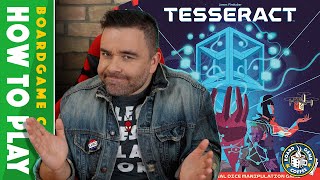
- Cooperative puzzle with multiple viable strategies
- Clear, approachable setup and rule explanations
- Dynamic tension with breach and threat phases
- Research and containment cards provide strategic variety
- Supports a range of player counts with lab setup
- Prototype components may differ from final product
- Rules can be dense and have a learning curve
- Component balance and quality may shift in final version
- Cooperative puzzle-solving to contain a powerful cube before it breaches and collapses reality.
- A mysterious cubic artifact appears near the magnetic north and is contained on a rotating platform and containment board within a cooperative lab setting.
- Tutorial and setup-driven explanation delivered in a host-led walkthrough.
Mechanics (from transcript analysis)
- Adjustments — Increase or decrease a cube's value; primed area allows limited decreases to destroy it.
- Containment board placement — Add a contained cube to the matching color/value space on the containment board.
- Containment cards — A containment card is earned when a column is filled and can be activated by any player during their action phase.
- Re-roll and gain rewards — Reroll remaining cubes from a set/run to gain a level of research cards.
- Research cards — Draw and play level-based cards for effects; can be played for free as a free action.
- Run/Set formation — Three or more cubes of the same value (set) or three or more consecutive values (run) must be assembled.
- set collection — Form sets or runs of cubes in your lab to contain them.
- Threat/Breach mechanics — Prime the lowest cube during the threat phase; breach occurs if the primed area fills or breach track reaches seven.
- Transfer — Move a cube between players' labs with permission.
Video topics + discussion points
Quotes (from this video)
- you and your friends will have to work together to contain the power of this cubic Menace
- there's only one way to win in Tesseract
- communication among players is vital to your success
- on your turn you could perform any three of these actions
- the containment is the most important action you can take because each time you contain a cube you're one step closer to winning the game
References (from this video)

- Strong visual/production value
- Optimistic potential as a thoughtful puzzle game
- Prototype status; specifics uncertain
- Tesseract, dimensional manipulation
- Sci-fi/abstract puzzle flavor
- Abstract strategy
Mechanics (from transcript analysis)
- Abstract strategy/puzzle — Players navigate a planar puzzle with strategic placement and sequencing
Video topics + discussion points
Quotes (from this video)
- It's a blast; it's like Magic. I haven't played yet, but I'm going to teach him how to play.
- The ghost adds so many layers of strategy.
- You spend ink points to ready your character, and then you can either fight or quest.
- It's sold out at the show; 90 minutes sold out in the rush.
- Two clever cats—it's a thinking game for two clever cats.
References (from this video)

- Unique sci-fi concept
- Dice-based research
- Alien threat neutralization
- Sci-fi
Mechanics (from transcript analysis)
Video topics + discussion points
Quotes (from this video)
- I'm a board game Somalia which means I play a bunch of board games so I can tell you which one's the best
References (from this video)
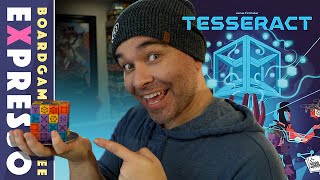
- highly cooperative experience
- engaging dice manipulation puzzle
- variety of player powers through researchers, cards, and containment cards
- strong team coordination and planning
- replayability via random containment cards
- events can be unfriendly or detrimental depending on draw
- breach mechanism and RNG can lead to punishing outcomes
- a learning curve due to multiple card types and interactions
- Cooperation under pressure to prevent catastrophic breaches while manipulating dice.
- A laboratory containment facility with a central Tesseract and a rotating containment board.
- Cooperative puzzle-solving with event-driven tension and variable setup.
Mechanics (from transcript analysis)
- breach/timer pressure — Breaches are triggered when certain cube patterns form; seven breaches ends the game, creating urgency to manage the board.
- cards system — Research cards and containment cards grant a variety of useful, sometimes one-time, abilities.
- character abilities — Each researcher has a passive ability always on and an activated ability to use for additional effect.
- dice manipulation — Players move, adjust, or transfer dice between the Tesseract and their own labs, building sets or runs to progress on the containment board.
- event tiles — Event tiles hidden beneath the Tesseract provide twists that can speed up or hinder progress.
- set collection — Sets or runs must be all the same color or all different colors; completing a set allows taking a cube to fill the containment board.
- turn-based action selection — On a turn, a player may perform three of six available actions in any order.
Video topics + discussion points
Quotes (from this video)
- this has got to be one of the most Cooperative co-op games I have ever played
- these unique actions are very helpful
- the events hidden under the Tesseract aren't great for you
- remember all these character abilities research cards super power containment cards all of it is useful
- figuring is half the fun as you chip away at the Tesseract
References (from this video)
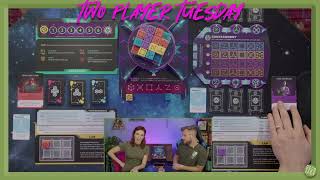
- Engaging puzzle-like gameplay
- Unique dice manipulation mechanic
- Interesting character abilities
- Tense cooperative experience
- Can become challenging quickly
- Potential for quick failure
- Preventing universe destruction
- Scientific laboratory
- Cooperative scientific mission
Mechanics (from transcript analysis)
- Cooperative action selection — Players take turns using various actions to contain a dangerous Tesseract
- dice manipulation — Players adjust and move dice on a rotating Lazy Susan
- Resource management — Managing dice, research cards, and preventing breaches
Video topics + discussion points
Quotes (from this video)
- We are scientists and as scientists, we have to save the world
- Life is a resource, breaches are a resource