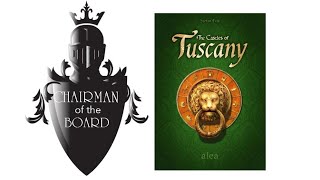
The beautiful Tuscany region, in the 15th century, is the home of the Italian Renaissance. As influential princes, the players make creative decisions to build their region into a flourishing domain.
By supporting towns, villages, and monasteries, or by extracting marble and delivering goods, players see their lands grow, earning them victory points. Each round, players use cards to place useful tiles to expand their regions and gain new opportunities.
The winner is the person who has the most victory points after three rounds of play.
NOTE: The English edition of the rules for the Castles of Tuscany have some translation and design issues, making it slightly harder than typical to learn how to play this introductory Feld game. Some smaller issues have been observed in other languages complicating a simple resolution of questions. A community FAQ is available here to provide some clarity and is highly recommended for first time players.

- solid game design
- interesting decision space
- expansion of predecessor mechanics
- overshadowed by superior predecessor (Castles of Burgundy)
- always choosing other game when available
- regional development
- medieval domain building
- towns and villages
- monasteries
- marble extraction
- The Castles of Burgundy (superior predecessor)
Mechanics (from transcript analysis)
Video topics + discussion points
Quotes (from this video)
- Open Season takes that theme of you actually play the part of the big bad monster going after the heroic adventurers and it puts a pretty unique twist on it.
- sometimes when I've only played a game on Board Game Arena and not like physically interacted with it, maybe it doesn't stick in my brain for as long as something that like I have on my shelf and I can pull off the shelf and like touch
- I was drawn to Rabble because it reminds me of the game Times Up Title Recall, which I always enjoy playing.
- I found Tales from Red Dragon Inn to be utterly charming. And unlike my own personality, there's more here than just charm. There's substance.
- I do not really have like any other games about fishing...this one is such a unique game in my collection.
- I prefer it to My City even though I think you should play My City first...the game progression is simply more interesting
- its box was too wide to fit on my shelf. And it ended up just being a game without a home
- Cloud Age remains one of those games that if someone says, 'Hey, do you want to play Cloud Age?' I'd say boy how do you bet your Nelly I do but for whatever reason it's just one that's fallen into the ether
- Castles of Burgundy is like my all-time favorite game. It's certainly the game I have played the most by a landslide of any other game.
- I'm just not going to pick Castles of Tuscany when Castles of Burgundy is right there
References (from this video)
- engaging but streamlined engine-building potential
- fast, accessible gameplay suitable for lighter Eurogaming
- clear and clean iconography; good components for the price
- pleasing, albeit not spectacular, components
- innovative scoring mechanism with compounding tracks
- low setup and fast rounds; good scalability with player count
- strong balance of risk and planning without heavy luck
- less depth and replay variability compared to Castles of Burgundy
- potential for a runaway leader due to compounding scoring and endgame timing
- limited pool of bonus tiles; once depleted, players must pivot
- themes are standard Euro-trope; not particularly thematic or immersive
- not a huge visual showpiece; function over form
- building and developing a Tuscan province with color-coded tiles and regional bonuses
- Tuscany, Italy
- engine-building with tile-laying and color-card drafting; Eurogame abstraction
- Castles of Burgundy
- Carpe Diem
- Notre Dame
Mechanics (from transcript analysis)
- action simplification — three core actions per turn (draw, take a tile, place a tile) for streamlined play
- card-cash-in and color matching — to place a tile you must discard two matching color cards or two of any color as a proxy
- engine building / token management — placing certain tiles grants tokens (workers, stone, storage increases) that improve future turns
- Resource management — balance cards and tiles with workers and stones to optimize actions
- scoring tracks with compounding scoring — two interlocking scoring tracks (green and red); scores accumulate green points and then transfer to red for endgame totals
- set collection/drafting — draw color-specific cards from a shared pool and discard to place tiles; proxy colors with mixed cards
- set/row completion end triggers — finish a color row to end a round; end-of-round scoring compounds across tracks
- tile placement — place colored tiles on your player board to score region-based points and trigger bonuses
- tile pool management — eight available tiles from a common pool; tiles replenished by players to keep flow; a glut is wiped when too many of a kind appear
Video topics + discussion points
Quotes (from this video)
- it's a very simple game that actually the objectives i'm pretty simple
- the engine building thing you know you can really focus on certain things
- the scoring track that looks really cool and the big lion's head
- it's definitely not a showcase game; it's not particularly beautiful
- i thought it flowed very well; i enjoyed my play of it
- six and a half out of ten for me