The Reckoners, a game based on the young adult fantasy novels by Brandon Sanderson, allows players to take on the roles of the novels' protagonists and work together to save the world.
Background:
10 years ago... A mysterious burst in the sky gave ordinary men and women extraordinary powers. They're called Epics. But, every Epic turned out to be evil. Today, in the city once known as Chicago (now Newcago), an all-powerful Epic named Steelheart reigns supreme!
Nobody fights back... nobody but the Reckoners! This is where you come in. You are a member of the Reckoners, a skilled group of normal humans who assassinate Epics. Your mission is simple, but not easy. Take down Steelheart and his Epics and save the city.
Gameplay:
The Reckoners is a simultaneous, co-operative game for 1-6 players that plays in 75 minutes. You win by defeating Steelheart. But before you can defeat him, you must first discover his weakness. Throughout the game, you will work with your fellow Reckoners to research and attack Steelheart, but he is not alone. Numerous Epics are scattered throughout the city, and they will wreak havoc upon the population, if left unchecked. If the Epics manage to destroy Newcago by reducing the population to 0, then all Reckoners lose.
The Reckoners determine which actions to take primarily through a simultaneous, dice rolling mechanism, where each player can keep and reroll results up to three times at their own pace. Equipment Cards and Plan Tokens will also allow you to gain extra actions or improve/manipulate the results of your dice. Actions are resolved simultaneously as well, so communication and collaborative planning are key to ensuring optimal outcomes.
Your dice can be used to attack Epics, research Epics, contain Epics, attack Enforcement, earn money, acquire Plan Tokens, move around the game board, remove barricades, and activate special equipment powers. Researching and Attacking Epics will help you earn valuable rewards, including clues about Steelheart's weakness. But, there will always be more Epics than you, so you have to choose your battles wisely. When all actions have been taken by The Reckoners, then it's the Epics turn.
Each round, all of the Epics are going to activate, performing an array of actions and then powering up to be even more devastating next round. Each Epic also has a unique set of actions it performs, so you're always facing multiple threats that function very differently. The crux of the game is deciding how to resolve these competing threats and prioritize your actions together to eliminate Epics and ultimately win the game. How, when, and where you act will determine your victory or failure.
Summary:
In short, The Reckoners plays like a challenging, ever-shifting puzzle. If you like co-operative games where you carefully manage resources, build powerful action combos, create tactical plans with your teammates, and work together to take down the bad guy while on the brink of defeat, then be sure to check out The Reckoners.
—description from the publisher

- Very thematic to the Reckoners book series
- Tight integration of setting and mechanics
- Can be brutal and challenging
- superhero-esque rebellion
- Earth ruled by superpowered epics
- thematic narrative co-op with asymmetric powers
- Dune Imperium
- Red Rising
Mechanics (from transcript analysis)
- Asymmetric abilities — Each Epic has unique powers to counter
- Dice/chance — Limited dice-based combat/mechanics
Video topics + discussion points
Quotes (from this video)
- This video is all about board games for Book Lovers.
- Call to Adventure is a card-based narr narration game where you are going to be building out a story path for your character.
- It's very story-driven; it's very RPG-like in a board game way.
- If you're into high fantasy, you like the development of a story, I think these games are really great for that.
References (from this video)
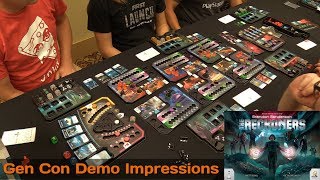
- Accessible cooperative gameplay
- Unique character roles
- Engaging dice mechanics
- Exciting combat feel
- Strategic item management
- Multiple elements to track
- Potential complexity for new players
- Cooperative superhero combat
- Superhero city
- Brandon Sanderson novel adaptation
- City of Heroes
Mechanics (from transcript analysis)
- cooperative play — Players work together to defeat enemies and research weaknesses
- Dice rolling — Players roll unique character dice with different actions
- Item purchasing — Players can buy gear to enhance abilities
Video topics + discussion points
Quotes (from this video)
- We would start out like all right what do we need to focus on
- Getting gear is important, you're not going to be able to do well or win without it
References (from this video)
- Highly cooperative and dynamic play that encourages teamwork
- Pushes for distributed control and shared decision-making
- Can feel chaotic without strong group coordination
- Potential for Alpha gaming in large groups
- cooperative action with simultaneous turns and team collaboration
- superheroic world with supervillain epics
- intense, group-driven problem solving
- Arkham Horror style co-ops
- Pandemic-style collaborative titles
Mechanics (from transcript analysis)
- simultaneous turns — All players roll dice and then act in a shared, non-linear sequence.
- Team-based dice resolution — Dice results are combined to decide action order and target effects.
Video topics + discussion points
Quotes (from this video)
- Clues are used to seal gates in the game which is one of the main ways of winning
- one at a time after any skill check failed or not each spent clue token allows the player to roll one additional die and the result is a success
- the Provost can be moved up and down the board
- it's a fantastic atmosphere at the table
- the greatness in games is that they're fun and enjoyable
- you trick yourself into spending your important resource Clues into passing a check out of desperation
- trades are binding and you can't lie
- success is harder to move forward from than failure
References (from this video)
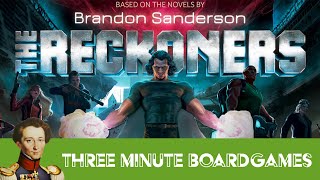
- Engaging cooperative puzzle with strong player interaction
- Clear thematic alignment with the source material
- Dice-driven action economy creates satisfying combos and tension
- Flexible difficulty scaling and replayability
- Distinct rogue's gallery and equipment interactions
- Ability to chain actions across players for a collaborative feel
- Large table footprint and component count (table hog)
- Overproduction of components can feel excessive
- Performance highly dependent on group dynamics and a quieter session
- Learning curve can be steep for new players
- Downtime can be lengthy with larger player counts
- Cooperative heroism vs oppressive superhumans; researching weaknesses and orchestrating team-based actions.
- In a world where Epics control cities and civilians live under threat; heroes are replaced by Epics, and Reckoners fight to uncover weaknesses and stop the tyrant Steelheart.
- Epic, cinematic board-game adaptation with a focus on teamwork, timing, and progressing the epics.
- Elder Sign
Mechanics (from transcript analysis)
- Action economy and turn order — Any player can act in any order; actions can be performed between players' turns, enabling chain actions for cooperative strategies.
- Containment and threat control — Blue symbols reduce an epic's action bar; containment makes epics less dangerous.
- Dice pool and rolling — Each character starts with six dice (three standard with one symbol per side and three colored with a double symbol). Up to three rolls per turn, saving dice after each roll.
- End-of-round rewards and progression — Players gain rewards after all dice are used and buy equipment for round progress.
- Enforcers and board control — Red symbols remove enforcers; enforcers empower epics in their spaces; managing them is crucial.
- Equipment and upgrades — Equipment cards can modify dice results and provide powerful combos.
- Narrative pacing and battlefield management — Positioning and bracket mechanics influence the action order and impact on Steelheart and civilians.
- Special action mapping per character — Each character maps to a unique special action; six characters align to six actions.
- Turn structure and zone movement — Spend dice to move between zones; each round includes epic actions, Reckoners' actions, and Steelheart's turn.
- Weakness research and health dynamic — Epic health is high until their weakness is researched; health then reduces to a lower value, making the weak epic easier to defeat.
Video topics + discussion points
Quotes (from this video)
- The Reckoners is a table hog and guilty of what might be called overproduction.
- The best thing about this game is that you can chain actions between players in a turn, truly working as a collaborative effort.
- The six characters map to the six special actions, so each character has a strength and you can understand their role immediately.
- If you like dice games, co-ops and games that can be scaled up in difficulty really easily then The Reckoners could be for you.
- It's a stunningly presented game.
- The core gameplay of managing the special action dice and timing your moves that really makes it shine.
References (from this video)

- unique timing rules
- fascinating discussions about teamwork
- stunning looking game
- truly cooperative experience
- cooperative superhero action
- supervillain battles
- action_cooperative
Mechanics (from transcript analysis)
- Action timing — timing rules allowing flexible action order
- cooperative dice game — cooperative game with dice
Video topics + discussion points
Quotes (from this video)
- this is my list the video says the top 100 board games of all time but it really is just my top 100 board games of all time
- three minute board games is an independent channel we dont take money from publishers and we do not do any form of paid content
- Mosaic has the ambitious goal of being a civilization game that can be played in two to three hours and it very much succeeds at this goal
- a game that does not need to be played with a traitor because the inherent selfish goals in this game created enough internal conflict
- I love space racing games and space corp is the game that is most racy as far as space racers go
- the term I use instead of gateway game is foundation game
- Sentinels could easily be a forever game the kind of game you just play over and over and over and over again endlessly
- Modern Art is a simple and brilliant and beautiful game and easily the best pure auction game Ive ever played
- Black Orchestra models some very clever things about how conspiracy is run
- when I asked the question hey what game should I play with my non-gamer friend who's interested in gaming but hasn't done much gaming I almost always answer Sentient Golem Edition
- Arkham Horror is the game that really made board gaming my number one hobby
- there are a few things more fun and rewarding in board gaming than organizing a fight in the arena
- Twilight Struggle is one of the best head-to-head games out there
- Santorini is the definition of an elegant design
- Arkham Horror the card game absolutely should be for you it's a hundred percent for me and it is my number one game of 2023
References (from this video)

- Based on beloved book series
- Thematic gameplay
- Very difficult - hosts have never won
- Superhero action
- Post-apocalyptic Chicago
- Based on Brandon Sanderson book series
Mechanics (from transcript analysis)
- boss battle — Defeat main antagonist Steelheart by chipping away at abilities
- Investigation — Investigate areas and uncover weak points of enemies
Video topics + discussion points
Quotes (from this video)
- we are doing our top 10 co-op games
- I love this game I've always loved this game and I feel like I always will love this game
- it's as close to a video game I've ever felt in playing in a board game
- sleeping Gods is absolutely one of the most awesome worlds I've ever experienced in a board game
- I feel like they've encaptured the video game in a board game very very well
References (from this video)
- Excellent balance of planning and adjustment
- Best laid plans with ability to pivot
- Great cooperative experience without alpha gaming
- Memorable tactical moments
- Based on excellent source material
- Not suitable with alpha gamers
- Heavy production/tray-filled
- Powerless people fighting superhero villains
- Brandon Sanderson's Reckoners universe
- Cooperative narrative dice game
- Project Elite
Mechanics (from transcript analysis)
- cooperative play — Team fights against Epics (super-villains)
- Planning and Adjustment — Plan, roll, evaluate, adjust between rolls
- role specialization — Different players focus on research, combat, etc.
- Yatzi-style dice rolling — Push your luck dice rolling for research
Video topics + discussion points
Quotes (from this video)
- It's like a gumbo. You want to have a little bit of worker placement? Cool. You want to have a little bit of interesting card play? Cool.
- You're trying to colonize the moon, baby.
- I love that there's just positive interaction that is people trigger the incomes.
- When do I kill my people? Like when do I use them for such a strong action and then reset them down to one?
- This game is stupid good.
- Don't be an alpha player. Done. This game is fantastic.
- Look what we all made.
- I'm so sorry I'm over here. (Said repeatedly in Project Elite)
References (from this video)
- Initial hype has died down
Mechanics (from transcript analysis)
Video topics + discussion points
Quotes (from this video)
- This is easily on this shelf. The most checked out game. Wonderlands War I see played every time.
- Foundations of Rome despite how big this game is. It gets checked out all the time.
- Everyone's really upset with Grimlord Games cuz they never delivered their last Kickstarter, but another company has picked it up.
- I don't I still don't understand why companies can't put names on the sides of their boxes. Come on now.
- Frostpunk, the board game if you're ready to have a depressing day.
- I think Mosaic is a fantastic civilization game. So fast and easy to play.
- People love Smashup. I have almost everything for Smashup, but it just barely gets played.
- Probably Twilight Imperium is my favorite of all these here, even though I don't play it that much.
- Last Kingdom is a kind of a really fun game from Games based on said TV series. Uh but pretty good. Think Game of Thrones style.
References (from this video)
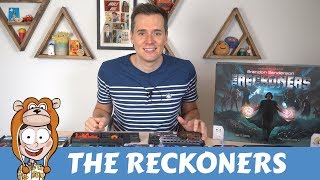
- Strong cooperative gameplay emphasizing communication and team planning
- Streamlined, thematic dice system that translates well to the source material
- Premium production values: chunky dice, trays, and miniatures that reinforce theme
- Rich integration with the books, offering thematic nods without heavy flavor bogging down rules
- Large, space-demanding box with a high price point
- Complex setup and rules complexity may deter casual or new-to-coop players
- Fighting Epics by coordinating a team of Reckoners to exploit their weaknesses
- Dystopian America; New Cargo (renamed Chicago) in the wake of Epic tyrannies
- Book-inspired, lore-forward cooperative dice game with references to source material
- Pandemic
Mechanics (from transcript analysis)
- Dice rolling — Players roll six dice each round; results influence actions and resource generation, with coordination affecting outcomes.
- District movement and barricades — Epics move between districts; players spend dice to remove barricades and contain threats, balancing short-term pain vs. long-term goals.
- Enforcements and containment — Red symbols recruit human soldiers (enforcements); blue symbols contain Epics by maintaining proximity within districts.
- Plan tokens — Plan tokens grant flexible actions, but rolling a plan symbol can lock you out of that plan for the next round.
- Symbol research — Symbols gathered from dice are used to uncover each Epic's weakness; research is a central prerequisite to defeating Epics.
- Weakness exploitation — Once a weakness is identified, players spend symbols to execute attacks against Epics.
Video topics + discussion points
Quotes (from this video)
- It's a team experience listening to each other and improvising on the fly.
- There are no bad phases of the dice, there are just bad times to play them.
- You won't win this game if you don't communicate with each other.
- This is a streamlined dice game that evokes its theme in the coordination you need to survive the insurmountable threat of endless epics and the excitement of the dice rolling.
- It's a breath of fresh air, a game based on an IP that isn't consumed by the weight of it.
- The Reckoners is full of little references to the books.
- This isn't a cheap cashing; you can tell that the designers love the source material.
- If you like the idea of fighting supervillains while rolling dice you should probably try this game.
References (from this video)

Mechanics (from transcript analysis)
Video topics + discussion points
Quotes (from this video)
- it's not a fan to jump the story; you have to wait and finish
- this is a real board game coffee seal of approval
- it's so simple that you can teach anybody how to play that
- have fun, keep gaming
References (from this video)

Mechanics (from transcript analysis)
Video topics + discussion points
Quotes (from this video)
- We crushed it.
- Stardew Valley is incredible.
- The theme really comes out in Obsession.
References (from this video)
- strong cooperative decision space
- high player interaction with a large pool of dice
- can be chaotic with many players
- depends on group dynamics
- cooperative team strategy with yahtzee mechanics
- superhero world where villains are the threat
- story-driven teamwork
- Yahtzee
Mechanics (from transcript analysis)
- dice pool and rerolls — each character has a set of dice; roll up to three times and allocate results
- group dice pool — the team shares a pool of dice to take actions in any order
Video topics + discussion points
Quotes (from this video)
- this is fundamentally the same game as yahtzee
- the biggest single difference is that all players are working off the same set of dice
- it's weirdly like a cross between a dice game of yahtzee and magic the gathering without the deck construction
- it's meanly hard at times and disturbingly unfair
- I would recommend it for people who love probability and love taking risk
- it's so silly and light that you can't take it too seriously
- this is a modern take on yahtzee
- my favorite game directly inspired by yahtzee
- you can roll and you can re-roll up to three times
- you can re-roll as much as you want but one side on each character is a biohazard
- it's on phones it's on tablets you can just pick it up and play it anywhere you want
- 30 dice worth of actions in a four- to six-player game
References (from this video)

- Thematic integration with Brandon Sanderson IP
- High production quality and engaging dice mechanics
- Large footprint; can be bulky
- Requires familiarity with the IP to maximize thematic resonance
- cooperative action with a dice-driven system
- comic-book style superhero universe
- Marvel United
Mechanics (from transcript analysis)
- dice-driven hero combat — Roll and re-roll dice to overcome villainous foes in a campaign-like setup.
- policy of cooperation — Players coordinate to take down super-powered adversaries.
Video topics + discussion points
Quotes (from this video)
- The goodest of morning to you all. I'm Tom Vassel.
- Two body parts. Well, I handed an elbow to take pieces out of the pool.
- This is Duel for Cardia. Simultaneous selection, simultaneous reveal kind of game with that brilliant little fun mechanism.
- It's the top of the bottom. No, top of the bottom is what I said.
- The mind of a genius, I tell you.