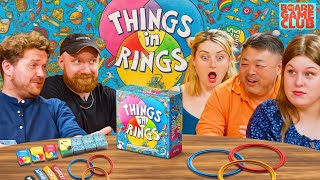
In the center of the table, place the Rings and form a triple Venn diagram. Designate one player to be "The Knower." The Knower knows the different logic rules for each Ring and will facilitate the game. All other players start with a hand of five object cards.
Depending on the Ring, the logic rules will be related to different characteristics, like spelling, grammar, physical properties, cultural relevance, or industry.
On your turn, place an object card from your hand into the Venn diagram. If it fits that ring's rules, place another card. If it doesn't fit the rules, "The Knower" moves the card to the right area. The player then draws another card.
The point of the game is to get rid of all of your cards. Can you figure out the Rings' logic before your opponents? Don't forget, you can play in the overlapping spots of the Venn diagram, or even outside it completely!
—description from publisher
- Creatively designed mechanic; engaging for groups
- Cute art; accessible and family-friendly
- Supports variable difficulty through category selection
- Subjectivity can lead to disagreements or frustration
- Downtime can be noticeable in larger groups
- Three overlapping rings form a Venn diagram to place cards
- Dr. Seuss-inspired art; abstract word categorization
- Playful, puzzle-like party game
- Code Names
Mechanics (from transcript analysis)
- hand management — Players work to shed all their cards; the knower positions influence play flow.
- Knower/Finder deduction — One player (the knower) assigns categories to three rings; others try to shed cards by placing them into intersecting zones.
- Venn-diagram placement — Cards are placed into overlapping rings that define intersections and scoring opportunities.
Video topics + discussion points
Quotes (from this video)
- the two-player experience was a little bit left to be desired
- there's a wide variety of scoring criteria
- it's a set collection game through and through
- I really like the look of the game I think the art is beautiful
- it's silly fun
References (from this video)
- Highly engaging gameplay
- Requires creative thinking
- Fun group interaction
- Replayability through changing rules
- Can be subjective
- Rules can be complex to deduce
- Categorization and deduction
- Abstract logic game
- Collaborative puzzle-solving
Mechanics (from transcript analysis)
- deduction — Players try to place cards in correct rings based on hidden rules
- set collection — Players aim to empty their hand of cards
Video topics + discussion points
Quotes (from this video)
- The ven diagram of boys who don't like smart girls and boys who don't want to date is a circle.
- We're on medium hard, right?
- I now understand the rule.
References (from this video)

- Accessible and quick to teach
- Strong nostalgic art style that encourages family engagement
- Good entry point for non-gamers into deduction-lite gameplay
- Early rounds can feel vague and rely on guessing
- Performance depends on group chemistry and communication
- Dr. Seuss-like objects and abstract clues fitted to overlapping rings
- Family game night setting with Dr. Seuss-inspired art
- Light deduction with gut-feeling associations
Mechanics (from transcript analysis)
- Card shedding / hand management — Players discard cards by correctly identifying patterns to empty their hand.
- Pattern recognition / clue deduction — Players infer what the shared trait is among a set of cards to discard their hand.
Video topics + discussion points
Quotes (from this video)
- Look through the town and find clues to solve the murders.
- This town needs a Batman.
- It is tedious, but because that there is a narrative to it, you actually like I don't know. I was motivated to keep looking for stuff.
- With this game in particular, it gives you specific things to look for.
- It's very easy to teach and people will probably really enjoy.
- This game thrives and excels in being a movie focused horror Halloweeny.
- The art is really cute. But I will admit I had lower expectations for Spooktacular. But I was very impressed.
- the game just provides a really good sense of agency
- there's a good amount of interaction here too
References (from this video)

- easy to pick up
- great party game
- subject to luck and clue quality
- word/clue association
- ring-based deduction party game
- light, social puzzle
Mechanics (from transcript analysis)
- deduction with clues — three rings hold clues; players deduce the common thread
- word/phrase association — derive clues from contextual hints
Video topics + discussion points
Quotes (from this video)
- Detective Club is going to be one where you have these different cards that are all different kinds of images that are really beautiful and very unique
- it's a clever timeline; accessible and easy to explain to anyone
- the expansion really elevates the gameplay on Aquatica
- it's the best slaughter game and it's very deep, but accessible
References (from this video)

- distinct art style and cohesive theme
- fun for larger groups and families
- can be challenging for players who prefer simpler rules
- deduction and clue-slug mechanics with spectacle
- Party game with Dr. Seuss-inspired art
- party-driven, lighthearted fun
Mechanics (from transcript analysis)
- clue deduction with varying difficulty — Clue cards guide players to deduce rules per ring; maps escalate difficulty.
Video topics + discussion points
Quotes (from this video)
- I call this our unicorn Kickstarter project because we went from about 500 backers to 5,000 backers.
- The travel line has a very outdoorsy vibe to it.
- Gazebo feels like a really good game... the dominoes are really nice. And the cloth map is really fun.
- Bombastic plays in five minutes, and let's do it again.