Tichu took much of its rules and mechanics from Zheng Fen. It is a partnership climbing card game, and the object of play is to rid yourself of your hand, preferably while scoring points in the process.
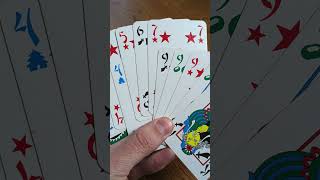
The deck is a standard 52-card pack with four special cards added: dog, phoenix, dragon and Mah Jong (1). When it's your turn, you may either beat the current top card combination — single card, pair of cards, sequence of pairs, full house, etc. — or pass. If play passes all the way back to the player who laid the top cards, they win the trick, clears the cards, and can lead the next one. The card led determines the only combination of cards that can be played on that trick, so if a single card is led, then only single cards are played; if a straight of seven cards is led, then only straights of seven cards can be played, etc.
The last player out in a round gives all the cards they won to the player who exited first, and the last player's unplayed cards are handed to the opposite team. Fives, tens and Kings are worth 5, 10 and 10 points, with each hand worth one hundred points without bonuses — but the bonuses are what drive the game. At the start of a round, each player can call "Tichu" prior to playing any card. This indicates that the player thinks they can empty their hand first this round; if they do so, their team scores 100 points, and if not, their team instead loses 100 points. Cards are dealt at the start of a round in a group of eight and a group of six; a player can call "Grand Tichu" after looking at only their first eight cards for a ±200 point bonus. If both players on a team exit a round prior to either player on the opposite team, then no points are scored for cards and the winning team earns 200 points (with Tichu/Grand Tichu bonuses and penalties being applied as normal).
The first team to 1,000 points wins.

- offers deep strategic play once learned
- fast rounds and satisfying payoff when mastered
- strong group dynamic through partnerships
- steep learning curve for new players
- can be punishing to mistakes in early plays
- card play and partnerships
- abstract trick-taking card game with partnerships
- non-narrative, competitive card play
Mechanics (from transcript analysis)
- hand management — players choose which cards to play and when to declare bids like Tichu
- Trick-taking — players play cards to win tricks; partnerships and signaling influence outcomes
Video topics + discussion points
Quotes (from this video)
- my number 10 is tachu
- it's fun I mean plant and I mean so you obviously I would say do you like that kind of having to siphon through
- the real MVP comment Micah down below
- Kay's number one game of all time tune in next year geez
References (from this video)

- Deep mind games and teamwork
- High strategic payoff when played well
- Can be tense or heated in some groups
- team-based trick-taking and signaling
- Traditional Chinese card game with Western adaptation
- competitive, intense
- Bridge
- Hearts
Mechanics (from transcript analysis)
- team_play — Partnerships and calling 'Grand Tichu' affect play.
- trick_taking — Players play to take tricks with signaling and bombs.
Video topics + discussion points
Quotes (from this video)
- it's so nostalgic that it's like so much of me wants to own it
- I think this quite possibly could be my top game
- the Mind Games I really like the mind games
- the combination of bag building and push your luck is just really nice
- we'll be seeing Twilight Imperium on Caitlyn's no we will not
References (from this video)

- deep strategic play and mind games
- high replayability with partners
- requires four players and strong group synergy
- partner-based cooperation and mind games
- classic trick-taking competition with four players
- high tension, strategic persuasion
- Bridge
- Spades
Mechanics (from transcript analysis)
- call-tichu and risk-laden plays — calling for a win and using trump-like moves.
- hand management — managing hands for optimal play and delaying risk.
- Team-based trick-taking — partnership-based trick-taking with bidding and calling 'Tichu'.
Video topics + discussion points
Quotes (from this video)
- the tension around managing the whole currency
- it's a gateway game, but interactive and not mean
- the sandbox space of possibility is so big
- arguably perfect game of Tichu
- the game nails the gateway experience
References (from this video)

- punchy, small package with deep strategy
- 2v2 teamwork adds depth
- learning curve and partner communication challenge
- risky bidding and partner coordination
- Traditional Chinese card game in a social setting
- competitive trick-taking with a sense of partnership
- Bridge
Mechanics (from transcript analysis)
- trick-taking / partnership bidding — two teams, hidden bids, and the aim to go out first by calling Tichu.
Video topics + discussion points
Quotes (from this video)
- There is a lot of tension around the table with arcs; the tension is utmost.
- This is one of the more polarizing games, but I enjoyed it.
- Mechs versus Minions is pure fun; you are manipulating this mech by running your command line.
- Race for the Galaxy which for both of us is our most played game from a physical play standpoint.
References (from this video)

- Deep yet approachable trick-taking with strong partner dynamics
- Rich tension and misdirection without explicit communication
- High strategic ceiling from a deck of standard cards with light absurdity
- Requires four players for full experience
- Rule calls (Grand Tichu, etc.) can be intimidating to new players
- Trick-taking, partnership-based card game
- abstract
Mechanics (from transcript analysis)
- Calling/Bets (Tichu mechanics) — Special calls (e.g., Grand Tichu) add risk and scoring nuance.
- hand management — Players must optimize a multi-suit hand to maximize trick wins and scoring opportunities.
- partnership — Two teams of two play together with hidden coordination and limited communication.
- Trick-taking — Players compete to win a sequence of tricks, with higher cards taking tricks.
Video topics + discussion points
Quotes (from this video)
- the partner Dynamics in tiu are so fun because you can't talk to each other
- it's the best card game trick-taking game
- this is the game that we keep coming back to for group drama and big moments
- you can't beat the drama at the end when both teams are close to a thousand points
References (from this video)
- Depth and strategic richness that emerge with repeated plays
- Strong social glue for groups that can commit to regular play
- High replayability due to combinations, bidding choices, and varying partner dynamics
- Accessible core idea (trick-taking) with elevated strategic layers
- Best experienced with four players; irregular schedules can reduce enjoyment
- Steep learning curve for newcomers unfamiliar with trick-taking and bidding
- Regulatory nuance of rules can be confusing without a reliable local group
- Competitive trick-taking with climbing/combination elements
- Casual home game nights with friends
- Informational review with personal anecdotes
Mechanics (from transcript analysis)
- bidding/calling (Tichu/Grand Tichu) — Players may declare Tichu or Grand Tichu for risk-reward point bonuses and strategic pressure.
- hand_management — Strategic control of when/how to deploy cards to maximize trick value and avoid giving opponents favorable plays.
- special combinations (bombs) — Powerful card groupings that can disrupt the flow and overturn control of a hand.
- Trick-taking — Players compete to win individual tricks by playing cards in order of rank or via valid combinations.
Video topics + discussion points
Quotes (from this video)
- if you enjoy classic card games with trick taking or climbing mechanisms you love exploring games that reveal their depth over repeated plays
- and you have at least three like-minded friends teu is a game that has been a staple in our group for over a decade
- if you want to check out our full review of teu we've got a link to it here and hopefully that'll help if you were wondering
References (from this video)

- exceptional value for two decks
- replayable with strong partner dynamics
- tight, tense decision space
- learning curve can be steep
- requires four players at a minimum
- hand management and partnership tactics
- team-based trick-taking with partnerships
- dynamic, mind-game driven play
Mechanics (from transcript analysis)
- team-based play — partners coordinate without overt communication
- Trick-taking — players play cards to win tricks with special combinations
Video topics + discussion points
Quotes (from this video)
- it is just unbelievable how rewarding of an experience this just little thing can deliver
- the cost per hour per player and play count are a great way to measure value
- this is the greatest value there is because it literally is a deck of cards
- it's cheap and with a high number of plays
References (from this video)

- rewards returning to the same group with a strong sense of flow
- high skill ceiling; very rewarding with a consistent group
- requires four players and a stable group
- rules can be dense for newcomers
- team-based, four-player partnership
- high-card, traditional trick-taking card game
- classic card play with serious group coordination
- Gloomhaven
- Dominion
Mechanics (from transcript analysis)
- team_play — partnership requires coordination and signaling through bids
- trick_taking — players compete in tricks using a hand of cards
Video topics + discussion points
Quotes (from this video)
- the box is worn, it is beaten, and yet it is still holding strong
- you've got to have four people and you have to play it with people that you're going to be able to play with again
- the tension of those things... I love the stress and the bet of 'is this the right move?'
- it's the granddaddy of the genre
- Race for the Galaxy sits the top of the list
References (from this video)

- partnership, signaling, and flexible play
- classic trick-taking card game
- abstract card play with team-based scoring
Mechanics (from transcript analysis)
- Card Play — hand management and signaling to outmaneuver opponents
- partnership — teams coordinate to maximize hand value and tricks
- Trick-taking — players aim to win tricks with card combinations
Video topics + discussion points
Quotes (from this video)
- we're going to bask in the world's negativity today
- the world's negativity cuz that's really what we need more of
- we want to be a beacon of negativity in this world
- the special cards are pictorially meaningless
- randomness disguising itself as difficulty
- it's an evil game
- sandbox experience
- I feel like a boy that has cheated on the test because that was one of the comments
- three faces on the cover
- three big faces one of them is wearing a cowboy hat
- this game is clearly inferior
- the rule book was great but everything else was weak
References (from this video)

- Highly social and accessible once learned, making it ideal for groups seeking a quick, energetic game
- Fast rounds and clear goals keep players engaged and eager for the next hand
- Engaging bidding and bluffing dynamics that reward shared understanding and micro-level strategy
- Rule learnability can be nontrivial for newcomers, especially around bids and special combinations
- Scoring can be fiddly and unintuitive at first, potentially slowing down initial sessions
- Less thematic depth and variance compared to heavier card games; may feel lightweight to some players
- Competitive trick-taking with a focus on bidding, signaling, and team play, where success hinges on reading opponents and coordinating with a partner under imperfect information.
- A fast-paced, social trick-taking card game with a thematic veneer that evokes traditional card play but is designed for modern tables. Thematic elements lean into playful competition, partnership dynamics, and a lighthearted aura around strategic bluffs and bids.
- Light, competitive, and social; narratives emerge from the interplay of bids, discards, and the ebb and flow of hand strength across rounds.
- Arkham Horror
Mechanics (from transcript analysis)
- hand management — Players must optimize card usage across rounds, balancing short-term gains against longer-term hand structure for future tricks.
- Partnerships and limited communication — Two-player partnerships exist with no partner signaling beyond conventional card play; communication is indirect and strategic rather than explicit, which adds depth and misdirection.
- Scoring and round structure — Scoring includes bonuses for specific combinations and penalties for certain misplays; rounds cycle rapidly, creating a brisk, social tempo suitable for party settings.
- Trick-taking and bidding — A fast cycle of hands where players bid and play cards to win tricks, with special combinations and higher-value cards shaping round outcomes.
Video topics + discussion points
Quotes (from this video)
- this was really the game that became my college group of friends and it's like a gamer's party game in a lot of ways
- it's got this like complexity to it that you're going to need people that like power interactions and like all this like it's not simple
- this is a wild random experience where you're jocking, somebody's gonna come out
- it's almost more the story and just like the dynamics that uh than than the end result
- the memories of those sessions still linger when we think about how the night unfolded and what almost happened on the board
References (from this video)

- Deep strategic tension around when to go out and how to set up your hand.
- Enjoyable 2v2 teamwork and comebacks.
- High replayability with groups that enjoy the game.
- Complex for new players and requires four players for full experience.
- Learning curve around the calling mechanic and hand management.
- Team coordination, bidding, and trick-taking
- Group social card game session with four players in teams of two
- Array
Mechanics (from transcript analysis)
Video topics + discussion points
Quotes (from this video)
- it's such a deeply uh strategic game
- 2v2 element in it is a ton of fun
- the whole calling teach you mechanism and how that changes the round
- it's one that you can really endlessly play
References (from this video)

- Heavy strategic depth for a relatively short game
- Excellent when played with a cohesive partner group
- Can be complex for newcomers; requires good communication
- Trick-taking, partnership
- Traditional card-game setting
- Deep strategic play with communication cues
- Bridge
- Spades
Mechanics (from transcript analysis)
- Partnership communication — Players deduce and read partners' intentions via play patterns
- Trick-taking / climbing — Players bid and play through a hand, trying to win tricks in pairs
Video topics + discussion points
Quotes (from this video)
- This goes to Times Up Title Recall. Ryan's now calibrating how many more plays.
- Carcassonne is a classic. I would totally be down to still play Carcassonne.
- The OG of Quacks of Quedlinburg. We have the OG of it.
- This is Summoner Wars being a fantastic game.
- The decks have their own identities. Day-long KeyForge experiences are special.
- The 3D Santorini with god powers is just incredible.
References (from this video)

- high interaction and tension
- deep strategic options
- steep learning curve
- depends on group dynamics
- racing to 1000 points, high-stakes partnership
- Four-player team-based shedding card game with a Chinese theme
- competitive, storytelling through play
Mechanics (from transcript analysis)
- call/bet on going out (teachU) — players may declare 'tichu' or 'grand tichu' to risk points on going out first.
- climbing/sh shedding — players try to discard cards by forming pairs, runs, and special hands.
- Team-based trick-taking — two teams of two coordinate to be the first to reach a goal.
Video topics + discussion points
Quotes (from this video)
- it's not over until it's over
- this is a game that lands itself towards so many stories
- I love Tichu so much
- I make all the rules I can break those rules if I want to
- we love that game and so do our friends
References (from this video)

- Deep social interaction and communication
- Excellent group game when four players are available
- Low cost and accessible starter for a strong game night
- Can be divisive or frustrating if players are not in sync
- Group needs to be four players for best experience
- Partnership-based strategy with signals and bids
- Traditional trick-taking card game
- Competitive, highly interactive trick-taking
- Cascadia
- Killer Bunnies
Mechanics (from transcript analysis)
- card passing / signaling — Passing cards to teammates and signaling intentions
- team-based play — Partnership between two players with shared objectives
- Trick-taking — Players bid and play cards to win tricks
Video topics + discussion points
Quotes (from this video)
- the dynamic map element, which that's unique to Catacombs, the other ones just have a static board, is a huge part of the fun of the experience.
- it's a game that allows as much thinking as you want.
- there's nothing like it.