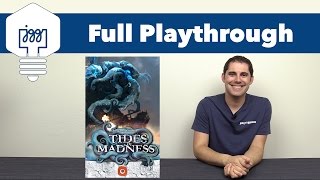
Tides of Madness is a sequel to Tides of Time and features gameplay similar to that design. Tides of Time is a drafting game for two players. Each game consists of three rounds in which players draft cards from their hands to build their kingdom. Each card is one of five suits and also has a scoring objective.
After all cards have been drafted for the round, players total their points based on the suits of cards they collected and the scoring objectives on each card, then they record their score. Each round, the players each select one card to leave in their kingdom as a "relic of the past" to help them in later rounds. After three rounds, the player with the the most prosperous kingdom wins.
Tides of Madness adds a new twist to the above game: madness. Some cards, while powerful, harm your psyche, so you must keep an eye on your madness level or else risk losing the game early as your mind is lost to the power of the ancients. More specifically, eight of the eighteen cards in the game feature a madness icon, and while scoring, you receive a madness token for each such icon in your collection of cards. Whoever has the most madness in a round either scores 4 points or discards 1 madness token — and the latter option is valuable because if you ever have nine or more madness, you lose the game immediately.
- Tense, well-balanced drafting that scales nicely in two-player
- Madness as a meaningful, risk-reward resource that drives decisions
- Dense Lovecraftian theme with multiple viable scoring avenues
- Clear interaction through drafting and strategic hand management
- Potential for dramatic comebacks via cross-card synergies
- High replayability due to varied card combinations and sets
- Rule complexity and memory load can be intimidating
- Scoring can require careful bookkeeping and a scoring pad
- Flavor text and terminology may feel opaque to newcomers
- Initial hand luck can influence early strategy
- Across rounds, players must track multiple categories simultaneously
- Thematic density may not appeal to all players
- Madness, risk management, tableau-building through card drafting and set-collection
- Lovecraftian Cthulhu universe
- Competitive drafting with escalating madness and thematic flavor
- Tides of Time
Mechanics (from transcript analysis)
- Card removal and round-end turnover — At the end of each round, players remove a card from the game and the remaining cards are permanently placed face-up for scoring; this shapes the available future options.
- Madness as a resource — Madness tokens are gained from cards and tentacles; excess Madness can cause an immediate loss, but Madness can also be converted into victory points or used to deny opponents.
- Set collection and majority scoring — Points are awarded for majorities in various categories (manuscripts, locations, outer gods, races, great old ones) and interactions between these sets create dynamic scoring opportunities.
- Three-round pacing with round-based scoring — The game unfolds over three rounds with scoring after each round and a final tally at the end.
- Two-player drafting with pass-and-reveal — Each round, both players select one card face-down, reveal simultaneously, then pass the remaining four to the opponent and select from the new four on the next reveal.
- Wild and suitless cards — Some cards are suitless or wild, which alters how majorities are computed and adds flexibility for pursuing certain combos.
Video topics + discussion points
Quotes (from this video)
- this is a two-player only handd drafting Style game that is set in the lovecraftian cthulu universe
- Madness can be bad if you ever end around with nine or more Madness you immediately lose the game
- this dreamlands is one of the three suitless cards and in fact it says this uh card has a wild suit so it does actually have a suit
- it's a no-brainer we are going to pick this card here
- that was a humongous 37 points
- this is a really big win for us in the end
References (from this video)
- Fun
- Tides of Time
Mechanics (from transcript analysis)
Video topics + discussion points
Quotes (from this video)
- Shelf 16 is kind of a an odd mix here
- This shelf has twice as many games as most shelves
- one of my favorite two-player games, but it's very difficult to learn and play
- Fantastic abstract strategy game
- Such a classic game and I like it a lot
- I don't know why I like it so much, but I do
- one of the most beautiful dexterity/party games there are
- There are so many games on the shelf