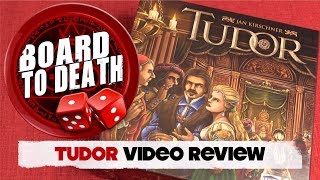
In Tudor, you are a Lord in the court of King Henry VIII. Here you will be positioning your Courtiers among the influential Lords who grant you actions that allow you to maneuver your family members to high title offices and gain their respective Rings of prestige and power.
Players take turns placing their Courtiers into the three Audience Chambers, each with unique actions. Then each player will place their one Lord in a Chamber of their choice. Only Courtiers in an Audience Chamber with any player's Lord present will be able to use that Chamber’s actions. But be careful, since there are only a limited number of seats available in each Chamber and competing families can push you out of a Chamber!
Then all player Courtiers, in Chambers with a Lord, take turns performing ONE of the two Actions in their Chambers. The powerful Lords may also take both actions in the Chamber they occupy. Chamber Actions allow you to gain Court Cards and to move your Courtiers in the Throne Room onto spaces with square Court Tokens that represent various faction interests and demands at the court. You collect these Court Tokens, which are one way to gain Prestige at court.
When you reach the top space of a Court Office in the Royal Court, you will gain that title - represented by a Ring. A player's Rings are placed and displayed on their individual Player Hand Screens. Positioning your Rings on different fingers project your interests, intent, and inclinations to the other players, because different positions enhance specific Actions that your Courtiers take in the Audience Chambers!
You must always be vigilant, because another players can seize your Court Office, kicking your Office Holder out in disgrace and then taking one of YOUR Rings!
The player with the most prestige at game end wins!
In each game of Tudor, you will choose to play one of many scenario cards, each with their own special rules that can alter the game in dramatic ways. In addition, choose two different scoring cards to vary gameplay, creating a strategic experience with exceptional replayability.
—description from the publisher

- intrigue and power dynamics
- varied scenarios and asymmetric features
- Diplomacy, intrigue, and power
- Court of King Henry VIII
- Historical political intrigue in a royal court
Mechanics (from transcript analysis)
- diplomatic resource management — Collect resources to influence positions of power
- ring/positioning mechanic — Place rings on a finger on your player screen to activate special abilities
- scenarios — Diverse scenarios with unique rules
- worker placement — Gather diplomatic resources to maneuver courtiers in the throne room
Video topics + discussion points
Quotes (from this video)
- Netta Tonka is a competitive strategy game with clever twists of worker placement
- it looks pretty stunning
- each player takes on a unique role with dramatically different abilities and goals
- there is dozens of player configurations and modular boards and scenarios
- you can play as the murderer skeletons the dreaded spider the bewitching enchanter or the manor itself
- you are a lord in the court of King Henry the eighth collecting diplomatic resources to maneuver your courtiers in the throne room and gather prestige
- you need to be careful though because your positions and rings can be stolen by other players
- Block is one irresistible game about resistance and social interaction inspired by real events around the world
References (from this video)
- Strong thematic integration of Tudor court politics
- High replay value due to multiple scoring and scenario cards
- Tense player interaction with strategic positioning
- Beautiful components and visual appeal
- Complex setup and rule density may deter newcomers
- Shields can be fragile under heavy ring/token load
- Best at higher player counts; may feel tight or slow at low counts
- Ambition, court intrigue, and power struggles
- Court of King Henry VIII in Tudor England
- political monarchy with factional play
- Game of Thrones-inspired court strategy (metaphor)
Mechanics (from transcript analysis)
- action selection and lord placement — Players place lords to determine which chamber actions are available and which courtiers are activated.
- area control and positional tug-of-war — Top spaces and warded chambers create positional competition among players, driving tension and strategic blocking.
- color/ring matching and card drafting — Movement and card acquisition are constrained by ring colors and faction tokens, influencing available actions.
- scoring cards and scenario cards variability — Scoring mechanics vary by setup via red/green scoring cards and blue scenario cards, yielding different play experiences.
- token and card management — Gaining, discarding, and using faction tokens and intrigue cards to drive scoring and actions.
- worker placement and movement — Courtiers move through chambers, collecting cards, tokens, and influences to advance in the court.
Video topics + discussion points
Quotes (from this video)
- It is an excellent game
- best played at a full player count
- the theme is captured nicely regardless what scoring and scenario cards came up
- Academy Games as always has provided quality components for a pretty unique game beside it being beautiful to look at
- we give Tudor an 8 out of 10