Twilight Imperium (Fourth Edition) is a game of galactic conquest in which three to six players each take on the role of one of seventeen factions vying for galactic domination through military might, political maneuvering, and economic bargaining. Every faction offers a completely different play experience, from the wormhole-hopping Ghosts of Creuss to the Emirates of Hacan, masters of trade and economics. These seventeen races are offered many paths to victory, but only one may sit upon the throne of Mecatol Rex as the new masters of the galaxy.
No two games of Twilight Imperium are ever identical. At the start of each galactic age, the game board is uniquely and strategically constructed from among 51 galaxy tiles that feature everything from lush new planets and supernovas to asteroid fields and gravity rifts. Players are dealt a hand of these tiles and take turns creating the galaxy around Mecatol Rex, the capital planet seated in the center of the board. An ion storm may block your race from progressing through the galaxy while a fortuitously placed gravity rift may protect you from your closest foes. The galaxy is yours to both craft and dominate.
A round of Twilight Imperium begins with players selecting one of eight strategy cards that both determine player order and give their owner a unique strategic action for that round. These may do anything from providing additional command tokens to allowing a player to control trade throughout the galaxy. After these strategies are selected, players take turns moving their fleets from system to system, claiming new planets for their empires, and engaging in warfare and trade with other factions. At the end of a turn, players gather in a grand council to pass new laws and agendas, shaking up the game in unpredictable ways.
After every player has passed their turn, players move up the victory track by checking to see whether they have completed any objectives throughout the turn and scoring them. Objectives are determined by setting up ten public objective cards at the start of each game, then gradually revealing them over the course of the game. Each player also chooses between two random secret objectives at the start of the game, achievement of which provides victory points--only for the holder of that objective. These objectives can be anything from researching new technologies to taking your neighbor's home system. At the end of every turn, a player can claim one public objective and one secret objective. As play continues, more of these objectives are revealed and more secret objectives are dealt out, giving players dynamically changing goals throughout the game. Play continues until a player reaches ten victory points.
—description from the publisher
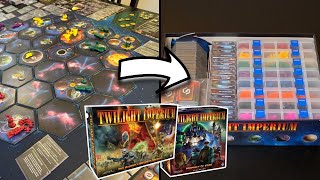
- Large, immersive sci-fi scope
- Rich faction variety and high replayability
- High component quality and modular storage potential (as discussed)
- High complexity and long play times
- Large footprint and setup can be time-consuming
- Expensive to acquire all expansions and accessories
- Empire-building, diplomacy, warfare, diplomacy, and exploration
- Galactic civilization in a science fiction universe with competing factions
- Epic space opera with political intrigue and long-term strategic planning
Mechanics (from transcript analysis)
- area control / planetary conquest — Players vie for control of planets and resources to gain influence and victory points.
- Diplomacy and alliances — Players negotiate treaties and alliances that grant temporary benefits and influence.
- fleet combat and space battles — Combat is resolved through fleet engagements with tactical positioning and unit strength.
- politics and agendas — Secret/political elements influence governance and strategic decisions.
- technology progression — A tech tree provides new capabilities and strategic options as the game advances.
Video topics + discussion points
Quotes (from this video)
- Twilight Imperium 4th edition and the prophecy of King's expansion stored all in one box
- inspiration and all the links to what you need for this storage solution are down in the comments and that is how I got
References (from this video)

- epic scope and thematic breadth
- deep strategic play if you enjoy long, player-driven games
- unwieldy length; difficult to teach and manage
- theme not enough to justify 6-8 hour marathon for many players
- epic galactic politics and conflict
- space opera empire-building
- grand, cinematic, player-driven diplomacy and warfare
- Ark Nova
- Imperial TI4 framing
Mechanics (from transcript analysis)
- area influence / combat — large fleet battles and territorial control in a sprawling galaxy
- negotiation / diplomacy — players negotiate, form and break alliances to advance
Video topics + discussion points
Quotes (from this video)
- it's dry as a bone
- beiges all get out
- the church track doesn't seem worth the cardboard it's printed on
- I gave this a 10 out of 10
- this is probably the best trick-taking game I've ever played
- it's unwieldy as anything can you tell what is going on
- the IP is important and you better make it thematically rich