The Undaunted series continues with this two-player deck-building game of tactical combat, pitting the raiders of Britain's Long Range Desert Group against Italian forces in the North African Theater of World War II.
The North African campaign has begun. Take control of the British Army's Long Range Desert Group and operate behind enemy lines or command the formidable Italian forces opposing them. In "Undaunted: North Africa", a sequel to Undaunted: Normandy, players once again lead their sides through a varied series of missions. As casualties mount, wounded soldiers leave the players' decks, forcing them to adapt in the face of changing tactical circumstances. Use your cards to strengthen your forces, deploy vehicles to advance rapidly across the battlefield, and seize the initiative as you determine the outcome of the North African Theater.
—description from the publisher
- Strong two-player duo experience
- Continues the successful Undaunted formula
- Same caveats as Normandy about deck-building depth
- deck-building, scenario-based tactical engagements
- World War II North Africa
- campaign-like scenarios with evolving decks
- Undaunted Normandy
Mechanics (from transcript analysis)
- deck-building — Similar to Normandy; build efficient hands.
- scenario-based play — Scenarios drive objectives and victory.
Video topics + discussion points
Quotes (from this video)
- bam that's a quote, baby, quotable
- it's one of those things that you should always feel like there's no chance for you to win on both sides simultaneously
- easy like sunday morning
References (from this video)
- Military combat and strategy
- World War II - North Africa
- Thematic simulation
- Undaunted: Normandy
Mechanics (from transcript analysis)
- Deck building driving action — Similar to Normandy, deck building controls military unit actions on the board
Video topics + discussion points
Quotes (from this video)
- that sense of destruction sheer destruction of the playing space and you don't get that much in board games
- i think that's a really nice level of interaction in games because it's not mean spirited it's not vindictive but it still means you've got to constantly keep thinking
- i've got my own deck that alone is exciting and different to the vast majority of games that i had played in the past
- the deck is created as we play we're buying cards from a central pool
- everybody's got a bit of the same information a bit of different information and it makes the game really really intriguing
- everybody's running around a table shouting over each other trying to find the people with the same card
- i've played it with my german family and my english family who can't speak to each other because i don't speak the same language but they could all play happy salmon together
- everyone's got their own set of poker dice and they're rolling them all at the same time you're not having to wait for somebody else
- these are just the most fantastic little components that i've i've found in games i absolutely love them
- it takes six minutes to play which is three rounds of drawing one minutes each and three rounds of guessing one minute each
- it's so frustrating it just gets in the way it's not fun
References (from this video)
- Maybe favorite Undaunted
- Introduced vehicles
- Fantastic game and series
- Love it
- Military combat with vehicles
- World War 2 North Africa
- War game
- Undaunted: Battle of Britain
Mechanics (from transcript analysis)
- Deck building — Build deck for tactical combat
- vehicles — Introduced vehicles to Undaunted series
Video topics + discussion points
Quotes (from this video)
- This is a series where I take a look at reviews I did last year, 5 years ago, 10 years ago, and 20 years ago
- I know it's hard to believe people were arguing about board games
- Seven Wonders Duel came out and changed gaming - now we have dual games everywhere
- This game's thematic because it feels like the Joker's making you play this at gunpoint
- No Thanks keeps getting better for me the more I play it
- Undaunted - such a fantastic game and series - I love it
References (from this video)
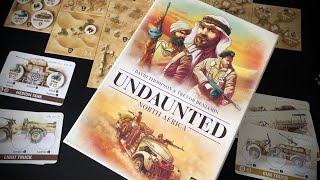
- Simple rules that are quick to learn
- Very tactical with deep interactions from cards and terrain
- Scenario-driven with the ability to invent your own scenarios
- Two-player asymmetric design with engaging objective mechanics
- Fog of war and recon add tension and variety
- High replayability via many terrains and scenarios
- Clear, compact components and aesthetic
- Fog of war cards can clog your hand; recon is needed to remove them
- Crew specialization and tile tokens can be fiddly; setup demands care
- Official solo support is lacking; solo play relies on homebrew rules or AI variants
- Two-player only design (no official multiplayer) and can be setup-heavy for new players
- Asymmetric, scenario-driven WWII squad-level combat
- Desert campaign in Libya, 1940-1943
- Tactical, scenario-driven card-driven engagements with terrain and fog of war
- Warchest
- Undaunted Normandy
Mechanics (from transcript analysis)
- combat resolution with dice and suppression — Attacker rolls dice to meet target values; a zero on a die is always a success; damage can suppress or destroy units or structures, with suppression limiting future actions.
- deck-building — Players build and cycle a small, scenario-defined deck; starting decks are fixed per scenario with upgrades drawn from a supply. There is no cross-game deck construction.
- fog of war and recon — Fog-of-war cards represent battlefield uncertainty; recon actions can remove fog-of-war from tiles to reveal them.
- initiative-based action order — Each turn, players select a card for its initiative value; cards are revealed to determine who acts first.
- scenario-driven objectives and asymmetry — Italian and Allied sides have different objectives on map tiles (e.g., control vs destroy) that drive play across scenarios.
- tile/terrain map with terrain effects — The map uses tiles with terrain features that modify range, cover bonuses, and line-of-sight-like considerations affecting combat.
- units with vehicle crew specialization — Units sit in roles with seat-specific specializations (e.g., spanner, crosshairs, steering wheel) that unlock unique actions when crewed.
- upgrades, bolstering, and card management — Actions to bolster, inspire, demolish, and hunker down influence deck strength and availability; cards can be added from supply and some can be removed from the game.
Video topics + discussion points
Quotes (from this video)
- This is a two-player war game that's very quick to get into.
- The rules are relatively straightforward.
- The game shines: simple rules with a complex set of interactions with the cards that are in your deck.
- This is superb two-player tactical game that can play really sharp lots of different scenarios mixing up what's going on the board not so many moving parts that you can't keep it all in your head.
- Short, sharp, playable, lots of action, lots of drama, easy to get to the table.
References (from this video)
- compact, fluid deck-building core
- focus on logistics and unit coordination in a desert setting
- deck-building abstraction may obscure some historical details
- squad-level action and supply-driven campaigns
- North Africa desert campaign during WWII
- deck-building wargame
- Undaunted Battle of Britain
- Raml in the Desert
Mechanics (from transcript analysis)
- deck-building — cards manage units, actions, and events
- squad-level movement — micro-level tactical decisions with vehicles and troops
Video topics + discussion points
Quotes (from this video)
- great history to learn about and great way to learn about history through gaming.
- what do you think? what are some of the games you would have played for some of these iconic battles?
- I couldn't fit every operation scenario. I couldn't fit every game in this.