In Underwater Cities, which takes about 30-45 minutes per player, players represent the most powerful brains in the world, brains nominated due to the overpopulation of Earth to establish the best and most livable underwater areas possible.
The main principle of the game is card placement. Three colored cards are placed along the edge of the main board into 3 x 5 slots, which are also colored. Ideally players can place cards into slots of the same color. Then they can take both actions and advantages: the action depicted in the slot on the main board and also the advantage of the card. Actions and advantages can allow players to intake raw materials; to build and upgrade city domes, tunnels and production buildings such as farms, desalination devices and laboratories in their personal underwater area; to move their marker on the initiative track (which is important for player order in the next turn); to activate the player's "A-cards"; and to collect cards, both special ones and basic ones that allow for better decision possibilities during gameplay.
All of the nearly 220 cards — whether special or basic — are divided into five types according to the way and time of use. Underwater areas are planned to be double-sided, giving players many opportunities to achieve VPs and finally win.
- Building an underwater civilization to optimize resources and scoring, emphasizing balance between growth, sustainability, and strategic infrastructure placement. The setting explores how technological and logistical ingenuity allows societies to flourish in an alternative habitat while navigating constraints and competition.
- Underwater cities and tunnel networks beneath the ocean. In a near-future scenario shaped by Earth's overpopulation, civilizations push infrastructure and population centers below the sea to secure scarce resources and extend their reach in a hostile but strategically rich environment. The game presents modular components and a dynamic board state that evolves as players expand their underwater domains.
- Strategic resource management and route-building across multiple eras, driven by concrete actions, card interactions, and spatial planning rather than a linear story arc.
Mechanics (from transcript analysis)
- Action-space selection — Players choose one action space per turn, which determines the primary course of their turn. The color-coding of action spaces interfaces with card plays, creating a layered decision tree where timing and color synergy matter.
- Card-driven effects — Cards provide benefits and bonuses only when their color matches the chosen action space. This coupling encourages careful deck management and sequencing to maximize impact and minimize wasted actions.
- End-of-era scoring — Scoring occurs at the conclusion of each era, with a final scoring phase at the end of the game. End-of-era scoring rewards accumulation, diversification of building types, and the strength of your network, shaping mid-to-late game decisions.
- Network/City building — The central map-building objective involves creating an interconnected network of cities, tunnels, and buildings. This network drives production, supports scoring criteria, and introduces strategic trade-offs between expansion and consolidation.
- Resource management — A core loop where players balance cards, resources, and production outputs. Efficient management across eras influences expansion options and scoring potential, rewarding forward planning and adaptation.
- Tableau cards and metropolises — Special cards are played into a tableau and contribute to scoring via metropolises and other card-driven bonuses. This mechanism adds depth to deck construction and long-term planning.
- Tile/production placement — Tunnels and buildings function as production units. They must be attached to cities to generate output, reinforcing a spatial strategy where connectivity and placement choices directly affect resource flow and scoring opportunities.
Video topics + discussion points
Quotes (from this video)
- in the game players are building an underwater Empire as a consequence of the Earth's overpopulation
- the effects on their card however are only triggered if its color matches the action space
- players will manage their cards as well as their resources efficiently in order to develop their underwater network of cities tunnels and buildings
- tunnels and buildings are the main production units but need to be attached to cities in order to produce
- players will be scoring points during the game
- but at the end of the third era there will also be a final scoring
- players will score victory points for having cities with different types of buildings
- points from their connected metropolises and points from their special cards played in their Tableau
- the player with the most victory points will win in underwater Cities
References (from this video)

- deep, satisfying engine-building with high replayability
- great card variety and thematic cohesion
- strong component quality and art
- long play time; not ideal for casual sessions
- heavy for newcomers; learning curve is steep
- underwater civilization building
- network of underwater cities with domes, tunnels, and kelp farms
- robust engine-building with multi-era cards
- Terraforming Mars
Mechanics (from transcript analysis)
- action tokens and color-m matching — place tokens; match card colors to activate actions; cards can trigger bonuses
- multi-era card-driven engine building — three eras; cards provide engine-building synergy and conditional bonuses
- production cycles and scalability — three production cycles escalate resources and opportunities
Video topics + discussion points
Quotes (from this video)
- the art is stunning it's got just a beautiful cover on the front
- adorable art this game is called Q Birds
- this might be the best game that I played this year
- the way all of the stuff bounces around is incredibly satisfying on a tactical and strategic level
- it's a lightweight set collection hand management style game
- this is easily the best of this trilogy
- Spring Meadow does it really well
- Underwater Cities might be the best game that I played this year
- Winner's Circle is still really good
References (from this video)
- deep, satisfying engine-building
- lots of variability and combos
- can be heavy and long
- engine-building tableau construction
- underwater future cities
- tech-tree driven with grids and combos
- Terraforming Mars
Mechanics (from transcript analysis)
- engine_building — build a tableau of actions and synergies
- tableau_building — combinatorial score growth from card/board interactions
Video topics + discussion points
Quotes (from this video)
- probably my favorite tire placement game of all time
- this one is like a companion game to el grande
- Arc Nova certainly the hotness at the moment
References (from this video)

- clear card-color matching for actions
- tight two-player experience as well as multiplayer
- board can feel dense; planning is needed
- expansions shift balance
- city-building and resource management undersea
- underwater cities with color-morted card slots
- strategic tableau-building with spatial placement
- Terraforming Mars
- Lorenzo il Magnifico
Mechanics (from transcript analysis)
- card drafting — draft cards to enable actions and build a city network
- engine-building — combo cards to maximize production and score
Video topics + discussion points
Quotes (from this video)
- my number 10 is tachu
- it's fun I mean plant and I mean so you obviously I would say do you like that kind of having to siphon through
- the real MVP comment Micah down below
- Kay's number one game of all time tune in next year geez
References (from this video)

- tight optimization puzzle
- breathes with tension and depth
- theme not universal; some dislike card quality/visuals
- production optimization, multi-resource engine
- Underwater future city-building
- strategic planning and efficiency
- Gaia Project
- Terraforming Mars
Mechanics (from transcript analysis)
- engine-building / resource management — place actions by color; matching color with hand to activate card play; production phases require careful timing.
Video topics + discussion points
Quotes (from this video)
- There is a lot of tension around the table with arcs; the tension is utmost.
- This is one of the more polarizing games, but I enjoyed it.
- Mechs versus Minions is pure fun; you are manipulating this mech by running your command line.
- Race for the Galaxy which for both of us is our most played game from a physical play standpoint.
References (from this video)

- Tumble and Dice
- Ark Nova
- Ticket to Ride
Mechanics (from transcript analysis)
Video topics + discussion points
Quotes (from this video)
- I landed on a bag called the Gorilla Grip heavyduty foldable reusable grocery bag.
- It is rated up to 50 lbs.
- 2 in gained here from 13 in to 11 in has completely solved that problem for me.
- What better place to put my board game bag when I'm not using it than to fold it down, collapse it down, and just slide it into one of those slots.
- I actually bought a three-pack of these. One cuz it had cost effectiveness. Two because I might sometimes want more than one of them.
References (from this video)

- strong thematic cohesion with other nominees
- solid mechanical framework
- aquatic expansion and city planning
- Underwater city-building landscape
- n/a
- Battle Lands
- Mice and Mystics
Mechanics (from transcript analysis)
- engine-building / network building — players develop networks to optimize resource generation and scoring
Video topics + discussion points
Quotes (from this video)
- this is a book that claims to have a hundred different mechanisms and 100 different diagrams to go with them
- I think this is going to be a great resource
- they are big fans of magic
- what is there there's like Jace and Chandra and Lilith and carne and chub toad
- I'm not sure exactly what Snap is maybe that has to do with shuffling
- I grew up playing Magic I was obsessed with it
- yo there's this article but you should go and check out which could describe this so much better than I could
- I really wanted to spend some time just emphasizing yo there's this article but you should go and check out
References (from this video)
- Rich production phase with multiple income sources
- Debate over whether income-centric design constitutes true engine-building
- Terraforming Mars
- Lorenzo Magnifico
Mechanics (from transcript analysis)
Video topics + discussion points
Quotes (from this video)
- furnace hits the my definition of an engine builder.
- it's a feeling not a mechanism.
- Terraforming Mars as being like a quintessential engine building game to me.
- Concordia... your hand in and of itself is an engine that you are building towards.
- Steampunk Rally matches your definition and it also matches mine in that it is you're making this frankenstein's monster of a racing machine.
- Golem is where you stack the cards and then you keep reactivating them.
- Darwin's Journey comes to mind.
- Dominion is deck builders but can build engines; it sits in a spectrum.
- Villages, vineyards, and aging workers can feel engine-like but not always.
- income is not an engine.
References (from this video)

- deep engine-building with modular city components
- lively card interactions and conditional benefits that reward planning
- high variability and replay potential with different card pools
- rules heavy; may require a careful teach
- can be lengthy at higher player counts
- engine-building through card-driven actions and city development
- underwater domed cities with labs, desalination facilities, and kelp farms
- engine-building with evolving player mats and a card-driven action cadence
Mechanics (from transcript analysis)
- hand resource management and engine-building — you acquire cards that develop engines on your player map with production phases to trigger more resources
- season/production rhythm — three periodic engine runs drive increasing outputs and new card interactions
- worker placement with card synergy — placing workers to activate actions that are tied to the cards you hold and your city’s needs
Video topics + discussion points
Quotes (from this video)
- the asymmetries which are really wonderful
- every turn is the main engine; you're trying to build up these combos
- this game is a big winner
- holy cow this is amazing
References (from this video)
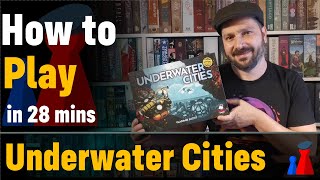
- Clear explanation of setup and core rules
- Comprehensive overview of actions and production
- Good coverage of scoring and end-game conditions
- Lengthy and dense for new players
- Rules heavy; requires careful attention to color-matching and placement rules
- Some details may be glossed over in a single setup video
- urban development, resource management, network building
- Underwater empire building in a submerged future
- economic/resource optimization with chain production and scoring
Mechanics (from transcript analysis)
- area control / metropolises scoring — Connect to metropolises for scoring.
- card powers and tableau management — Played cards provide ongoing or immediate effects and are placed in tableau.
- multi-era game progression — Three eras with transitions and end-game scoring.
- Production Phase — All players produce resources based on connected networks and upgrades.
- Resource management — Manage credits, kelp, biomatter, steel, plastic, science, etc.
- set collection / card drafting — Choose cards each round affecting actions and scoring.
- tile/area placement and network building — Place tunnels, cities, and buildings to connect networks.
Video topics + discussion points
Quotes (from this video)
- The game is for one to four players, takes about 2 to 2 and a half hours to finish.
- The player with the most victory points will win.
- You must select a vacant space to perform actions.
- production all players produce simultaneously.
References (from this video)
- Brilliant engine-building with a satisfying progression
- Feels expansive yet coherent
- Terraforming Mars
Mechanics (from transcript analysis)
- Engine building with modular cards — Play cards to upgrade actions and improve efficiency over time.
- Worker/placement with card-payoffs — Place workers to activate actions and trigger card bonuses.
Video topics + discussion points
Quotes (from this video)
- I love how streamlined this game is.
- it's a drafting style game as you're trying to build up the civilization of cards
- one world worthy of all the hype
- this engine builder
- it's the crunchiness
- this is widely considered to be one of the best if not the best economic style board game of all time
- it's a joy to play
- you are destined to love it
References (from this video)

- ambitious theme in a regular setting
- unfit for water environments and hot tub format
- subaquatic civilization-building
- underwater metropolis
- structured strategic planning
Mechanics (from transcript analysis)
- unknown — unknown
Video topics + discussion points
Quotes (from this video)
- hot tub gate
- soggy tarp hot tub a fun game that's not what I asked for
- Publishers watching please put in the comments why don't they make every game hot tub proof
- stupid stupid game can't play it in a hot tub
- I hate it all
References (from this video)
- described as a very good game
- offers depth and strategic decisions
- noted as a bit complex
- could be hard to get to the table due to its complexity
- unknown
- unknown
- unknown
Mechanics (from transcript analysis)
- engine_building — players gradually develop an engine of actions and card/tile combos to maximize scoring opportunities
- worker_placement — utilizes worker placement concepts to select actions and advance the player's city-building engine
Video topics + discussion points
Quotes (from this video)
- not a bad game but nothing to write home about in my opinion
- that is a really great game combining worker placement and deck building so really good game i can highly recommend that
- a very good game too
- bit complex
- cooperative tech builder so i suggest looking into that if you like deck builders
References (from this video)
- Noteworthy worker placement game
- science_fiction
- underwater
- city_building
Mechanics (from transcript analysis)
Video topics + discussion points
Quotes (from this video)
References (from this video)

- engaging engine-building
- interesting spatial decisions
- complex teaching
- longer playtime
- beneath-the-sea expansion and resource management
- futuristic underwater city-building
- techno-science fiction
Mechanics (from transcript analysis)
- card drafting — draft cards to build engines and score
- tile placement — place city tiles to extend underwater cities
Video topics + discussion points
Quotes (from this video)
- it's only a game
- it's the real juicy bit
- the only way for this channel to evolve is to test new things
- top 10 two-player games collaboration on Feb 6th
References (from this video)

- Engaging engine-building
- Pleasant thematic feel
- Some players find it heavy
- Resource management and engine-building
- Underwater civilizations building networks
- Sci-fi/technological
- Terraforming Mars
- Gaia Project
Mechanics (from transcript analysis)
- engine-building — Build networks and ships to gain actions
- Network/area control — Connect cities to maximize points
Video topics + discussion points
Quotes (from this video)
- I think it might just be the most underrated feature on Board Game Geek.
- I found it to be very very helpful for myself.
- the analyze feature is actually built into every game page.
- Lisboa might be one that I want to check out.
References (from this video)

- Robust modular expansion options
- strong mechanism baseline
- museum variant adds heavy rule overhead
- can be long and slow
- engineering and societal growth under water
- futuristic underwater city-building
- mechanism-driven with modular expansion
- Ark Nova
- Terraforming Mars
Mechanics (from transcript analysis)
- hand management and resource tracking — players optimize resources and placements for points
- tile/board augmentation with modular expansions — base game plus modular expansions adding complexity
Video topics + discussion points
Quotes (from this video)
- "I think this is my favorite Alexander Fisher game"
- "it's just it just works for me like it just clicks with my brain"
- "I adore teach you it's one of my favorite games"
- "terraforming mars is one of my favorite games"
- "you can gain hopefully some insight from that"
References (from this video)

- Deep card system with strong thematic integration
- Expansion content adds replayability
- Rule density can be intimidating
- Card-driven city-building undersea kingdoms
- Underwater civilization development with expansions
- Strategic and modular with varied paths
- Terraforming Mars
- Energy Empire
Mechanics (from transcript analysis)
- Card-driven engine building — Cards provide actions and synergies to grow the city
- tile-based placement — Place modules and build up a connected underwater world
Video topics + discussion points
Quotes (from this video)
- I like co-ops sometimes it's nice to not have bad blood between players and work together
- everything just rewards you gently little rewards that remind you you're doing well
- Underwater Cities really sings with the card system
References (from this video)

- rich card variety
- expansions add depth
- some players find it more restrictive than Terraforming Mars
- colonization undersea
- underwater city-building with domes and cards
- strategic, card-driven engine-building
- Terraforming Mars
Mechanics (from transcript analysis)
- Card-driven engine-building — players develop their domed underwater cities via card combos and actions.
Video topics + discussion points
Quotes (from this video)
- Pandemic base game is absolutely amazing; it's one of my top 10 favorite games of all time.
- Dominion ... it's the big box and it's organized by sets; the grand Puba of deck-building.
- Ticket to Ride is a solid gateway game; a must-have for building a collection.
- Steampunk Rally Fusion is amazeballs ... it's that good ... board game coffee seal of approval ten times over.
- This is not an expansion; this is the Cure—the dice game of Pandemic.
- Pandemic Legacy Season 1 — one of my top ten favorite games.
References (from this video)
- A compact and powerful action-economy loop that rewards plan-ahead thinking and flexibility.
- High information density per turn; even imperfect plays can contribute to a meaningful overall strategy.
- Strong thematic cohesion—the sci-fi undersea setting and the constrained action space reinforce the game's core tension.
- Excellent sense of progression from blank slate to a completed underwater complex that feels personal and earned.
- Steep learning curve; players new to this style of engine-building may feel overwhelmed at first.
- The required pivoting when cards don’t match the desired action can feel punishing early on.
- Some players may dislike the constant constraint pressure and the feeling of compromising a preferred path.
- engine-building and city-building in a science fiction undersea world
- Futuristic underwater metropolis with modular development and interlinked districts
- analytical and personal narrative, with a focus on decision pressure and long-term planning
- Terraforming Mars
- Gaia Project
Mechanics (from transcript analysis)
- card action placement — Each turn you select one card from a small hand and place it to activate an action, with placement bonuses and card bonuses influencing the payoff. The ideal is to match the right color to the right space, but perfect matches are rare.
- engine-building and city tableau — Your personal city grows as you utilize cards and actions to lay down buildings, resources, and scoring opportunities. The decisions you make early in the game shape what comes onto the board later and how efficiently you can advance.
- hand-management and action economy — You manage a limited set of actions (about 30 across the game) and must strategically decide when to take the most immediate benefit and when to sacrifice that benefit to gain something better in the future. This creates strong tension between short-term optimization and long-term payoff.
Video topics + discussion points
Quotes (from this video)
- one of the deceptively clever things about underwater cities each turn you're really only making one decision
- it's a game that's absolutely ruinous for people who are stuck on one path
- the fundamental core of why underwater cities is a great game
- you have to adapt to what's in your hand
- there's always going to be spaces blocked up that you can't use
- the pressure that comes with the game to make good decisions in bad circumstances
- start off with a blank slate a board like this which is full of possibilities and the decisions you make shape what turns up on the board
- you cannot take the action you want to take each and every time you play that you have to make the best of a bad situation continuously
- you have to suck it up and do a bad move because you know it will allow you to do a good move later
- this is better than terraforming mars in that regard
References (from this video)

- Host really liked this game
- Reason for getting other Suchy games
- City building
- Underwater civilization
Mechanics (from transcript analysis)
Video topics + discussion points
Quotes (from this video)
- I used to call this a shelf of shame that was a pretty common thing to call it back in the day and I don't never really liked that term because I don't feel shame that I haven't got to these games
- this is mostly work like this is just a backload of things I probably should get to
- people will still be looking for it
- it doesn't matter if the game is like 20 years old people will still be looking for it
- I've painted this one and I spent a lot of time doing it
- there's no point putting them on the channel I think both of them have been out of print for like a decade
- one of the worst kickstarters by one of the worst studios in board gaming history
- Golden Bell Studios did everything wrong you could possibly think of
- purely toxic company run by incredibly terrible people
- it would be kind of a joke that I'd be able to do a three minute video of feudum
- this game has a tutorial video online that's like 40 minutes long
- The Rose explanation video feels like a parody but it's actually how the game is played
- nothing personally to me puts me off playing a game that then sitting down unboxing it and having a craft assignment
- stop making me spend hours assembling your damn games
- this is an uncontrollable mess right now
- I'm a full-time dad and I'm really doing this in the evenings
- I have a finite space and also it just puts pressure and stress on me having a whole bunch of crap there that I know I'm not going to get to
- I'm going to do a big cull
- I will be published by this company but that doesn't mean I'm going to be slavishly devoted to every single game they put out
- I am a sucker for cute animal games like I really am
References (from this video)

- Premium components and interesting base mechanics
- Premium elements can bloat box size
- Infrastructure, urban planning
- Underwater city development
- Systematic
Mechanics (from transcript analysis)
- Expansion / building networks — Construct networks and upgrade components
- Resource optimization — Players optimize resource flow to maximize city growth
Video topics + discussion points
Quotes (from this video)
- it's a euro style game that plays up to six
- it's fully simultaneous
- Concordia Venus ... brings in team play and that lets you play two on two which is a four player game and it also lets you play two versus two which is a six player game
- not a euro game really it's more of a deduction style game where it's one versus many
- I started to work on that video and I'm hoping to make it happen
- Miniatures don't do anything for me
References (from this video)
- Innovative pairing of actions with matching cards
- Deep engine-building that scales with play
- Tight, satisfying euro feel with varied turns
- Discarding a card with every action can create planning constraints
- Engine-building through a card-driven tableau
- Underwater city-building with tunneling and habitat development
- Strategic, modular engine-building that evolves through card use
- Calimala
- Teotihuacan: City of the Gods
- Aqua Sphere
Mechanics (from transcript analysis)
- card-driven tableau — Pair actions with matching colored cards to build a powerful engine over time.
- set collection / tableau growth — Add cards to your tableau to improve efficiency and capabilities.
- worker placement — Place workers to take actions and build a network of tunnels/land scaled to resources.
Video topics + discussion points
Quotes (from this video)
- What a Beautiful Design
- it's criminal that this game isn't so widely accessible
- one of the cleanest Euros I've played in quite some time
- I am absolutely terrible at this game and despite that I love this one
- this game is quite a polarizing game
- it's a real Euro Gamers game
- ton of planning and strategy here
References (from this video)

- excellent card system
- color-matching rewards
- rewarding turn combos
- tight resource management
- many paths to victory
- heavy game with minimal theme
- card luck element
- not visually impressive
- underwater base building
- kelp
- aquatic civilization
Mechanics (from transcript analysis)
Video topics + discussion points
Quotes (from this video)
- this is a really solid game and yet nobody's talking about it
- it's just a really really cool game I just like sandbox games
- this one is alongside psar 2849 probably my favorite underwater cities
- one of the coolest ideas for a Euro game I have ever come across
- can't help but play this without a smile on your face
- it's Marvel I love superheroes
- Seven Wonders it is one of the Evergreen classic drafting games
- one of the best examples of video game adaptation done right
References (from this video)

Mechanics (from transcript analysis)
Video topics + discussion points
Quotes (from this video)
- We inflate our numbers.
- Day One was a game I bought because of the designers
- I knew it was a light game
- From Vital Sura, which is a a game that melts cinema's brain
- I'm happy if I never have to play it again.
References (from this video)

- Beautiful, abstract-yet-thematic design
- Solid solo engine via digital implementations
- Availability and distribution vary by region
- City-building optimization with modular goals
- Underwater city-building and infrastructure
- Feast for Odin
- Pax Premier
Mechanics (from transcript analysis)
- Card-driven city-building — Cards drive actions and layouts; players optimize infrastructure.
Video topics + discussion points
Quotes (from this video)
- Spirit Island is just so engaging and interesting.
- Words cannot express how dominant this is.
- My true love is still Mage Knight… but Spirit Island ate and left no crumbs.
- The solo gaming community is the best gaming community.
- Thank you so much to the solo Community; you guys do a great job.
References (from this video)

- strong thematic integration
- solid engine-building core
- rules complexity can be daunting for new players
- ocean infrastructure and engineering
- Underwater city construction and expansion
- engine-building with modular goals
- Praga Caput Regni
- Trismegistus (Tris Magistas)
Mechanics (from transcript analysis)
- engine_building — Progressing a personal engine to unlock actions and synergy.
- hand_management — Managing a hand of cards to trigger actions.
- resource_management — Allocating resources to build networks and fulfill goals.
Video topics + discussion points
Quotes (from this video)
- I would say I prefer Praga Caput Regni.
- Praga Caput Regni is my number one game of 2020.
- I absolutely love everything about the hobby to be honest.
- I love the social aspect of the hobby.
- I'm a semi-omnigamer in some ways yes in some ways no.
- Quacks of Quedlinburg lived up to the hype for me.
- Concordia is one of my favorite games; timeless and elegant.
References (from this video)
- deep strategic depth with tight, meaningful decisions
- strong two-player pacing and engagement
- replayability through varied board and build options
- long playtime and table presence can be daunting
- board iconography may be initial hurdle for new players
- undersea infrastructure, resource management, and strategic city planning
- Underwater city-building in a flooded future where players develop submerged metropolises
- Eurogame-esque, card-driven action selection with color-matched actions
- Terraforming Mars Prelude
Mechanics (from transcript analysis)
- Card-driven action selection — play a card to take the action; only if the card color matches the action do you get both the action and the card effect.
- Resource management — manage various resources to fuel city development and scoring opportunities.
- scoring through city diversity — points come from building variety and city development, with strategic emphasis on balance.
- tile/board placement — build tunnels and buildings to shape your underwater city and access income opportunities.
Video topics + discussion points
Quotes (from this video)
- Expansions is like one of the best ways for me to be able to go back and be able to set aside time to go back and play old favorite games.
- This is a great game. If you like good games, check this one out.
- The triple layer boards are almost a must get.
- The biggest change, there's two things.
- I wouldn't see a reason not to [include the expansion] when I play this game.
References (from this video)

- Marine civilization expansion
- Underwater city-building and card placement
Mechanics (from transcript analysis)
- Modular board — board modularity and expansion
- route network building — build networks to connect areas
- worker placement — place workers to advance actions
Video topics + discussion points
Quotes (from this video)
- I have made the decision to stop making my reviews now.
- I do not enjoy making reviews honestly my worst emotional moments with John gates games in general happens when I am staring at the camera trying to do these reviews.
- I started making these videos because I was bored and I have a lot to say about board games.
- I want this to continue to be a part time sort of endeavor like you know a significant portion of my hours going into it but not like 40 hours a week.
- I would definitely recommend giving that one a listen.
- Watching playthroughs is a better way in my opinion to show people how the game works.
References (from this video)

- strong thematic feel
- deep engine-building potential
- complex setup
- heavy rules for newcomers
- engineering, resource management, networked city-building
- Underwater futuro-urban development and city-building
- thematic Euro-style governance and growth
Mechanics (from transcript analysis)
- card drafting — players draft and manage action cards to optimize city-building options
- engine-building / tableau building — creating synergies between cards to maximize city output
- tile placement — placing districts on a modular board to form efficient layouts
Video topics + discussion points
Quotes (from this video)
- Destinies could be cool it's kind of Cooperative but only one of you will fulfill his Destiny so it's a race game
- Time stories Revolution is something I'd say the smaller boxes the new ones yeah time series Revolution it will apply fine with two it's perfect with two I enjoy time stories more most with less people because you each individual can do more things
- there's a game called mysterium Park which they say is better than mysterium because it's shorter
- one person hides his treasures somewhere on the map just draws an X there and then he has to from time to time give Clues to other people to search and you actually can draw huge circles on the map from the information you have
- draft desire is an amazing quick simple drafting game
References (from this video)

- Clever action selection mechanic
- Accessible take on a thematic engine-building concept
- Rules can feel dense on first pass
- Underwater city-building / resource management
- Through the Ages
- Gaia Project
Mechanics (from transcript analysis)
- Worker placement with action selection — Players select actions via cards to build and develop their underwater network.
Video topics + discussion points
Quotes (from this video)
- I'm very bold in my opinions, I hate it but I'm still willing to give it a second and third try because it's better it's an expensive game
- America blue shell is when you brace Mario Kart and then if you're in last place you get rewarded the blue shell
- it's a shared objective, you really pay attention to what other people are doing
- canvas... what a stinker... you're a pile of poops I love that game
- Rise of X added ... I had the Dreadnought portion and it replaced the main board
- I'll take it from me, I think he's French no he's Jamaican
References (from this video)
- Tactically rich card play with color-matching bonuses that reward careful sequencing
- Deep, engaging tactical decision-making and strong card combo potential
- Solid rulebook with clear layout, diagrams, and helpful examples
- Good solo mode and approachable entry for experienced players despite weight
- Limited downtime for a heavy Euro; opportunities to stay engaged between turns
- Thematic immersion is not strong; theme is largely abstracted from mechanics
- Lengthy play sessions, especially with four players; can feel like a marathon
- Limited direct player interaction; largely multiplayer solitaire
- Component quality is not top-tier (thin cards, modest tokens); sleeves recommended
- Price is relatively high for the included components and content; longevity relies on expansions
- urban planning and resource management undersea civilization
- Underwater city network with domes, labs, farms, and desalination plants connected by tunnels
- mechanics-driven, theme largely abstracted
- Terraforming Mars
- Pulsar 2849
Mechanics (from transcript analysis)
- Card draw and cycle — Draw from a deck each turn; certain actions allow drawing additional cards to optimize your tableau.
- Card-driven worker placement — Play a card into a color-coded slot to trigger a location action; if the card color matches the location action color, you trigger both the location action and the card action.
- Deck drafting and random special cards — Three eras with randomized special cards; six in-game scoring cards are drawn to introduce variability each game.
- End-game scoring and production phases — Multiple rounds with production/ scoring phases; end-game scoring to determine winner.
- Resource production and network building — Construct domes and tunnels to produce resources and connect cities; upgrade buildings to improve efficiency.
- Tableau/hand management — Limit of four cards in your tableau; order and timing of card plays drive engine-building and scoring opportunities.
- Tile/board placement for engine setup — Place domes, tunnels, labs, and farms on a world/map board to build a functioning underwater city network.
Video topics + discussion points
Quotes (from this video)
- this is a game that really needs to take three hours it doesn't need to be that long but it does well at a two to two-and-a-half hour mark
- it's multiplayer solitaire
- the card play in this is great
- the rulebook is very well laid out; it's logical; it's in the right orders in terms of steps that you should learn; it's fairly clear written
- I would give this a solid 8/10
References (from this video)
- Tight, highly satisfying core action system that blends action selection with card play.
- Engaging engine-building that scales clearly across production rounds.
- Compelling tactical decisions stemming from color-matching actions and card play.
- New Discoveries expansion significantly increases variability and asymmetry.
- 2-3 players is a sweet spot; a solo mode exists for solitary play.
- Theme can feel more mechanical than thematic due to the central color-matching mechanic driving most decisions.
- Endgame state can feel less varied across plays as the underlying network tends to look similar.
- Downtime and upkeep can become tedious at higher player counts, and manual resource tracking can invite errors.
- Technology-driven habitation and resource optimization aimed at alleviating overpopulation and expanding civilization underwater.
- A near-future scenario in which humanity seeks to make underwater habitats habitable by expanding an underwater network of cities and managing resources.
- Analytical and systems-driven; emphasis on mechanics, efficiency, and strategic planning over cinematic storytelling.
- Terraforming Mars
- Agricola
Mechanics (from transcript analysis)
- card_draw_and_hand_management — At the end of each turn a new card is drawn, reshaping options and forcing re-evaluation of priorities.
- color_matching_action_cards — A core gimmick where players must match the color of their hand cards to the color of the action spaces to gain rewards; this drives decision-making and timing.
- endgame_scoring_and_special_cards — Endgame scoring is shaped by city networks, buildings, and endgame scoring cards that alter final tallies.
- engine_building — Players expand their production network by constructing tunnels and buildings that increase resource production and unlock new actions.
- expansion_variability_and_assymetry — The New Discoveries expansion adds asymmetrical player boards, unique personal assistants, and more starting resources for replayability.
- production_phase_and_resource_management — A production phase converts card-driven actions into resources, fueling expansion and progression of the underwater network.
- worker_placement — Each turn, players place workers on limited spaces and must consider timing, space blocking, and potential card-synergies.
Video topics + discussion points
Quotes (from this video)
- the core Action System is killer
- this is a heavy strategic game that rewards optimal action efficiency and resource management
- the most fun part of underwater cities is navigating the decisions that emerge from trying to match cards to action spaces of the same color
- the endgame scoring and the endgame cards are a big pull, yet can make decisions tense at the end
- it's weird because sometimes when I think about playing it, it's not the first game I think of; but once you start playing, it's surprisingly rewarding
References (from this video)
- Bold title and composition, strong focal point
- Cover ambiguity makes it hard to read the subject matter
Mechanics (from transcript analysis)
Video topics + discussion points
Quotes (from this video)
- It's iconic. It is at least eye-catching; it's a classic.
- The box should tell us what we're doing in the game and how we're going to feel.
- This is top-notch stuff.
- I actually just ordered my copy, so this is obviously working for me.
- The cover sells the game, it screams what you're going to do.
References (from this video)
- discard phase at the start of a turn speeds up decision-making and overall pacing
- large-scale engine-building with a satisfying sense of network expansion
- thematic integration of plants, colors, and city-building creates a cohesive experience
- high potential for strategic planning and adaptability mid-game
- lengthy and complex; not ideal for casual players
- analysis paralysis can occur due to the depth of options each turn
- heavy euro weight may deter lighter-weight gamers
- urban planning and resource management in an oceanic future
- underwater city-building, networks of cities connected by tunnels and powered by living plants
- expository/enthusiastic
- Paladins of the West Kingdom
- Terraforming Mars
Mechanics (from transcript analysis)
- area/building_network — cities are built on a personal board and connected via tunnels and network links to maximize scoring and resource flow
- card_management — players manage a hand of five types of cards (instant, production, action, permanent, scoring) to augment their main actions and timing
- engine_building — players progressively optimize actions and card types to create a scalable engine that generates resources and points over time
- resource_management — five resources (money, kelp, plasteel, science, biomatter) must be produced, upgraded, and spent to build cities, tunnels, and plants
- set_collection_and_scoring — end-game scoring cards and finished city/plants combos drive final point totals
- worker_placement — each turn a player places markers on actions on the main board to gain benefits and triggers card synergy
Video topics + discussion points
Quotes (from this video)
- the core of the game is this you all have 30 actions throughout the whole game and you must make the absolute best of them to win
- you'll discard at the start of your turn it speeds up the game and gives you the maximum time to consider your moves
- it's also long and complex so not for everyone definitely a heavy euro game for people who like that sort of thing
- Underwater Cities the best game i've played this year
References (from this video)

- Strong tactical flow and meaningful two-player interaction with expansions
- Engaging thematic integration
- Can be memorization-heavy
- Endgame scoring cards can feel situational
- aquatic infrastructure and city-building
- Underwater civilization development
- thematic but mechanically focused
- Race for the Galaxy
- Great Western Trail
Mechanics (from transcript analysis)
- Card-driven action selection — Three action cards determine available actions; color matching to actions is key.
- dynamic card generation / hand cycling — New cards appear and drive ongoing tactical decisions.
- Two-player optimization — Scoring tension and long-term planning are emphasized in a two-player context.
Video topics + discussion points
Quotes (from this video)
- "The pendulum die landed on a bullseye"
- "Underwater Cities is a game that has managed to carve out its own niche"
- "I ended up winning and it wasn't particularly close"
References (from this video)
- Color-coded card engine provides satisfying synergy
- Engaging thematic through underwater city idea
- Expansion boards add variability and depth
- Long playtime (around three hours)
- Poor card draws can significantly impact outcomes
- Aquatic urban development and resource management.
- Underwater city-building on the seafloor with domes and infrastructure.
- Eurogame engine with color-coded actions and location bonuses.
- Escape Plan
- Imperial Settlers: Empires of the North
Mechanics (from transcript analysis)
- Color-coded action cards — Play a card on a location; matching color grants location bonus plus card bonus.
- Location actions — Locations provide bonuses; players try to color-match to maximize gains.
- Resource and engine building — Develop domes and buildings to generate resources and points over the course of the game.
Video topics + discussion points
Quotes (from this video)
- it's a quirky game of underwater city
- the gallerist still brilliant I love it
- it's dripping in theme it's difficult it's gritty it's dark
- Surely you can't be serious I am serious and don't call me Shirley
- the crew is now in the top half of the top 100
- Star Wars Outer Rim got the expansion it deserved
References (from this video)

- rich theme
- deep strategic decisions
- heavy setup and lengthy games
- city-building under the sea
- futuristic underwater civilization
- system-focused with a strong thematic skin
Mechanics (from transcript analysis)
- card management — managing cards to trigger actions
- engine-building — developing a network of underwater cities
- tile placement — laying hexagonal tiles to build districts
Video topics + discussion points
Quotes (from this video)
- this is supposed to be a really good game
- i'm really excited to play that
- there was just an expansion on kickstarter
- i really would like to play the base game now
- that's going to be exciting
- let's see how all these games are alright see on the channel