Union Stockyards is a mid-weight economic euro game with unique features:
A supply/demand driven market that is central to game play, not a sidebar.
Low randomness -- market changes due to player decisions.
A worker-placement game where your workers may go on strike.
Extensively-researched historical theme about one of the great industrial wonders of U.S. Gilded Age.
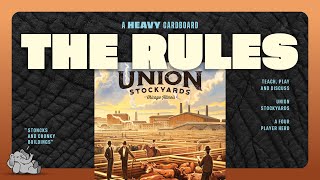
Opening in 1865, the Union Stockyards became Chicago’s largest industry and one of the city’s top tourist attractions with a half million visitors annually in the early 1900’s. From the Civil War through the 1920’s, more meat was processed here than anywhere in the world. During its height, 40,000 mostly immigrant workers labored in “the busiest square mile on earth”, where over one million livestock passed monthly, supplying 80% of all U.S. meat. There were over 2,300 livestock pens and 130 miles of railroad within the “yards”.
You play one the “Big Five” meat packers, developing technologies to use every part of the animal while battling labor unions and manipulating the market to your advantage. Union Stockyards is played over six years (rounds), each beginning with an historical event affecting game conditions or adding an additional action. You select your actions through worker placement; however, if you don’t pay your workers enough, they may go on “strike”. You earn cash based on your profit margins when you slaughter cattle, hogs, or sheep. Your profit margin is your meat value minus the livestock cost. The livestock cost is the same for all players, but your meat values will differ due to your engine-building decisions of constructing buildings, establishing branch houses in eastern cities, and improving your brand reputation. At the end of each year, livestock costs (cattle, hogs, sheep) will be adjusted up or down depending on the demand that you created. Sometimes you may choose to slaughter certain livestock just to manipulate the market in your favor. Whichever packer accumulates the most wealth wins the game.

- cool, thematic feel
- interesting spatial decisions
- theme may be niche
- depth and interactivity not as strong as expected
- stockyard economics
Mechanics (from transcript analysis)
- economic_management — income and profit from building choices
- spatial_puzzle — placing buildings to improve efficiency and scoring
Video topics + discussion points
Quotes (from this video)
- "This is a deck deconstruction game where you want to be the first player to abandon all of your artichokes"
- "hidden movement games are a strange one for me"
- "it's a very light game it's very quick bit of silly fun"
- "the more weird a theme is the heavier the game is"
- "Revive is such a great card driven Euro"
- "best game from 2022 No Doubt"
References (from this video)

- rich thematic context
- accessible playtime for 3 players (~1 hour)
- lighter than expected, may be surface-level for some players
- Profit maximization with strikes and building networks
- Economic themed worker-placement around livestock processing
- Historical economic simulation
Mechanics (from transcript analysis)
- economic engine — Build and optimize profit margins and buildings
- labor relations — Workers can go on strike at times
- stock/livestock management — Managing cows, pigs, sheep, and markets
- worker placement — Place workers to perform actions
Video topics + discussion points
Quotes (from this video)
- hidden movement games are something that I I'm kind of interested in but I've not really found the one for me
- I love bidding games
- the more people in this queues the more money you have to spend
- this is one of my most anticipated games from last year
- this is basically a game within a game
- it's lightning quick too it only takes around 15 minutes to play
- you can get a three-player game of this done in about an hour
- it's a passion project with some good historical context
References (from this video)
- Strong thematic cohesion with historical stockyards
- Chunky, tactile components and a visually deep board
- Engaging core of worker placement with multiple strategic lanes
- Rule complexity and learning curve can be steep
- Adjacency/building rules can be fiddly and slow down play
- Potential for long play sessions in multi-player games
- Meat packing industry, labor dynamics, and political processes
- Turn-of-the-century Chicago Stockyards
- Historical economic simulation with worker-placement mechanics
Mechanics (from transcript analysis)
- Adjacency and area development — Building adjacent to same-colored buildings yields savings; buildings must be contiguous and connected back to the plant.
- End-game scoring across multiple tracks — Brand reputation, stock price, branch houses value, savings, and cards contribute to final score.
- Resource and cash management — Money and savings are used for actions; savings provide end-of-game points.
- Variable market and labor events — Year cards drive livestock arrival and events (e.g., strikes) influencing worker availability and actions.
- worker placement — Players place workers on action spaces (yards, markets, campaign) to take immediate actions.
Video topics + discussion points
Quotes (from this video)
- it is a true worker Placer mint game in that regard
- opening in 1865 the union Stockyards became Chicago's largest industry
- poker chips not a part of the game cardsboard money I don't want to get yelled at by Martin
- this is the end of the game first second third whoever's on top is in first