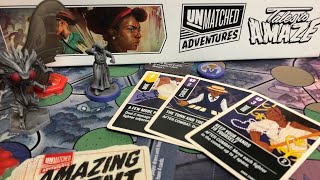
Unmatched Adventures: Tales to Amaze, which is themed around the pulp adventures, tall tales, and local legends of the mid-20th century, gives you a whole new way to play Unmatched.
In the game, players work together to defeat one of two villains: Mothman or the Martian Invader. Each villain has a unique battlefield with unique objectives. If the villain completes their objective (or defeats the heroes), the players lose. The villains are aided by a number of possible minions: Jersey Devil, Ant Queen, Loveland Frog, The Blob, Tarantula, and Skunk Ape. The enemies use special action cards and a simple targeting scheme to control their movement and attacks.
The set comes with four new heroes: Nikola Tesla discharges his electrified coils to power up his effects; Annie Christmas gets stronger when she's fighting from behind; The Golden Bat, the world's first superhero, has a variety of powerful effects; and Dr. Jill Trent, Science Sleuth, calls on a collection of gizmos.
Keeping to the Unmatched brand, you may use heroes from other Unmatched sets in Unmatched Adventures, and you can use the included heroes and battlefields to play competitive Unmatched.
—description from the publisher
- expands Unmatched into cooperative space
- strong art direction
- Kickstarter logistics can be involved
- not always quick to learn for new players
- puzzle-driven hero-vs-villains in cooperative format
- cooperative take on Unmatched with a maze theme
- story-led adventure with thematic art
- Unmatched core sets
Mechanics (from transcript analysis)
- Cooperative combat — team up to defeat villains using hero decks
- hero customization — mix and match heroes from different sets with a common foe
Video topics + discussion points
Quotes (from this video)
- you're not going to make them do the 45 minute history lesson
- the kickstarter's three two three two three two three
- this is a vast playground for cooperative and competitive play alike
References (from this video)

- Cooperative twist on a familiar IP compared to classic Unmatched
- Clear flow of combat with distinct character abilities and gadgets
- Bridge mechanics add strategic depth and tension
- Humorous and thematic character banter enhances immersion
- Threat management can escalate quickly and feel punishing
- Game length can be lengthy for casual players
- Some interactions require careful sequencing and may frustrate newcomers
- Cooperative combat against a villain and his minions within a cryptid-populated mythos
- Mythic cryptid squad battling across a modular board with bridges and a Martian invader variant
- pulp-adventure flavor with tongue-in-cheek banter and character-driven moments
- Horrified
- Unmatched (base game)
- Cosmopus
Mechanics (from transcript analysis)
- bridges_and_threat_tokens — bridges offer special powers when activated; threat eyes and doom tokens escalate pressure toward losing conditions
- card_based_attack_defense — combat is resolved by playing attack/defense cards; some cards count as both attack and defense
- cooperative_combat — players cooperate to defeat a single villain (Moth Man) and two minions, with collective threat management
- initiative_deck — round order is driven by an initiative deck; cards determine turn order and actions
Video topics + discussion points
Quotes (from this video)
- the entire game is driven by this initiative deck
- we're going to play board games at sea
- Defeating Moth Man is as simple as playing cards to cause damage and knocking his health down to zero
References (from this video)

- cooperative play with asymmetric heroes
- engaging initiative system
- beautiful art and components
- mercifully quick setup for a co-op game
- random card draws can feel luck-based
- potentially punishing for new players unfamiliar with deck synergies
- team-based hero cooperation against an asymmetric villain
- Point Pleasant, West Virginia (Moth Man scenario)
- episodic cooperative adventure with minions and bridges
- Unmatched (competitive core game)
- Martian Invader (alternate villain in the Martian Invader variant)
Mechanics (from transcript analysis)
- hand management — discarding cards to activate boosts and to heal/modify actions
- initiative deck — one initiative card per piece on board; order reshuffles rounds
- maneuver action — draw a card, move up to 2 spaces, discard to activate bridge effects
- minions and bridges — minions aid the villain; bridges have doom tokens and can grant effects when leveraged
- special hero powers — each hero has unique abilities that modify attack/defense or movement
Video topics + discussion points
Quotes (from this video)
- artwork is spectacular
- the cooperative experience
- initiative system makes it fresh
- hand management is important
- we did it we defeated Moth Man
References (from this video)
- Wide variety of heroes, villains, and minions across sets
- Co-op and solo play with many permutations
- Accessible rules and satisfying combat
- Beautiful miniatures and thematic art
- Dynamic bridge and terrain elements add strategic depth
- Foil cards are cosmetic and replace existing cards with no new content
- Setup can be fiddly due to small punched tokens and assembly
- Box contents may not include all content from expansions; reliance on additional events
- Heroic duels against mythic monsters using a shared deck-building framework
- Supernatural hero-vs-monster arena with a modular board of zones and bridges
- episodic combat scenarios with themed minions and variable events
- Cobble and Fog
- Robin Hood and Bigfoot
- Marvel Heroes
Mechanics (from transcript analysis)
- Acid tokens and zone control — Acid tokens occupy spaces and interact with movement and zones to constrain players.
- Bridges and doom — Bridge tiles activate special effects; doom tokens advance threat toward losing the game.
- Co-op and solo play — Supports solo (one or more heroes) or 2-4 players cooperatively with shared objective.
- combat resolution — Attack vs. defense values with immediate, during-combat, and after-combat effects.
- Event cards and customization — Advanced event cards alter the difficulty and add variety to gameplay.
- Initiative system — An initiative deck determines turn order and triggers special effects.
- Minions and villains — Foes are drawn from minion decks with per-foe initiative cards.
- Turn structure — Each hero takes two actions per turn chosen from maneuver, scheme, or attack.
Video topics + discussion points
Quotes (from this video)
- I love the fact that they've added this variety
- loved it and this is really neat just to get these things out give them a quick matchup a super way to play unmatched with all your different Heroes villains and minions
- this is really neat